
[Paper Review] HBFL: A Hierarchical Blockchain-based Federated Learning Framework for a Collaborative IoT Intrusion Detection
This paper proposes HBFL, a hierarchical blockchain-based federated learning framework that enables secure, privacy-preserving collaboration among IoT organizations for intrusion detection. By integrating permissioned blockchains and smart contracts to verify model updates, HBFL achieves a 99.71% mean detection accuracy across diverse attack types, significantly outperforming non-collaborative federated learning approaches.
The continuous strengthening of the security posture of IoT ecosystems is vital due to the increasing number of interconnected devices and the volume of sensitive data shared. The utilisation of Machine Learning (ML) capabilities in the defence against IoT cyber attacks has many potential benefits. However, the currently proposed frameworks do not consider data privacy, secure architectures, and/or scalable deployments of IoT ecosystems. In this paper, we propose a hierarchical blockchain-based federated learning framework to enable secure and privacy-preserved collaborative IoT intrusion detection. We highlight and demonstrate the importance of sharing cyber threat intelligence among inter-organisational IoT networks to improve the model's detection capabilities. The proposed ML-based intrusion detection framework follows a hierarchical federated learning architecture to ensure the privacy of the learning process and organisational data. The transactions (model updates) and processes will run on a secure immutable ledger, and the conformance of executed tasks will be verified by the smart contract. We have tested our solution and demonstrated its feasibility by implementing it and evaluating the intrusion detection performance using a key IoT data set. The outcome is a securely designed ML-based intrusion detection system capable of detecting a wide range of malicious activities while preserving data privacy.
Motivation & Objective
- To address the lack of secure, privacy-preserving collaboration in ML-based IoT intrusion detection systems.
- To enable inter-organizational sharing of cyber threat intelligence (CTI) without exposing raw training data.
- To enhance detection accuracy for unseen attack classes, especially reconnaissance and theft, through collaborative model training.
- To integrate blockchain and smart contracts to ensure trust, immutability, and verifiability of model updates in federated learning.
- To design a scalable, secure architecture using cloud-fog-edge topology for practical deployment in IoT ecosystems.
Proposed method
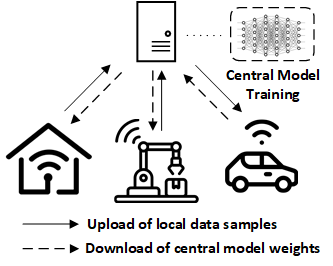
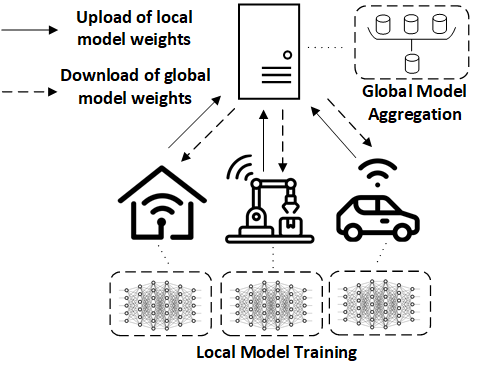
- HBFL employs a hierarchical federated learning (HFL) architecture with edge, fog, and cloud layers for distributed model training.
- Local models are trained on IoT devices using organization-specific data, preserving data privacy.
- Model updates (gradients) are aggregated at fog-level combiners and then sent to the cloud-level reducer for global model aggregation.
- A permissioned blockchain stores all model update transactions, ensuring immutability and auditability of the learning process.
- Smart contracts validate the conformance of model updates against predefined criteria before inclusion in the global model.
- The framework supports cross-organizational collaboration by enabling secure sharing of threat intelligence through federated model updates.
Experimental results
Research questions
- RQ1Can a hierarchical federated learning framework with blockchain integration effectively improve detection accuracy for unseen IoT attack classes?
- RQ2To what extent does collaborative threat intelligence sharing enhance the detection performance of ML-based IDS in decentralized IoT environments?
- RQ3How does the integration of smart contracts and blockchain improve trust and verifiability in federated learning for IoT intrusion detection?
- RQ4Does the proposed HBFL framework maintain high detection accuracy while preserving data privacy and ensuring secure collaboration across organizations?
- RQ5What is the impact of architectural layers (edge, fog, cloud) on the scalability and performance of collaborative IoT intrusion detection?
Key findings
- HBFL achieved a mean detection accuracy of 99.71% across all attack classes, significantly outperforming non-collaborative scenarios (60.53% and 71.1%).
- The F1 score for DDoS detection reached 99.12% and 99.93% for DoS, indicating near-perfect detection performance.
- Reconnaissance attacks, previously poorly detected in non-collaborative settings (58.85% F1), achieved 94.80% F1 in HBFL after eight training rounds.
- The false alarm rate (FAR) was reduced to 0.05% for reconnaissance attacks and below 0.12% across all attack types in HBFL, demonstrating high precision.
- HBFL stabilized detection performance after eight rounds, with minimal degradation in accuracy across diverse attack types.
- The integration of blockchain and smart contracts did not compromise model accuracy and ensured verifiable, secure, and immutable model updates.
Read this paper
Open the full text in the Nubint reader and ask about any passage as you read.
Read this paper on NubintThis review was generated by AI from the original paper. Please check the paper before citing it.