
[Paper Review] Heterogeneous Face Attribute Estimation: A Deep Multi-Task Learning Approach
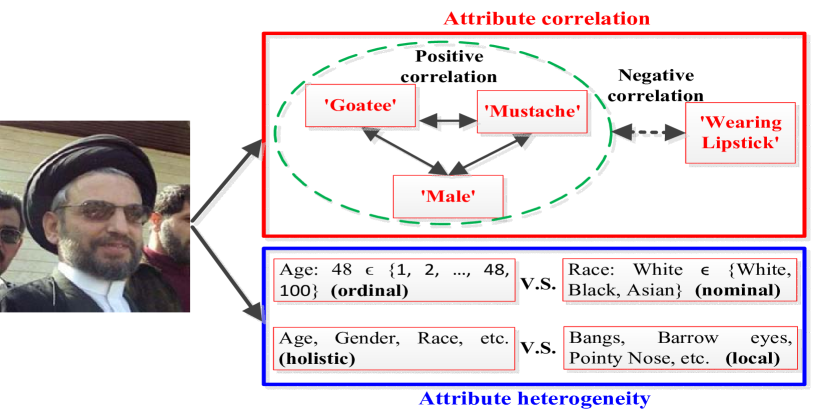
This paper proposes a Deep Multi-Task Learning (DMTL) framework that jointly estimates multiple heterogeneous face attributes—such as age, gender, race, and facial features—by modeling both attribute correlation and heterogeneity (e.g., ordinal vs. nominal, holistic vs. local) through shared and category-specific feature learning. The approach achieves state-of-the-art performance on multiple benchmarks, including 98.6% accuracy for race and 85.3% for age estimation on MORPH II, with real-time inference capabilities.
Face attribute estimation has many potential applications in video surveillance, face retrieval, and social media. While a number of methods have been proposed for face attribute estimation, most of them did not explicitly consider the attribute correlation and heterogeneity (e.g., ordinal vs. nominal and holistic vs. local) during feature representation learning. In this paper, we present a Deep Multi-Task Learning (DMTL) approach to jointly estimate multiple heterogeneous attributes from a single face image. In DMTL, we tackle attribute correlation and heterogeneity with convolutional neural networks (CNNs) consisting of shared feature learning for all the attributes, and category-specific feature learning for heterogeneous attributes. We also introduce an unconstrained face database (LFW+), an extension of public-domain LFW, with heterogeneous demographic attributes (age, gender, and race) obtained via crowdsourcing. Experimental results on benchmarks with multiple face attributes (MORPH II, LFW+, CelebA, LFWA, and FotW) show that the proposed approach has superior performance compared to state of the art. Finally, evaluations on a public-domain face database (LAP) with a single attribute show that the proposed approach has excellent generalization ability.
Motivation & Objective
- To address the limitations of existing face attribute estimation methods that ignore attribute correlation and heterogeneity in feature learning.
- To develop a unified deep learning framework capable of jointly estimating diverse attribute types (ordinal, nominal, holistic, local) from a single face image.
- To create a new unconstrained face database, LFW+, with crowdsourced demographic attributes (age, gender, race) to support benchmarking.
- To evaluate generalization across diverse databases and testing scenarios, including cross-database and cross-attribute settings.
- To achieve high accuracy and real-time inference for practical deployment in surveillance, retrieval, and social media applications.
Proposed method
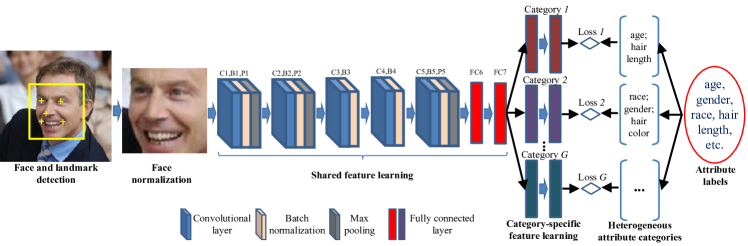
- The DMTL network uses a shared feature learning stream based on a modified AlexNet with batch normalization to extract general features across all attributes.
- It incorporates category-specific subnetworks after the shared trunk to tailor feature learning for different attribute types (e.g., ordinal vs. nominal, holistic vs. local).
- The model jointly optimizes multiple loss functions for different attributes, enabling end-to-end learning that captures inter-attribute correlations.
- Attribute heterogeneity is explicitly modeled by designing distinct subnetworks for different semantic and scale types (e.g., race vs. age).
- The approach uses a multi-task training objective that balances gradients across heterogeneous attributes to improve robustness and generalization.
- A new database, LFW+, is constructed by extending LFW with 2,466 images of subjects aged 0–20, annotated via crowdsourcing for demographic attributes.
Experimental results
Research questions
- RQ1Can a unified deep learning framework jointly estimate heterogeneous face attributes (e.g., age, gender, race, facial features) with improved accuracy by modeling both correlation and heterogeneity?
- RQ2How does the proposed DMTL approach perform compared to state-of-the-art methods on diverse benchmarks with multiple heterogeneous attributes?
- RQ3To what extent does the model generalize to unseen databases and cross-database testing scenarios?
- RQ4Can the model maintain high accuracy and real-time inference speed in practical deployment settings?
- RQ5How does attribute heterogeneity (e.g., ordinal vs. nominal, holistic vs. local) impact the performance and design of joint attribute estimation models?
Key findings
- The proposed DMTL approach achieves 98.6% accuracy for race classification and 85.3% for age estimation (MAE 3.0) on the MORPH II dataset, outperforming state-of-the-art methods.
- On the LFW+ database, the model attains 96.7% accuracy for gender and 94.9% for race, demonstrating strong performance on a diverse age range (0–20 years).
- In cross-database testing, the model generalizes well: it achieves 77.4% accuracy for age and 70.5% for race when training on MORPH II and testing on LFW+, indicating robustness to domain shifts.
- The model runs in 8 ms on a Titan X GPU and 35 ms on a CPU, enabling real-time inference at ~16 fps on a commodity desktop, outperforming prior methods in speed and accuracy.
- The approach achieves 93.0% average accuracy across 40 attributes on CelebA and 86.0% on LFWA, with consistent improvements over separate models and prior multi-task methods.
- The ablation study confirms that modeling both attribute correlation and heterogeneity significantly improves performance, especially in cross-database and cross-attribute settings.
Read this paper
Open the full text in the Nubint reader and ask about any passage as you read.
Read this paper on NubintThis review was generated by AI from the original paper. Please check the paper before citing it.