
[Paper Review] Heterogeneous network approach to predict individuals' mental health
This study proposes a heterogeneous information network (HIN) framework that integrates smartphone, wearable (Fitbit), and survey data to predict depression and anxiety using recommender system (RS) and node classification (NC) methods. The best-performing method, Deep Matrix Factorization (DMF), outperformed traditional logistic regression and random baselines, demonstrating that RS on HINs is more effective than NC for mental health prediction.
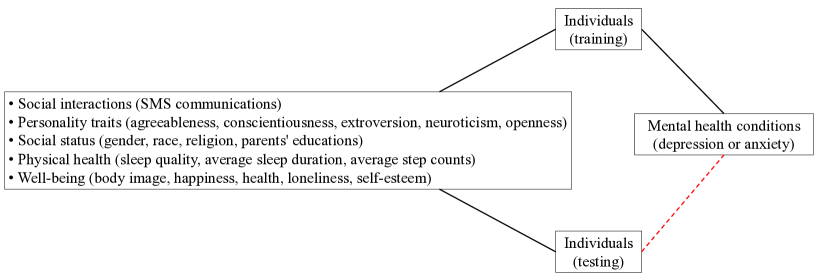
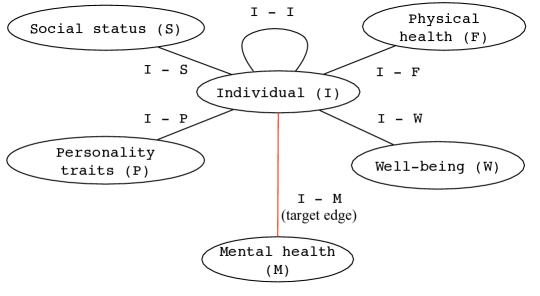
Depression and anxiety are critical public health issues affecting millions of people around the world. To identify individuals who are vulnerable to depression and anxiety, predictive models have been built that typically utilize data from one source. Unlike these traditional models, in this study, we leverage a rich heterogeneous data set from the University of Notre Dame's NetHealth study that collected individuals' (student participants') social interaction data via smartphones, health-related behavioral data via wearables (Fitbit), and trait data from surveys. To integrate the different types of information, we model the NetHealth data as a heterogeneous information network (HIN). Then, we redefine the problem of predicting individuals' mental health conditions (depression or anxiety) in a novel manner, as applying to our HIN a popular paradigm of a recommender system (RS), which is typically used to predict the preference that a person would give to an item (e.g., a movie or book). In our case, the items are the individuals' different mental health states. We evaluate four state-of-the-art RS approaches. Also, we model the prediction of individuals' mental health as another problem type - that of node classification (NC) in our HIN, evaluating in the process four node features under logistic regression as a proof-of-concept classifier. We find that our RS and NC network methods produce more accurate predictions than a logistic regression model using the same NetHealth data in the traditional non-network fashion as well as a random-approach. Also, we find that the best of the considered RS approaches outperforms all considered NC approaches. This is the first study to integrate smartphone, wearable sensor, and survey data in an HIN manner and use RS or NC on the HIN to predict individuals' mental health conditions.
Motivation & Objective
- To address the limitations of single-data-type mental health prediction models by integrating diverse data sources.
- To develop a novel approach that models mental health prediction as a recommender system (RS) problem on a heterogeneous information network (HIN).
- To evaluate the performance of RS and node classification (NC) methods on the HIN against traditional non-network models and random baselines.
- To explore the relative importance of different data modalities (e.g., physical activity, well-being, personality traits) in predicting mental health outcomes.
- To establish a generalizable framework for predicting individual traits using multi-source data in an HIN structure.
Proposed method
- The NetHealth study data—comprising smartphone interaction logs, Fitbit wearable sensor data, and survey-based trait data—were modeled as a heterogeneous information network (HIN) with distinct node and edge types.
- The mental health prediction task was reframed as a recommender system (RS) problem, where individuals are 'users' and mental health states (depression/anxiety) are 'items' to be predicted.
- Four state-of-the-art RS methods (including Deep Matrix Factorization) were evaluated for their ability to predict mental health conditions based on the HIN structure.
- Four node classification (NC) methods were also evaluated using logistic regression with node features derived from the HIN, serving as a proof-of-concept comparison.
- The HIN was constructed with multiple edge types: individuals to social interactions (S), physical activity (F), well-being (W), and personality traits (P), enabling multi-modal data integration.
- Performance was evaluated using standard metrics (AUC, F1, accuracy), and statistical significance was assessed using p-values.
Experimental results
Research questions
- RQ1Can a heterogeneous information network (HIN) effectively integrate multi-source data (smartphone, wearable, survey) to improve mental health prediction?
- RQ2Is the recommender system (RS) paradigm on an HIN more effective than traditional node classification (NC) or non-network models for predicting depression and anxiety?
- RQ3Which combination of data modalities (e.g., F+W, P+W) yields the highest prediction accuracy for depression and anxiety?
- RQ4How do the predictive performances of different RS and NC methods compare in the context of mental health prediction using HINs?
- RQ5What insights can be drawn from the overlap between depressed and anxious individuals in the dataset regarding the similarities and differences in prediction patterns?
Key findings
- The Deep Matrix Factorization (DMF) recommender system method achieved the highest performance across all evaluation metrics, outperforming all other RS and NC methods as well as the non-network logistic regression baseline.
- The FW combination (Fitbit and well-being data) was the most accurate for predicting depression, while the PW combination (personality and well-being) was best for anxiety prediction.
- The DMF method significantly outperformed the non-network logistic regression model, indicating that network-based modeling enhances predictive power.
- There was a statistically significant overlap (51 individuals) between depressed and anxious individuals (p < 0.05), which may explain the similarities in prediction patterns across both conditions.
- The FW combination was the second-best for anxiety prediction, suggesting that physical health and well-being are strong predictors for both conditions.
- The non-significant overlap between DMF and non-network model predictions suggests potential for ensemble learning to further improve performance.
Read this paper
Open the full text in the Nubint reader and ask about any passage as you read.
Read this paper on NubintThis review was generated by AI from the original paper. Please check the paper before citing it.