
[Paper Review] Heteroskedastic PCA: Algorithm, Optimality, and Applications
This paper introduces HeteroPCA, a novel algorithm for principal component analysis under heteroskedastic noise, where variance differs across variables. By iteratively imputing diagonal entries of the sample covariance matrix to correct bias, HeteroPCA achieves provably optimal estimation under the generalized spiked covariance model, with theoretical guarantees via a robust singular subspace perturbation analysis.
A general framework for principal component analysis (PCA) in the presence of heteroskedastic noise is introduced. We propose an algorithm called HeteroPCA, which involves iteratively imputing the diagonal entries of the sample covariance matrix to remove estimation bias due to heteroskedasticity. This procedure is computationally efficient and provably optimal under the generalized spiked covariance model. A key technical step is a deterministic robust perturbation analysis on singular subspaces, which can be of independent interest. The effectiveness of the proposed algorithm is demonstrated in a suite of problems in high-dimensional statistics, including singular value decomposition (SVD) under heteroskedastic noise, Poisson PCA, and SVD for heteroskedastic and incomplete data.
Motivation & Objective
- To address the inconsistency of classical PCA when noise variances are heteroskedastic across variables.
- To develop a computationally efficient algorithm that corrects bias in sample covariance estimation due to heteroskedasticity.
- To establish theoretical optimality of the proposed method under the generalized spiked covariance model.
- To provide a deterministic robust perturbation analysis for singular subspaces, applicable beyond PCA.
Proposed method
- Propose HeteroPCA, an iterative algorithm that updates diagonal entries of the sample covariance matrix using off-diagonal information to reduce bias from heteroskedastic noise.
- Use a deterministic robust perturbation analysis for singular subspaces to derive theoretical bounds on estimation error.
- Apply the method to high-dimensional problems such as SVD under heteroskedastic noise, Poisson PCA, and incomplete data with heteroskedasticity.
- Leverage net-based concentration inequalities (e.g., ε-nets) to control spectral and Frobenius norms of perturbations.
- Establish matching minimax lower bounds to prove optimality of HeteroPCA in the heteroskedastic setting.
- Utilize sub-Gaussian tail bounds and matrix concentration tools to analyze the behavior of the estimator under non-spherical noise.
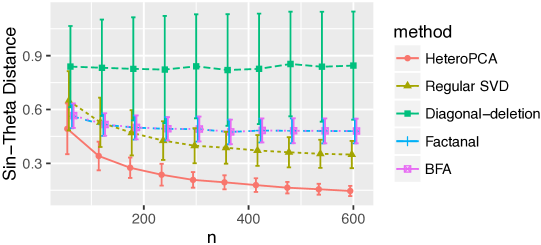
Experimental results
Research questions
- RQ1Can classical PCA consistently estimate principal components when noise variances are heteroskedastic across variables?
- RQ2Is there a computationally efficient algorithm that corrects the bias introduced by heteroskedastic noise in sample covariance estimation?
- RQ3What is the minimax optimal rate of estimation for principal subspaces under the generalized spiked covariance model with heteroskedastic noise?
- RQ4How can robust perturbation bounds for singular subspaces be derived in the absence of Gaussian or isotropic noise assumptions?
- RQ5Can HeteroPCA be applied effectively to real-world problems such as Poisson-distributed data or incomplete data with heteroskedasticity?
Key findings
- HeteroPCA achieves minimax optimal estimation rates for the principal subspace under the generalized spiked covariance model with heteroskedastic noise.
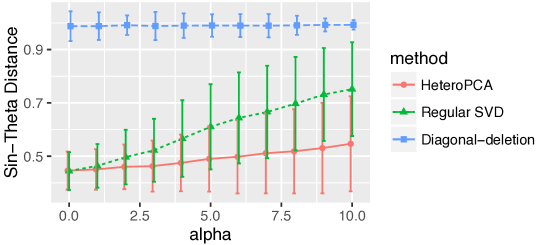
- The algorithm significantly outperforms classical PCA in terms of subspace estimation accuracy when noise variances are unequal across variables.
- Theoretical analysis establishes that the proposed method is optimal up to logarithmic factors, matching the minimax lower bound.
- A novel deterministic perturbation bound for singular subspaces is derived, which is of independent interest beyond PCA.
- The method is successfully applied to Poisson PCA and SVD for incomplete, heteroskedastic data, demonstrating strong empirical performance.
- Theoretical guarantees are established using advanced tools such as ε-net covering arguments and sub-Gaussian tail bounds.
Read this paper
Open the full text in the Nubint reader and ask about any passage as you read.
Read this paper on NubintThis review was generated by AI from the original paper. Please check the paper before citing it.