
[Paper Review] HICEM: A High-Coverage Emotion Model for Artificial Emotional Intelligence
HICEM proposes a high-coverage emotion model with 15 discrete emotion categories derived from unsupervised clustering of multilingual word embeddings, achieving near-maximal coverage of 1,720 emotion concepts across six languages while minimizing label overlap. The model outperforms existing emotion models in coverage efficiency and provides a principled framework for evaluating emotion models using semantic similarity to word vectors.
As social robots and other intelligent machines enter the home, artificial emotional intelligence (AEI) is taking center stage to address users' desire for deeper, more meaningful human-machine interaction. To accomplish such efficacious interaction, the next-generation AEI need comprehensive human emotion models for training. Unlike theory of emotion, which has been the historical focus in psychology, emotion models are a descriptive tools. In practice, the strongest models need robust coverage, which means defining the smallest core set of emotions from which all others can be derived. To achieve the desired coverage, we turn to word embeddings from natural language processing. Using unsupervised clustering techniques, our experiments show that with as few as 15 discrete emotion categories, we can provide maximum coverage across six major languages--Arabic, Chinese, English, French, Spanish, and Russian. In support of our findings, we also examine annotations from two large-scale emotion recognition datasets to assess the validity of existing emotion models compared to human perception at scale. Because robust, comprehensive emotion models are foundational for developing real-world affective computing applications, this work has broad implications in social robotics, human-machine interaction, mental healthcare, and computational psychology.
Motivation & Objective
- To develop a high-coverage, low-overlap emotion model for artificial emotional intelligence (AEI) that supports natural human-machine interaction.
- To address the limitations of existing emotion models, which either lack sufficient coverage or contain excessive, overlapping labels.
- To provide a principled, data-driven method for evaluating emotion models using semantic similarity to a large set of emotion concepts.
- To identify a minimal core set of emotions that can represent the full range of human emotional experience across multiple cultures.
Proposed method
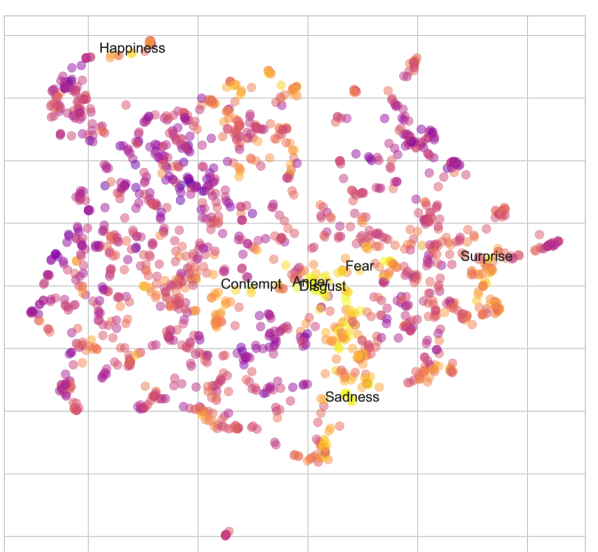
- Utilizes FastText word embeddings for 1,720 emotion concepts across Arabic, Chinese, English, French, Spanish, and Russian.
- Applies unsupervised clustering (via UMAP and k-means) to group emotion concepts into coherent clusters.
- Employs UMAP for dimensionality reduction to preserve global semantic structure while visualizing model coverage.
- Quantifies model coverage using maximum log cosine similarity between emotion concept vectors and model cluster centroids.
- Validates model quality by comparing coverage against existing models (e.g., Ekman, Plutchik, GoEmotions) using the same semantic similarity metric.
- Uses median vector of each cluster to generate representative summary words for each emotion label.
Experimental results
Research questions
- RQ1Can a minimal set of discrete emotion categories achieve maximum coverage across diverse languages and emotion concepts?
- RQ2How does the coverage of existing emotion models compare to human perception of emotion, as measured by semantic similarity to word embeddings?
- RQ3What is the optimal number of emotion components that minimizes label overlap while maximizing coverage of the human emotion space?
- RQ4Can multilingual word embeddings and clustering techniques identify a universal core set of emotions across cultures?
- RQ5How does HICEM compare to continuous dimensional models (e.g., VAD) in terms of coverage and practical utility for AEI applications?
Key findings
- HICEM with 15 components achieves near-maximal coverage of 1,720 emotion concepts across six major languages, outperforming models with more labels such as Plutchik’s 32-label wheel.
- The model achieves this coverage with significantly less label overlap than existing models, including GoEmotions (28 labels) and Cowen’s 27-label model.
- HICEM-15 provides coverage comparable to Plutchik’s model but with half the number of components, demonstrating superior efficiency.
- The analysis shows that existing emotion models, including Ekman’s 7 basic emotions, are insufficient in coverage, leaving large portions of the emotion space unrepresented.
- Word embeddings and clustering techniques successfully identify a universal core of 15 emotion components that are consistent across cultures and languages.
- The study confirms that continuous dimensional models like VAD are complementary to HICEM, and suggests dominance may be redundant in future data collection.
Read this paper
Open the full text in the Nubint reader and ask about any passage as you read.
Read this paper on NubintThis review was generated by AI from the original paper. Please check the paper before citing it.