
[Paper Review] Hierarchical Dialogue Understanding with Special Tokens and Turn-level Attention
This paper proposes HiDialog, a simple yet effective method for hierarchical dialogue understanding that uses special tokens and turn-level attention to capture intra-turn semantics without additional pre-training. By inserting turn-specific special tokens and applying turn-level masking in self-attention, HiDialog achieves state-of-the-art performance on dialogue relation extraction, emotion recognition, and dialogue act classification across multiple benchmarks, outperforming prior models by up to 4% in F1 score.
Compared with standard text, understanding dialogue is more challenging for machines as the dynamic and unexpected semantic changes in each turn. To model such inconsistent semantics, we propose a simple but effective Hierarchical Dialogue Understanding model, HiDialog. Specifically, we first insert multiple special tokens into a dialogue and propose the turn-level attention to learn turn embeddings hierarchically. Then, a heterogeneous graph module is leveraged to polish the learned embeddings. We evaluate our model on various dialogue understanding tasks including dialogue relation extraction, dialogue emotion recognition, and dialogue act classification. Results show that our simple approach achieves state-of-the-art performance on all three tasks above. All our source code is publicly available at https://github.com/ShawX825/HiDialog.
Motivation & Objective
- To address the challenge of modeling dynamic, inconsistent semantics in multi-turn dialogues, which are often overlooked by standard pre-trained language models.
- To bridge the gap between general pre-training and dialogue-specific fine-tuning without requiring additional pre-training or computational cost.
- To develop a lightweight, plug-in solution that enhances dialogue understanding via hierarchical modeling of turn-level representations.
- To improve performance on key dialogue understanding tasks such as relation extraction, emotion recognition, and dialogue act classification.
Proposed method
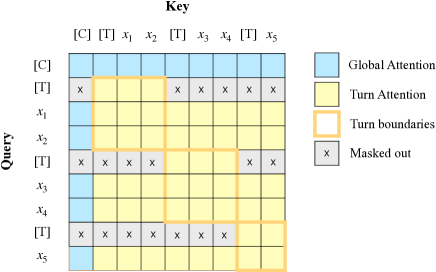
- Special tokens ([T]) are inserted into each turn of the dialogue to represent turn-level semantic units, enabling focused attention within individual turns.
- Turn-level attention is applied by masking out tokens outside the current turn, ensuring that each turn's representation is contextually aware and isolated from other turns.
- The model uses a standard BERT-style encoder with modified attention mechanisms that restrict computation to the current turn during the encoding of special tokens.
- Speaker identities are encoded via dedicated embeddings and concatenated with input tokens to preserve speaker-aware context.
- A heterogeneous graph neural network module is applied post-encoding to refine and propagate information across turns, enhancing inter-turn understanding.
- The final classification head uses the [CLS] token representation for downstream task prediction, maintaining simplicity and compatibility with standard fine-tuning.
Experimental results
Research questions
- RQ1Can a simple, pre-training-free method achieve state-of-the-art performance in dialogue understanding by focusing on turn-level semantics?
- RQ2How does turn-level attention with special tokens compare to global [CLS] or average pooling in capturing intra-turn information?
- RQ3Does the proposed method generalize across diverse dialogue understanding tasks such as relation extraction, emotion recognition, and dialogue act classification?
- RQ4How robust is the method to increasing dialogue length, especially in comparison to models that degrade on long sequences?
- RQ5What is the contribution of the heterogeneous graph module in improving performance on long or complex dialogues?
Key findings
- HiDialog achieved state-of-the-art performance on the DialogRE dataset, surpassing the previous SOTA (TUCORE-GCN) by 4% in F1 and 2.3% in F1_c.
- On the MELD dataset, HiDialog outperformed TUCORE-GCN by 1.5% in weighted F1 for emotion recognition.
- The ablation study showed that removing turn-level attention caused a 1.5% drop in F1 and 0.8% in F1_c, confirming its importance for context-aware turn representation.
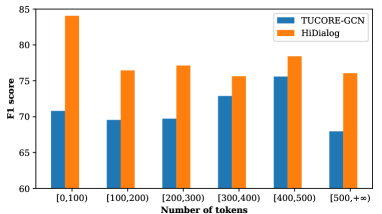
- HiDialog maintained strong performance across all dialogue length groups, with the largest performance gap over TUCORE-GCN observed in dialogues with fewer than 100 tokens.
- The model showed improved robustness on long dialogues, while TUCORE-GCN exhibited a significant performance drop as sequence length increased beyond 500 tokens.
- The heterogeneous graph module was found to be particularly effective for asymmetric relations, while its removal led to a reversal in performance trends between symmetric and asymmetric relations.
Read this paper
Open the full text in the Nubint reader and ask about any passage as you read.
Read this paper on NubintThis review was generated by AI from the original paper. Please check the paper before citing it.