
[Paper Review] High-dimensional Asymptotics of Denoising Autoencoders
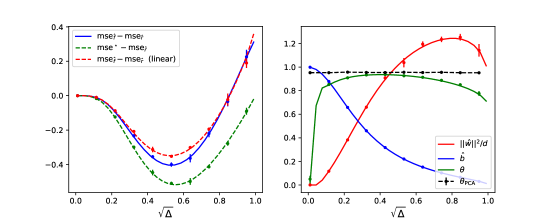
This paper provides a rigorous high-dimensional asymptotic analysis of denoising autoencoders (DAEs) with tied weights and skip connections, using the replica method to derive closed-form expressions for the denoising mean-squared error (MSE). It shows that DAEs significantly outperform PCA-based denoising by a Θ(d) margin and quantifies the complementary roles of the skip connection and bottleneck in noise removal and feature preservation.
We address the problem of denoising data from a Gaussian mixture using a two-layer non-linear autoencoder with tied weights and a skip connection. We consider the high-dimensional limit where the number of training samples and the input dimension jointly tend to infinity while the number of hidden units remains bounded. We provide closed-form expressions for the denoising mean-squared test error. Building on this result, we quantitatively characterize the advantage of the considered architecture over the autoencoder without the skip connection that relates closely to principal component analysis. We further show that our results accurately capture the learning curves on a range of real data sets.
Motivation & Objective
- To theoretically characterize the denoising performance of two-layer non-linear autoencoders with tied weights and skip connections in high-dimensional settings.
- To quantify the advantage of the DAE architecture over standard autoencoders and PCA in terms of test error, especially under finite sample complexity.
- To provide sharp, closed-form asymptotic expressions for key learning metrics such as MSE, weight norms, and cosine similarity to cluster means.
- To validate theoretical predictions against real-world data, including MNIST and FashionMNIST, demonstrating strong empirical alignment.
- To disentangle the functional roles of the skip connection and the non-linear bottleneck in the denoising process through quantitative analysis.
Proposed method
- Applies the replica method to compute asymptotic statistics in the high-dimensional limit where n, d → ∞ with α = n/d = Θ(1).
- Derives closed-form expressions for the denoising MSE, weight norms, skip connection strength, and cosine similarity between weights and cluster means.
- Uses the Moreau envelope formalism to relate the DAE to the reconstruction autoencoder (RAE) and recover known PCA results as a limiting case.
- Employs a Gaussian mixture model as the data distribution with isotropic covariance and cluster means of fixed norm.
- Validates theoretical predictions via numerical simulations on real datasets (MNIST, FashionMNIST) using full-batch Adam optimization.
- Analyzes the trade-off between noise removal (via bottleneck) and data structure preservation (via skip connection) through asymptotic metrics.
Experimental results
Research questions
- RQ1How does the denoising mean-squared error (MSE) of a two-layer DAE with tied weights and skip connection behave in the high-dimensional limit?
- RQ2What is the quantitative performance gap between DAEs and PCA-based denoising in terms of test MSE?
- RQ3How do the skip connection and the non-linear bottleneck contribute independently to the denoising capability of the DAE?
- RQ4To what extent do the theoretical predictions match empirical learning curves on real data like MNIST and FashionMNIST?
- RQ5How does the DAE’s performance approach the theoretical lower bound as a function of sample complexity α?
Key findings
- The DAE achieves a test MSE that is superior to PCA by a margin of Θ(d), demonstrating that DAEs do not simply learn to perform PCA.
- Closed-form expressions for the denoising MSE, weight norms, and cosine similarity are derived and shown to match numerical simulations on MNIST and FashionMNIST with high accuracy.
- The skip connection and the non-linear bottleneck play complementary roles: the former preserves data nuances, while the latter removes noise, with training reflecting a trade-off between these functions.
- The RAE case (without skip connection) is shown to be limited by the PCA test error, and the theory quantitatively captures how RAEs approach this bound as a function of sample complexity α.
- The replica method successfully characterizes the non-convex optimization landscape of DAEs, providing sharp asymptotic results even in the presence of non-linearities and tied weights.
- The theoretical framework recovers the Eckart-Young theorem as a limiting case, confirming that PCA is the optimal linear denoising method, but showing that DAEs surpass it in non-linear settings.

Read this paper
Open the full text in the Nubint reader and ask about any passage as you read.
Read this paper on NubintThis review was generated by AI from the original paper. Please check the paper before citing it.