
[Paper Review] Home advantage and crowd attendance: Evidence from rugby during the Covid 19 pandemic
This study investigates the impact of crowd attendance on home advantage in rugby using a natural experiment during the COVID-19 pandemic, analyzing 1,027 matches across 11 tournaments. It finds that home advantage significantly decreased—home teams won 5% fewer games and had a 2-point lower average point difference—providing strong evidence that fan presence substantially influences match outcomes, likely through psychological or social pressure effects.
The COVID-19 pandemic forced almost all professional and amateur sports to be played without attending crowds. Thus, it induced a large-scale natural experiment on the impact of social pressure on decision making and behavior in sports fields. Using a data set of 1027 rugby union matches from 11 tournaments in 10 countries, we find that home teams have won less matches and their points difference decreased during the pandemics, shedding light on the impact of crowd attendance on the {\em home advantage} of sports teams.
Motivation & Objective
- To examine how the absence of spectators during the COVID-19 pandemic affected home advantage in rugby.
- To isolate the role of crowd attendance as a driver of home advantage, using a large-scale natural experiment.
- To assess whether social pressure, team motivation, or referee bias—fueled by fans—contributes to the home advantage effect.
- To provide empirical evidence on the magnitude of crowd influence on match outcomes in professional rugby.
Proposed method
- The study uses a dataset of 1,027 rugby union matches from 11 tournaments across 10 countries during the 2019/2020/2021 seasons.
- It compares matches played before and after pandemic-related restrictions, categorizing them by crowd conditions: 'Covid' (full restrictions), 'Restricted' (partial attendance), and 'Closed' (no spectators).
- Difference-in-means tests are conducted to compare home win rates and point differences across crowd conditions.
- Multiple regression models are estimated with robust standard errors to control for country, tournament, team strength (Predic), travel, and streak effects.
- Logistic regression is used to model the probability of a home team winning under different crowd conditions.
- White’s test confirms heteroskedasticity, justifying the use of robust standard errors in all regression models.

Experimental results
Research questions
- RQ1Does the absence of spectators during the COVID-19 pandemic reduce the home advantage in rugby?
- RQ2To what extent does crowd attendance influence the point difference between home and away teams in rugby matches?
- RQ3Is the home advantage effect driven by fan-induced psychological pressure on players or referees, or by other factors such as travel fatigue?
- RQ4How does the magnitude of home advantage compare across different levels of crowd restrictions (full, partial, or no attendance)?
- RQ5Does the effect of crowd presence on home advantage vary by gender of competition (men’s vs. women’s tournaments)?
Key findings
- Home teams won approximately 5% fewer matches during the pandemic when crowd attendance was restricted or absent, indicating a measurable decline in home advantage.
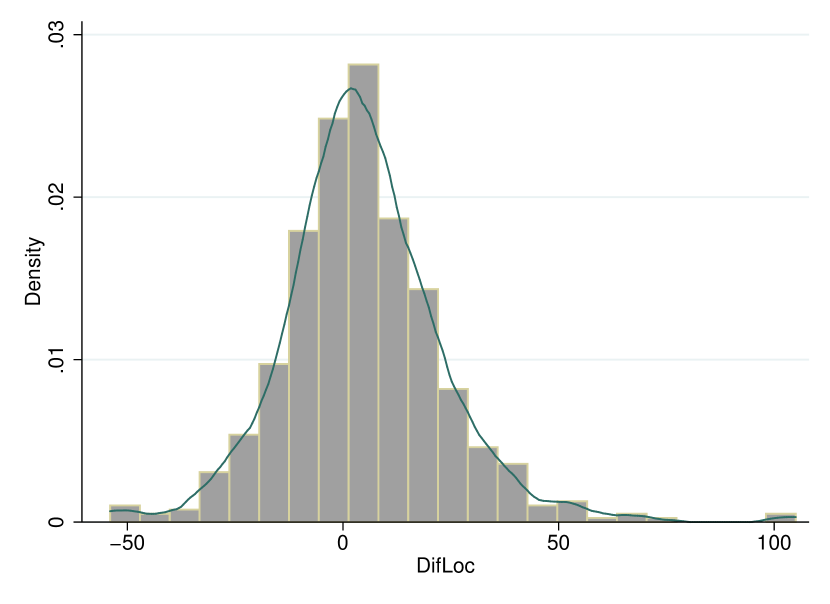
- The average point difference in favor of home teams decreased from about 6.7 points to 4.4 points under restricted or closed conditions.
- The one-tailed p-value for the difference in home win rates under 'Closed' conditions was 0.086, suggesting a statistically significant reduction in home advantage at the 10% significance level.
- The point difference reduction was statistically significant at the 5% level in one-tailed tests, with p-values of 0.0463 and 0.0461 for 'Covid' and 'Restricted' conditions respectively.
- The logistic regression results confirmed that the probability of a home team winning decreased under restricted crowd conditions, consistent across model specifications.
- The gender variable was significant, indicating that home advantage is less pronounced in women’s rugby tournaments compared to men’s.
Read this paper
Open the full text in the Nubint reader and ask about any passage as you read.
Read this paper on NubintThis review was generated by AI from the original paper. Please check the paper before citing it.