
[Paper Review] Hot Pixels: Frequency, Power, and Temperature Attacks on GPUs and ARM SoCs
This paper demonstrates that GPUs and ARM SoCs leak sensitive information through software-accessible frequency, power, and temperature sensors due to DVFS mechanisms under thermal or power constraints. The authors exploit these side channels via JavaScript-based attacks—pixel stealing, history sniffing, and website fingerprinting—achieving 76% top-5 accuracy in website classification despite countermeasures.
The drive to create thinner, lighter, and more energy efficient devices has resulted in modern SoCs being forced to balance a delicate tradeoff between power consumption, heat dissipation, and execution speed (i.e., frequency). While beneficial, these DVFS mechanisms have also resulted in software-visible hybrid side-channels, which use software to probe analog properties of computing devices. Such hybrid attacks are an emerging threat that can bypass countermeasures for traditional microarchitectural side-channel attacks. Given the rise in popularity of both Arm SoCs and GPUs, in this paper we investigate the susceptibility of these devices to information leakage via power, temperature and frequency, as measured via internal sensors. We demonstrate that the sensor data observed correlates with both instructions executed and data processed, allowing us to mount software-visible hybrid side-channel attacks on these devices. To demonstrate the real-world impact of this issue, we present JavaScript-based pixel stealing and history sniffing attacks on Chrome and Safari, with all side channel countermeasures enabled. Finally, we also show website fingerprinting attacks, without any elevated privileges.
Motivation & Objective
- Investigate whether modern GPUs and ARM SoCs leak information through software-accessible frequency, power, and temperature sensors due to DVFS mechanisms.
- Assess the feasibility of mounting side-channel attacks using only internal sensor data without external measurement devices.
- Demonstrate real-world privacy attacks—pixel stealing, history sniffing, and website fingerprinting—on browsers like Chrome and Safari with all countermeasures enabled.
- Analyze the correlation between instruction/data patterns and observable sensor behavior across different device types (passively vs. actively cooled).
Proposed method
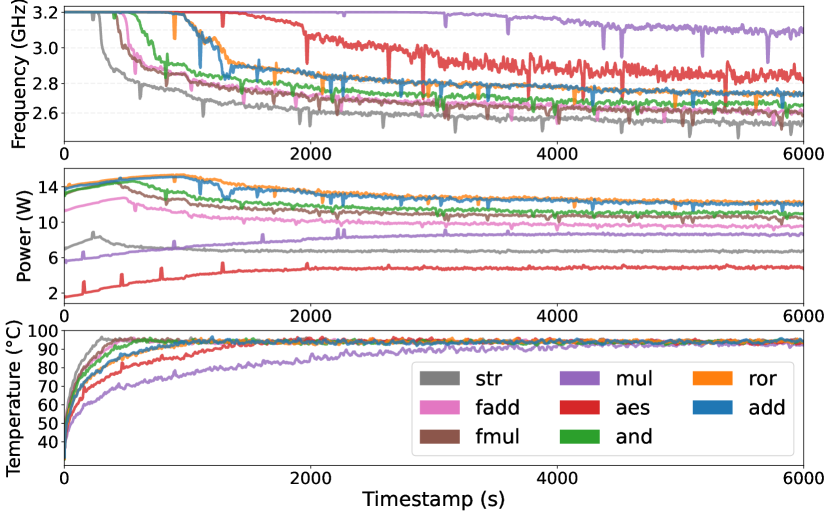
- Measure instruction- and data-dependent variations in frequency, power, and temperature using internal sensors on ARM SoCs and GPUs.
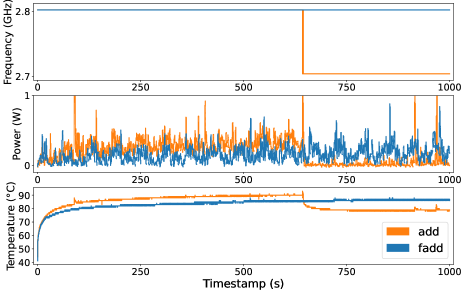
- Model CPU leakage using the Hamming Distance (HD) model to correlate operand differences with power, frequency, and thermal changes.
- Develop a website fingerprinting classifier trained on sensor traces from different websites, using top-1, top-2, and top-5 accuracy as evaluation metrics.
- Implement browser-based pixel stealing and history sniffing attacks using JavaScript, leveraging data-dependent frequency throttling as a timing channel.
- Use timing measurements from JavaScript to infer pixel values or browsing history based on observable frequency variations.
- Evaluate attack performance across different devices (Mac Mini, MacBook Air) and cooling conditions to assess robustness and generalization.
Experimental results
Research questions
- RQ1Can software-only side-channel attacks be mounted on GPUs and ARM SoCs using only internal sensor readings for frequency, power, and temperature?
- RQ2To what extent do instruction and data patterns influence observable frequency, power, and thermal behavior in DVFS-controlled devices?
- RQ3Can these sensor-based side channels be exploited to perform website fingerprinting, pixel stealing, or history sniffing in a browser environment?
- RQ4How does cooling method (passive vs. active) affect the detectability and leakage rate of these side channels?
- RQ5What are the practical limitations and potential mitigations for such attacks in real-world systems?
Key findings
- The classifier achieved a top-5 accuracy of 0.76 on validation data from the actively cooled Mac Mini, demonstrating strong website fingerprinting capability.
- On the passively cooled MacBook Air, the top-5 accuracy dropped to 0.49 due to thermal dynamics and content changes, but remained an order of magnitude above baseline (0.01).
- The leakage rate is limited to approximately 0.1 bits per second on thermally constrained devices due to slow thermal equilibrium and small frequency/power variations.
- Data-dependent frequency throttling is observable via JavaScript timing channels, enabling pixel stealing and history sniffing attacks even with all side-channel countermeasures enabled.
- Active cooling in devices like the Mac Mini prevents data-dependent frequency changes, suggesting that cooling strategy significantly impacts attack feasibility.
- The Hamming Distance model shows a measurable relationship between operand differences and observed power, frequency, and temperature changes on both CPUs and GPUs.
Read this paper
Open the full text in the Nubint reader and ask about any passage as you read.
Read this paper on NubintThis review was generated by AI from the original paper. Please check the paper before citing it.