
[Paper Review] How far is Language Model from 100% Few-shot Named Entity Recognition in Medical Domain
This paper investigates the performance of small and large language models (SLMs and LLMs) in few-shot medical named entity recognition (NER), proposing a Retrieval-and-Thinking (RT) framework that enhances LLMs by retrieving relevant examples and applying step-by-step reasoning. RT significantly outperforms strong baselines on two open medical NER benchmarks, achieving near-state-of-the-art results, yet challenges like misidentification and symbol generation errors prevent 100% accuracy.
Recent advancements in language models (LMs) have led to the emergence of powerful models such as Small LMs (e.g., T5) and Large LMs (e.g., GPT-4). These models have demonstrated exceptional capabilities across a wide range of tasks, such as name entity recognition (NER) in the general domain. (We define SLMs as pre-trained models with fewer parameters compared to models like GPT-3/3.5/4, such as T5, BERT, and others.) Nevertheless, their efficacy in the medical section remains uncertain and the performance of medical NER always needs high accuracy because of the particularity of the field. This paper aims to provide a thorough investigation to compare the performance of LMs in medical few-shot NER and answer How far is LMs from 100\% Few-shot NER in Medical Domain, and moreover to explore an effective entity recognizer to help improve the NER performance. Based on our extensive experiments conducted on 16 NER models spanning from 2018 to 2023, our findings clearly indicate that LLMs outperform SLMs in few-shot medical NER tasks, given the presence of suitable examples and appropriate logical frameworks. Despite the overall superiority of LLMs in few-shot medical NER tasks, it is important to note that they still encounter some challenges, such as misidentification, wrong template prediction, etc. Building on previous findings, we introduce a simple and effective method called extsc{RT} (Retrieving and Thinking), which serves as retrievers, finding relevant examples, and as thinkers, employing a step-by-step reasoning process. Experimental results show that our proposed extsc{RT} framework significantly outperforms the strong open baselines on the two open medical benchmark datasets
Motivation & Objective
- To compare the performance of SLMs and LLMs in few-shot medical NER tasks.
- To investigate whether NER models trained on the general domain can be effectively transferred to the medical domain.
- To analyze the impact of annotation quantity and quality on SLM and LLM performance in medical NER.
- To identify the remaining barriers preventing language models from achieving 100% few-shot medical NER accuracy.
Proposed method
- Proposes a Retrieval-and-Thinking (RT) framework that acts as both a retriever and a reasoner in few-shot NER.
- Retrieves relevant in-context examples using semantic similarity to improve prompt quality.
- Applies step-by-step reasoning to guide LLMs through logical entity extraction processes.
- Employs different example selection strategies—using only positive examples or combining positive and negative examples—based on dataset-specific performance.
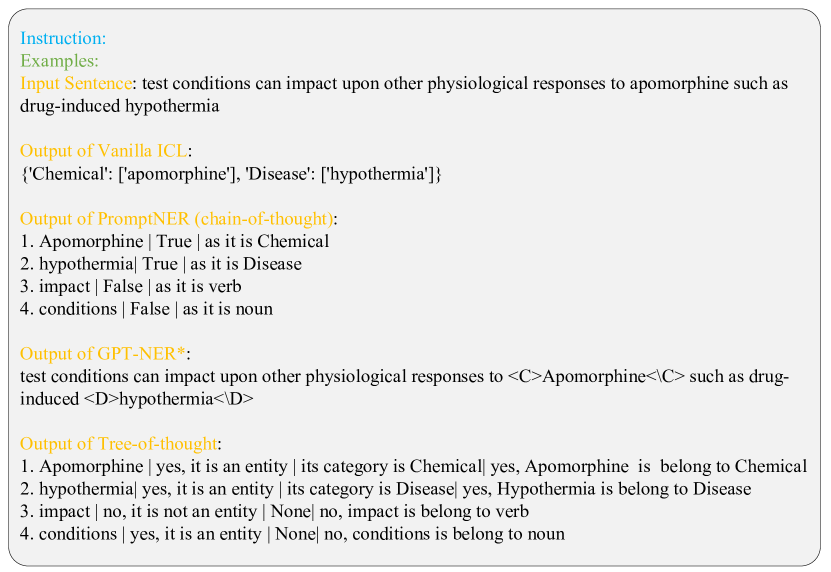
- Uses output templates to constrain prediction format and reduce structural errors.
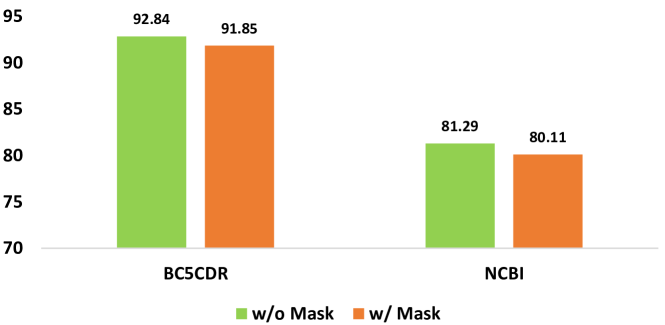
- Evaluates performance using Micro-F1 and exact-match F1 on two open medical NER datasets: BC5CDR and NCBI.
Experimental results
Research questions
- RQ1Which model type—SLMs or LLMs—performs better in few-shot medical NER tasks?
- RQ2Can NER models trained on the general domain be successfully transferred to the medical domain?
- RQ3How do the quantity and quality of annotated examples affect SLM and LLM performance in medical NER?
- RQ4What factors prevent current state-of-the-art models from achieving 100% few-shot medical NER accuracy?
Key findings
- LLMs outperform SLMs in few-shot medical NER when provided with high-quality instructions and appropriate logical frameworks.
- Transfer of general-domain NER models to the medical domain is only effective when models are specifically pre-trained on medical data.
- LLMs show more stable performance than SLMs under low-data conditions, especially when training data is partially annotated.
- The effectiveness of retrieved examples varies by dataset; for NCBI, using only positive examples yields better results, while for BC5CDR, combining positive and negative examples is more effective.
- RT achieves superior or comparable performance to strong baselines on both BC5CDR and NCBI datasets, particularly excelling in 1-shot and 5-shot settings.
- Despite improvements, RT still fails to reach 100% accuracy due to issues like misidentification, symbol generation errors, wrong template predictions, and class collision in partially annotated data.
Read this paper
Open the full text in the Nubint reader and ask about any passage as you read.
Read this paper on NubintThis review was generated by AI from the original paper. Please check the paper before citing it.