
[Paper Review] HuBERT: Self-Supervised Speech Representation Learning by Masked Prediction of Hidden Units
HuBERT proposes a self-supervised speech representation learning method that predicts K-means clustered units from masked speech features, using an offline clustering step to generate pseudo-labels. By applying prediction loss only on masked regions, it learns robust acoustic and linguistic representations, achieving state-of-the-art WER reductions of up to 19% on Librispeech dev-other and 13% on test-other with a 1B-parameter model.
Self-supervised approaches for speech representation learning are challenged by three unique problems: (1) there are multiple sound units in each input utterance, (2) there is no lexicon of input sound units during the pre-training phase, and (3) sound units have variable lengths with no explicit segmentation. To deal with these three problems, we propose the Hidden-Unit BERT (HuBERT) approach for self-supervised speech representation learning, which utilizes an offline clustering step to provide aligned target labels for a BERT-like prediction loss. A key ingredient of our approach is applying the prediction loss over the masked regions only, which forces the model to learn a combined acoustic and language model over the continuous inputs. HuBERT relies primarily on the consistency of the unsupervised clustering step rather than the intrinsic quality of the assigned cluster labels. Starting with a simple k-means teacher of 100 clusters, and using two iterations of clustering, the HuBERT model either matches or improves upon the state-of-the-art wav2vec 2.0 performance on the Librispeech (960h) and Libri-light (60,000h) benchmarks with 10min, 1h, 10h, 100h, and 960h fine-tuning subsets. Using a 1B parameter model, HuBERT shows up to 19% and 13% relative WER reduction on the more challenging dev-other and test-other evaluation subsets.
Motivation & Objective
- To address the challenges of self-supervised speech representation learning: multiple overlapping sound units, no predefined lexicon, and variable-length units.
- To develop a method that learns robust representations without relying on linguistic annotations during pre-training.
- To improve generalization and performance on downstream ASR tasks using a BERT-like masked prediction objective on continuous speech features.
- To investigate the impact of clustering quality, hyperparameters, and ensemble methods on model performance.
Proposed method
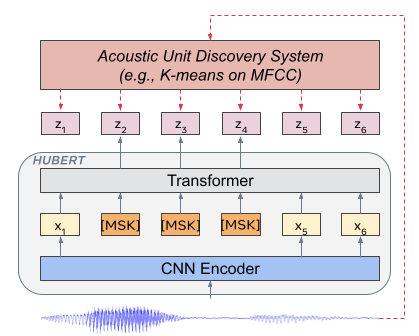
- An offline k-means clustering step is applied to MFCC or HuBERT features to generate discrete target units for masked prediction.
- The model uses a BERT-like transformer architecture to predict cluster assignments for masked speech frames, with loss computed only on masked regions.
- The prediction task forces the model to learn contextualized representations by reconstructing masked units using unmasked context.
- Iterative refinement of cluster assignments is performed using latent representations from previous model iterations to improve target quality.
- A multi-stage training process uses increasingly accurate cluster targets across iterations, improving representation quality.
- Effective batch size and masking probability are tuned to optimize generalization and convergence.
Experimental results
Research questions
- RQ1How does predicting only masked frames improve self-supervised speech representation learning compared to predicting all or unmasked frames?
- RQ2What is the impact of clustering quality on model performance, especially when using noisy or low-quality cluster assignments?
- RQ3How does using an ensemble of k-means models trained on different feature types or configurations affect representation quality?
- RQ4What hyperparameters—such as masking probability and batch size—most significantly influence HuBERT’s performance?
- RQ5Can iterative refinement of cluster assignments lead to consistent performance gains across different pre-training data scales?
Key findings
- HuBERT matches or exceeds state-of-the-art wav2vec 2.0 performance on Librispeech (960h) and Libri-light (60,000h) across all fine-tuning subsets (10min to 960h).
- Using a 1B-parameter model, HuBERT achieves a 19% relative WER reduction on the more challenging Librispeech dev-other set and 13% on test-other.
- Predicting only masked frames yields significantly better performance than predicting all or unmasked frames, especially when cluster quality is low.
- Training for longer (up to 800k steps) consistently improves performance, with the best WER of 11.68% achieved on the 10h Libri-light split.
- Ensembling multiple k-means models (e.g., on spliced MFCCs with product quantization) leads to better performance than single clustering setups.
- The optimal masking probability is 8%, and increasing batch size significantly improves model generalization.
Read this paper
Open the full text in the Nubint reader and ask about any passage as you read.
Read this paper on NubintThis review was generated by AI from the original paper. Please check the paper before citing it.