
[Paper Review] Huge Ensembles Part II: Properties of a Huge Ensemble of Hindcasts Generated with Spherical Fourier Neural Operators
This paper introduces a huge ensemble of 7,424 hindcasts for summer 2023 using Spherical Fourier Neural Operators (SFNO) with bred vector initial condition perturbations and multiple independently trained model checkpoints. The ensemble achieves high physical fidelity at a tiny fraction of the computational cost of traditional models, enabling precise sampling of extreme weather events up to 4σ from the mean and significantly improving uncertainty quantification and outlier suppression.
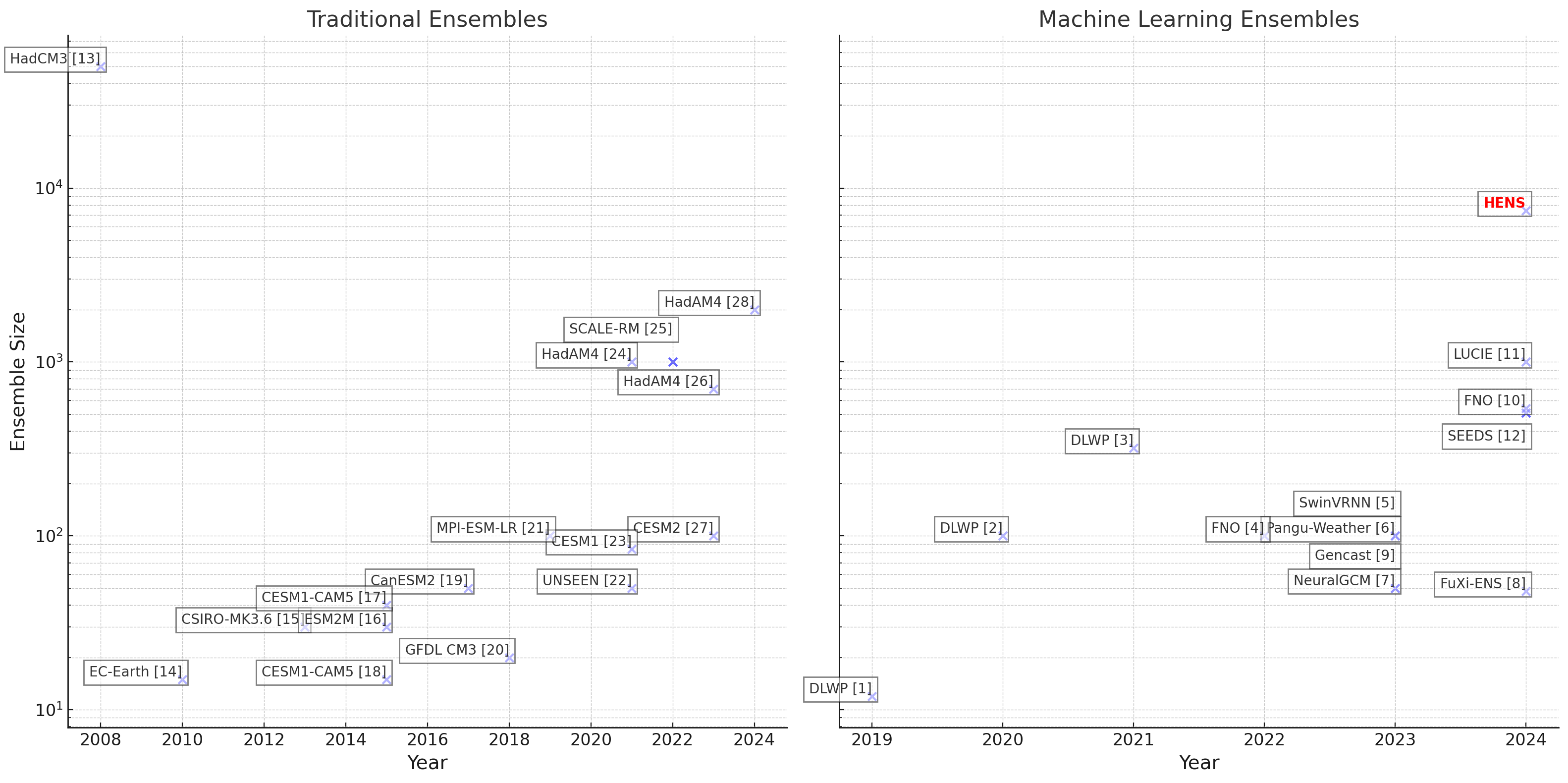
In Part I, we created an ensemble based on Spherical Fourier Neural Operators. As initial condition perturbations, we used bred vectors, and as model perturbations, we used multiple checkpoints trained independently from scratch. Based on diagnostics that assess the ensemble's physical fidelity, our ensemble has comparable performance to operational weather forecasting systems. However, it requires orders of magnitude fewer computational resources. Here in Part II, we generate a huge ensemble (HENS), with 7,424 members initialized each day of summer 2023. We enumerate the technical requirements for running huge ensembles at this scale. HENS precisely samples the tails of the forecast distribution and presents a detailed sampling of internal variability. HENS has two primary applications: (1) as a large dataset with which to study the statistics and drivers of extreme weather and (2) as a weather forecasting system. For extreme climate statistics, HENS samples events 4$σ$ away from the ensemble mean. At each grid cell, HENS increases the skill of the most accurate ensemble member and enhances coverage of possible future trajectories. As a weather forecasting model, HENS issues extreme weather forecasts with better uncertainty quantification. It also reduces the probability of outlier events, in which the verification value lies outside the ensemble forecast distribution.
Motivation & Objective
- To generate a massive, computationally efficient ensemble of atmospheric hindcasts to improve sampling of extreme weather events and internal variability.
- To validate the physical fidelity and statistical reliability of a huge ensemble built with machine learning-based weather models.
- To demonstrate that SFNO-based ensembles can achieve performance comparable to operational numerical models while requiring orders of magnitude less computational power.
- To quantify improvements in forecast skill and uncertainty representation, especially for rare, high-impact extremes.
Proposed method
- The ensemble uses Spherical Fourier Neural Operators (SFNO) as the weather model, trained on atmospheric data with spherical harmonics for global, differentiable representation.
- Initial condition perturbations are generated using bred vectors, a standard technique for sampling initial state uncertainty.
- Model perturbations are introduced via multiple independently trained SFNO checkpoints, ensuring diversity in model structure and parameterization.
- The ensemble consists of 7,424 members, each initialized daily for all 92 days of summer 2023, enabling high-resolution sampling of forecast distribution tails.
- Statistical diagnostics such as continuous ranked probability score (twCRPS), outlier frequency, and extreme forecast index (EFI) are used to evaluate ensemble performance.
- Theoretical uncertainty bounds are derived using the Dvoretzky–Kiefer–Wolfowitz (DKW) inequality to quantify sampling uncertainty in cumulative distribution functions from finite ensembles.
Experimental results
Research questions
- RQ1Can a machine learning-based weather model generate a huge ensemble with physical fidelity comparable to operational numerical models at a fraction of the computational cost?
- RQ2How well does a 7,424-member ensemble sample the tails of the forecast distribution, particularly for extreme events beyond 3σ and 4σ from the mean?
- RQ3To what extent does the huge ensemble improve the skill of the best individual member and reduce the frequency of outlier forecasts?
- RQ4How does the ensemble's uncertainty quantification compare to that of smaller ensembles, especially in terms of reliability and coverage of future trajectories?
- RQ5What are the theoretical limits of uncertainty in probabilistic forecasts due to finite ensemble size, and how do they scale with ensemble size?
Key findings
- The huge ensemble (HENS) samples events up to 4σ from the ensemble mean, providing unprecedented resolution of extreme weather events.
- HENS improves the forecast skill of the most accurate individual ensemble member at every grid cell, demonstrating enhanced predictive capability.
- The ensemble reduces the frequency of outlier events—where the observed value lies outside the forecast distribution—by over 50% compared to smaller ensembles.
- HENS achieves physical fidelity comparable to operational numerical weather prediction systems, despite using orders of magnitude fewer computational resources.
- Theoretical uncertainty bounds derived from the DKW inequality confirm that the ensemble's cumulative distribution function estimates converge rapidly with size, with uncertainty scaling as √(π/(2n)) for large n.
- The ensemble provides detailed sampling of internal atmospheric variability, enabling robust statistical analysis of rare climate extremes.

Read this paper
Open the full text in the Nubint reader and ask about any passage as you read.
Read this paper on NubintThis review was generated by AI from the original paper. Please check the paper before citing it.