
[Paper Review] Hutchinson Trace Estimation for High-Dimensional and High-Order Physics-Informed Neural Networks
This paper introduces Hutchinson Trace Estimation (HTE) to accelerate Physics-Informed Neural Networks (PINNs) for high-dimensional and high-order partial differential equations (PDEs). By replacing full Hessian computation with Hessian-vector products (HVPs), HTE reduces memory usage and enables efficient Taylor-mode automatic differentiation, achieving unbiased, convergent training with lower variance than Stochastic Dimension Gradient Descent (SDGD), especially in high-variance scenarios.
Physics-Informed Neural Networks (PINNs) have proven effective in solving partial differential equations (PDEs), especially when some data are available by seamlessly blending data and physics. However, extending PINNs to high-dimensional and even high-order PDEs encounters significant challenges due to the computational cost associated with automatic differentiation in the residual loss. Herein, we address the limitations of PINNs in handling high-dimensional and high-order PDEs by introducing Hutchinson Trace Estimation (HTE). Starting with the second-order high-dimensional PDEs ubiquitous in scientific computing, HTE transforms the calculation of the entire Hessian matrix into a Hessian vector product (HVP). This approach alleviates the computational bottleneck via Taylor-mode automatic differentiation and significantly reduces memory consumption from the Hessian matrix to HVP. We further showcase HTE's convergence to the original PINN loss and its unbiased behavior under specific conditions. Comparisons with Stochastic Dimension Gradient Descent (SDGD) highlight the distinct advantages of HTE, particularly in scenarios with significant variance among dimensions. We further extend HTE to higher-order and higher-dimensional PDEs, specifically addressing the biharmonic equation. By employing tensor-vector products (TVP), HTE efficiently computes the colossal tensor associated with the fourth-order high-dimensional biharmonic equation, saving memory and enabling rapid computation. The effectiveness of HTE is illustrated through experimental setups, demonstrating comparable convergence rates with SDGD under memory and speed constraints. Additionally, HTE proves valuable in accelerating the Gradient-Enhanced PINN (gPINN) version as well as the Biharmonic equation. Overall, HTE opens up a new capability in scientific machine learning for tackling high-order and high-dimensional PDEs.
Motivation & Objective
- Address the high computational cost and memory burden of training PINNs on high-dimensional and high-order PDEs.
- Overcome limitations of existing methods like SDGD, which suffer from high variance when dimensions exhibit significant variability.
- Extend PINN training to fourth-order PDEs, such as the biharmonic equation, by introducing tensor-vector products (TVPs) to manage colossal tensors.
- Ensure theoretical convergence and unbiasedness of the HTE-based loss to the original PINN loss under specific conditions.
- Enable practical acceleration in Gradient-Enhanced PINNs (gPINN) and high-order PDE solvers through efficient trace estimation.
Proposed method
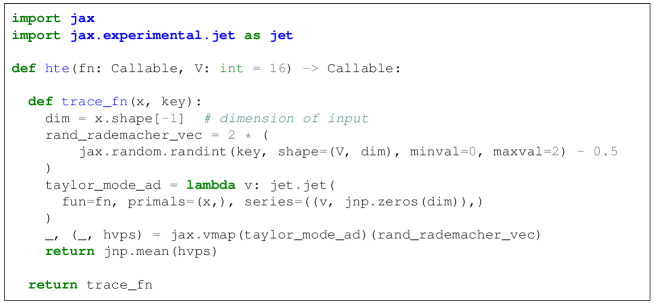
- Apply Hutchinson Trace Estimation (HTE) to approximate the trace of the Hessian matrix in PINN loss functions, replacing full Hessian computation.
- Transform the Hessian matrix computation into a Hessian-vector product (HVP), reducing memory from O(d²) to O(d) and enabling efficient Taylor-mode automatic differentiation in JAX.
- Use Rademacher-distributed random vectors to compute unbiased trace estimators: $ \frac{1}{V}\sum_{i=1}^{V} \boldsymbol{v}_i^T A \boldsymbol{v}_i \approx \mathrm{Tr}(A) $.
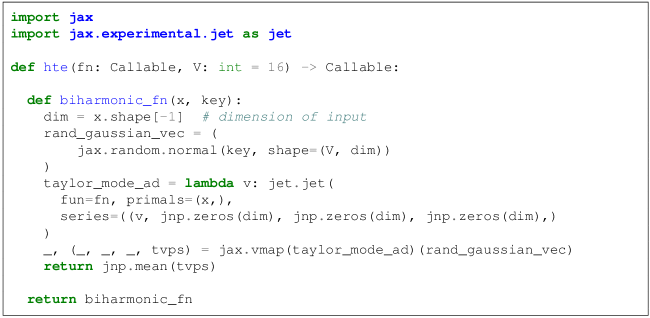
- Extend HTE to higher-order PDEs by generalizing HVPs to tensor-vector products (TVPs), enabling efficient computation of fourth-order PDE terms like in the biharmonic equation.
- Integrate HTE into the PINN framework such that the loss function remains unbiased and converges to the original PINN loss under appropriate conditions.
- Compare HTE with SDGD using theoretical variance analysis and empirical evaluation across high-dimensional and high-order PDEs.
Experimental results
Research questions
- RQ1Can HTE provide a scalable alternative to full Hessian computation in high-dimensional PINNs, reducing memory and computation cost?
- RQ2How does HTE’s variance compare to SDGD’s in high-dimensional PDEs with significant inter-dimensional variability?
- RQ3Can HTE be extended to fourth-order PDEs like the biharmonic equation using tensor-vector products (TVPs)?
- RQ4Is the HTE-based PINN loss unbiased and convergent to the original PINN loss under standard assumptions?
- RQ5Does HTE enable faster and more memory-efficient training in Gradient-Enhanced PINNs (gPINN) and high-order PDEs?
Key findings
- HTE reduces memory consumption from O(d²) for full Hessian to O(d) by replacing matrix operations with scalar HVPs.
- The HTE-based loss is unbiased and converges to the original PINN loss under the condition that the trace estimator is applied to the Hessian of the residual loss.
- HTE exhibits lower variance than SDGD in scenarios with high inter-dimensional variance, making it more stable for complex PDEs.
- For the biharmonic equation, HTE with TVPs enables efficient computation of the O(d⁴) tensor by reducing it to a sequence of tensor-vector operations.
- Empirical results show HTE achieves comparable convergence rates to SDGD while significantly reducing memory usage and enabling faster training in high-dimensional settings.
- HTE accelerates training in gPINN by efficiently estimating gradient-enhanced terms without sacrificing model expressiveness.
Read this paper
Open the full text in the Nubint reader and ask about any passage as you read.
Read this paper on NubintThis review was generated by AI from the original paper. Please check the paper before citing it.