
[Paper Review] HyperTransformer: A Textural and Spectral Feature Fusion Transformer for Pansharpening
HyperTransformer proposes a novel self-attention-based fusion mechanism for hyperspectral pansharpening that transfers high-resolution textural features from a panchromatic (PAN) image to low-resolution hyperspectral (LR-HSI) features using a multi-head soft-attention module. By modeling cross-feature space dependencies and long-range spatial-spectral relationships across multiple scales, it achieves state-of-the-art performance in both spectral and spatial quality, with improvements of up to 11.2% in RMSE and 2.1 dB in PSNR over prior methods on benchmark datasets.
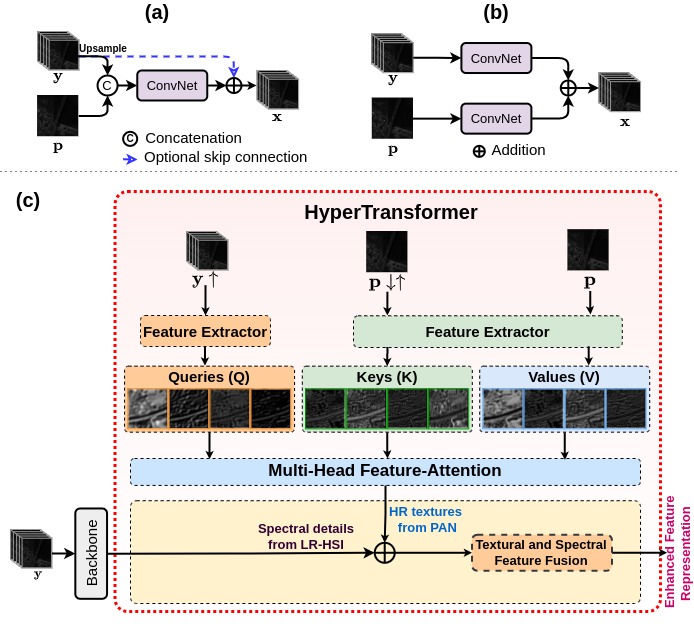
Pansharpening aims to fuse a registered high-resolution panchromatic image (PAN) with a low-resolution hyperspectral image (LR-HSI) to generate an enhanced HSI with high spectral and spatial resolution. Existing pansharpening approaches neglect using an attention mechanism to transfer HR texture features from PAN to LR-HSI features, resulting in spatial and spectral distortions. In this paper, we present a novel attention mechanism for pansharpening called HyperTransformer, in which features of LR-HSI and PAN are formulated as queries and keys in a transformer, respectively. HyperTransformer consists of three main modules, namely two separate feature extractors for PAN and HSI, a multi-head feature soft attention module, and a spatial-spectral feature fusion module. Such a network improves both spatial and spectral quality measures of the pansharpened HSI by learning cross-feature space dependencies and long-range details of PAN and LR-HSI. Furthermore, HyperTransformer can be utilized across multiple spatial scales at the backbone for obtaining improved performance. Extensive experiments conducted on three widely used datasets demonstrate that HyperTransformer achieves significant improvement over the state-of-the-art methods on both spatial and spectral quality measures. Implementation code and pre-trained weights can be accessed at https://github.com/wgcban/HyperTransformer.
Motivation & Objective
- Address the limitations of existing pansharpening methods that fail to effectively model cross-feature dependencies between PAN and LR-HSI.
- Overcome spatial and spectral distortions caused by naive concatenation or unguided fusion of high-resolution textural and low-resolution spectral features.
- Leverage attention mechanisms to selectively transfer relevant HR texture features from PAN to LR-HSI based on global context and spectral similarity.
- Enable multi-scale feature fusion in the backbone to capture richer texture representations across different spatial resolutions.
- Improve both spectral and spatial fidelity of pansharpened HSI through a dedicated textural-spectral feature fusion module guided by attention.
Proposed method
- Employ two separate feature extractors (FE-PAN and FE-HSI) to encode PAN and LR-HSI into deep feature representations.
- Formulate LR-HSI features as queries (Q), PAN features as keys (K), and PAN features as values (V) in a multi-head self-attention mechanism to compute cross-feature attention weights.
- Use a multi-head feature soft-attention module to dynamically attend to the most relevant HR texture features in PAN for each spatial location in LR-HSI.
- Integrate a spatial-spectral feature fusion module that combines attended PAN features with LR-HSI features to generate enhanced HSI representations.
- Inject HyperTransformer modules at multiple spatial scales (×1, ×2, ×4) to capture hierarchical texture details and improve feature representation learning.
- Train the network using a combination of L1 loss, VGG perceptual loss, and transfer perceptual loss to preserve both pixel-level accuracy and high-level semantic consistency.
Experimental results
Research questions
- RQ1Can a self-attention mechanism effectively model long-range dependencies and cross-feature space relationships between PAN and LR-HSI features in pansharpening?
- RQ2Does multi-scale integration of PAN features improve the quality of pansharpened HSI compared to single-scale fusion?
- RQ3Can attention-based feature fusion reduce spectral and spatial distortions compared to concatenation-based or convolution-only fusion methods?
- RQ4How do perceptual losses (VGG and transfer-based) contribute to improving the perceptual quality and spectral fidelity of the output HSI?
- RQ5To what extent does the proposed HyperTransformer outperform existing state-of-the-art methods in both quantitative and qualitative evaluations?
Key findings
- HyperTransformer achieves a 0.989 CC, 3.85 SAM, 0.0087 RMSE, 2.01 ERGAS, and 43.80 PSNR on the Pavia Center dataset, outperforming prior SOTA methods.
- Injecting HyperTransformer at all three scales (×1, ×2, ×4) yields a 11.2% improvement in RMSE and 2.1 dB gain in PSNR compared to using only the ×4 scale.
- The addition of transfer perceptual loss improves SAM by 4.0% and RMSE by 3.3% compared to using only L1 and VGG perceptual losses.
- The ablation study confirms that multi-scale feature fusion significantly enhances performance, with the best results achieved when all three scales are used.
- Visual analysis shows reduced MAE in visible bands and improved texture preservation, though UV and IR bands still show higher errors due to PAN image limitations.
- The method demonstrates robustness across three widely used datasets, confirming generalization and superiority in both spectral and spatial quality metrics.

Read this paper
Open the full text in the Nubint reader and ask about any passage as you read.
Read this paper on NubintThis review was generated by AI from the original paper. Please check the paper before citing it.