
[논문 리뷰] Implications for the non-Gaussianity of curvature perturbation from pulsar timing arrays
이 논문은 결합 PTA 데이터를 사용하여 스칼라로 유도된 중력파를 통해 곡률 요동의 국소형 비가우지아니성(local-type non-Gaussianity)을 제약하고, PBH 과생산을 피하기 위해 |F_NL| ≲ 13.9 및 -13.9 ≲ F_NL ≲ -0.1 를 발견한다.
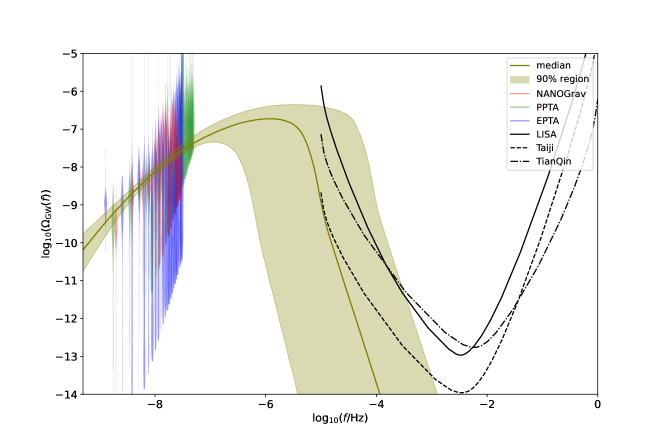
The recently released data by pulsar timing array (PTA) collaborations present strong evidence for a stochastic signal consistent with a gravitational-wave background. Assuming this signal originates from scalar-induced gravitational waves, we jointly use the PTA data from the NANOGrav 15-yr data set, PPTA DR3, and EPTA DR2 to probe the small-scale non-Gaussianity. We put the first-ever constraint on the non-Gaussianity parameter, finding $|F_\mathrm{NL}|\lesssim 13.9$ for a lognormal power spectrum of the curvature perturbations. Furthermore, we obtain $-13.9 \lesssim F_\mathrm{NL}\lesssim -0.1$ to prevent excessive production of primordial black holes. Moreover, the multi-band observations with the space-borne gravitational-wave detectors, such as LISA/Taiji/TianQin, will provide a complementary investigation of primordial non-Gaussianity. Our findings pave the way to constrain inflation models with PTA data.
연구 동기 및 목표
- stMotivate probing small-scale non-Gaussianity of primordial curvature perturbations using PTAs that have detected a stochastic gravitational-wave background.
- Quantify how local-type non-Gaussianity (F_NL) affects scalar-induced gravitational waves and primordial black hole production.
- Demonstrate a Bayesian framework combining NANOGrav 15-yr, PPTA DR3, and EPTA DR2 data to constrain F_NL and related parameters.
제안 방법
- Adopt a local-type expansion R(x) = R_G(x) + F_NL( R_G^2(x) - <R_G^2> ) linking F_NL to non-Gaussian curvature perturbations.
- Use an effective curvature perturbation power spectrum P_R^{NG} = P_R + F_NL^2 ∫∫ P_R(uk)P_R(vk)/(u^2 v^2) du dv to capture non-Gaussian contributions.
- Compute the SIGW energy density Omega_GW(k) via a second-order source term from scalar perturbations with a radiation-era transfer function T(u,v).
- Model P_R(k) with a lognormal spectrum and relate k to frequency f through k = 2πf to obtain Omega_GW,0(f) after cosmic evolution.
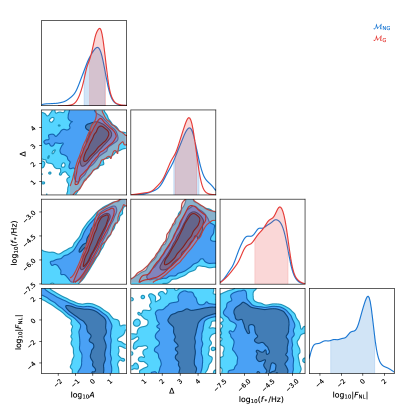
- Perform Bayesian inference with a 66-point multi-band PTA spectrum, using dynesty/BILBY to constrain parameters including A, Δ, f_*, and |F_NL|.
실험 결과
연구 질문
- RQ1PTA 측정이 SIGW가 작은 스케일의 곡률 요동에서 기인한다고 가정할 때 로컬 비가우스성 매개변수 F_NL의 허용 범위는 무엇인가?
- RQ2F_NL이 SIGW 스펙트럼과 PTA 주파수 창 내 PBH 밀도에 어떤 영향을 미치는가?
- RQ3복수 PTA 데이터(NANOGrav, PPTA, EPTA)를 결합하면 단일 PTA 분석보다 F_NL에 대한 제약이 강화되는가?
- RQ4F_NL에 대한 제약이 비가우스 곡률 요동을 생성하는 인플레이션 시나리오(예: 커루탄 모델)에 어떤 시사점을 주는가?
주요 결과
- 결합 PTA 분석은 로그정규 P_R(k)에 대해 |F_NL| ≲ 13.9를 도출한다.
- PBH 제약을 허용하면 범위가 -13.9 ≲ F_NL ≲ -0.1로 축소되어 과도한 PBH 생성이 피봐진다.
- 진폭 매개변수는 A = 1.06^{+5.20}_{-1.02}로 제약되며 Δ와 f_* 값은 결과에서 제공되며 NANOGrav 단독 분석보다 정밀도가 향상된다.
- 양의 F_NL과 음의 F_NL은 SIGW에 대한 영향에서 열적으로 편향되며, PBH 기반의 색다른 제약이 필요함을 시사한다.
- 결과는 원주변 커루탄 붕괴 비율 r_D(r_D ≳ 0.05, 95% 신뢰구간에서; F_NL ≲ -0.1일 때 더 강함)이 인플레이션 모델의 실현 가능성에 영향을 미친다는 것을 시사한다.
더 나은 연구,지금 바로 시작하세요
연구 설계부터 논문 작성까지, 연구 시간을 획기적으로 줄여보세요.
카드 등록 없음 · 무료 플랜 제공
이 리뷰는 AI가 만들고, 인간 에디터가 검토했습니다.