
[Paper Review] Implications of the electron-phonon coupling in CuPb$_9$(PO$_4$)$_6$O for superconductivity: an extit{ab initio} study
This ab initio study investigates electron-phonon coupling in CuPb9(PO4)6O to assess its potential for high-temperature superconductivity. Despite flat Cu 3d–O 2p bands near the Fermi level and soft low-energy phonons, the electron-phonon coupling strength is too weak (λ ≈ 0.4) to overcome Coulomb repulsion, predicting a superconducting transition temperature below 2 K, ruling out conventional high-temperature superconductivity via the Migdal-Eliashberg mechanism.
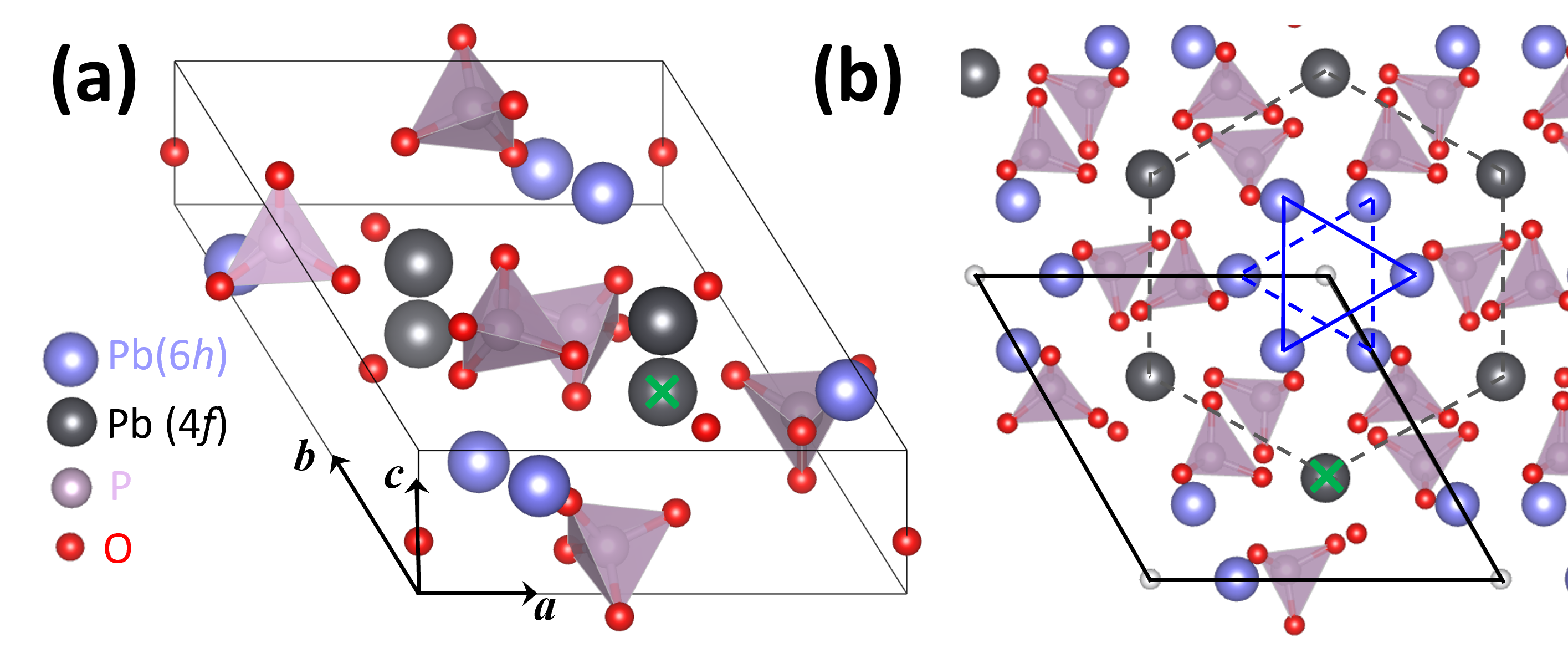
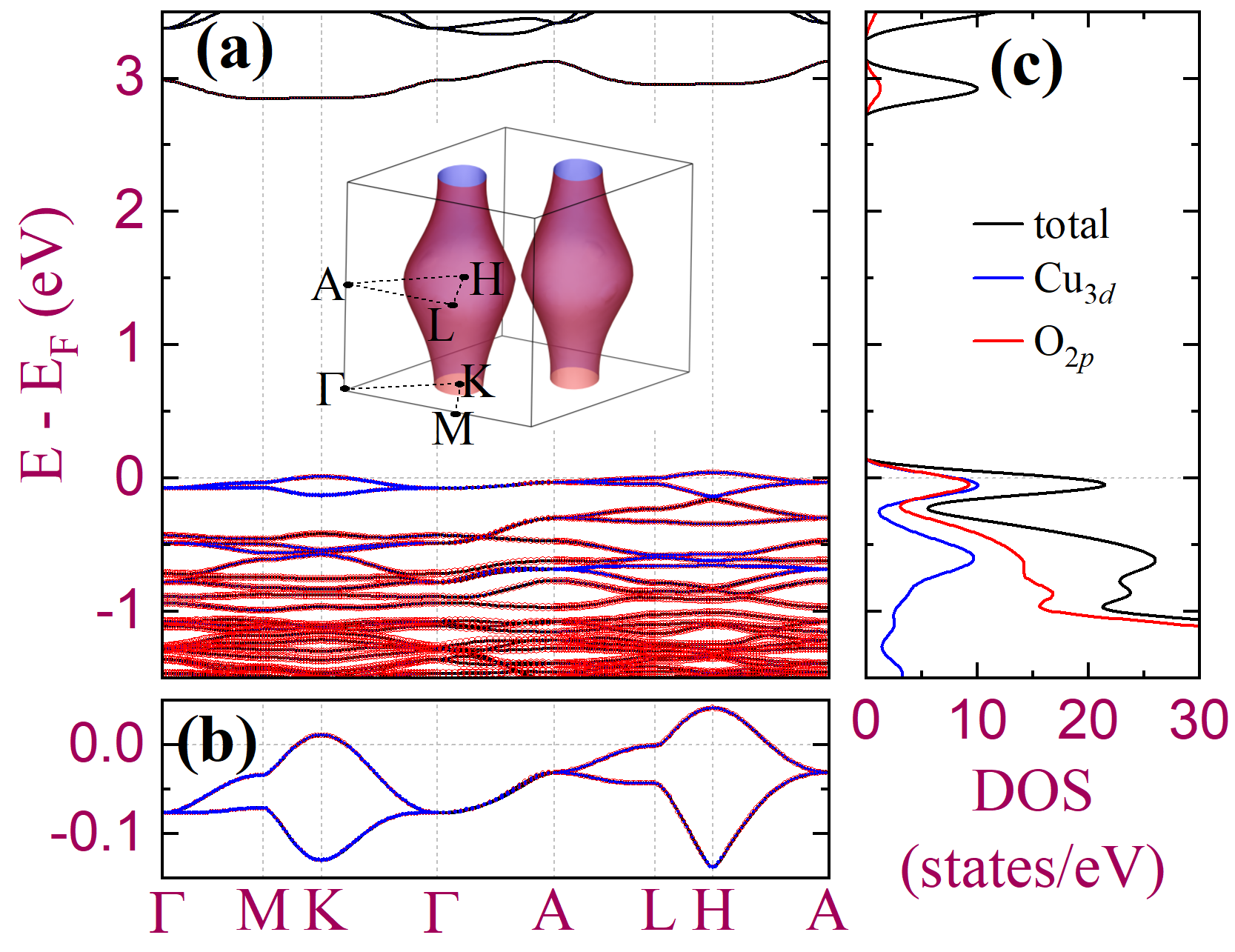
We report $ab~initio$ calculations of the electronic and vibrational properties in CuPb$_9$(PO$_4$)$_6$O, including the electron-phonon coupling strength via strong-coupling Migdal-Eliashberg theory. We verify the presence of appealing flat electronic bands near the Fermi level, a strong hybridization between the Cu $3d$ and O $2p$ states, and soft low-energy phonons, which can suggest high-temperature superconducting behavior. However, the electron-phonon coupling strength appears insufficient to overcome the Coulomb repulsion between an electron pair and thus does does not support high-temperature superconductivity in CuPb$_9$(PO$_4$)$_6$O via the conventional electron-phonon Migdal-Eliashberg mechanism. Even neglecting Coulomb repulsion of the electron pair we find this electron-phonon coupling suggests a superconducting transition temperature less than 2~K.
Motivation & Objective
- To evaluate whether electron-phonon coupling in CuPb9(PO4)6O can support high-temperature superconductivity via the strong-coupling Migdal-Eliashberg mechanism.
- To assess the role of flat electronic bands, strong Cu 3d–O 2p hybridization, and low-energy phonons in promoting superconductivity.
- To determine if the electron-phonon coupling strength is sufficient to overcome electron-electron Coulomb repulsion in this system.
- To investigate the impact of electron correlation effects on superconducting potential using spin-polarized calculations with Hubbard U.
- To provide a quantitative estimate of the superconducting transition temperature (Tc) based on ab initio electron-phonon coupling and Eliashberg theory.
Proposed method
- Ab initio calculations using Quantum ESPRESSO with norm-conserving pseudopotentials and the PBE-GGA exchange-correlation functional.
- Electronic structure and Fermi surface calculations performed with dense k-meshes (16×16×16 and 32×32×32) for accurate density of states and band dispersion.
- Lattice dynamics and electron-phonon coupling computed via density-functional perturbation theory on a 4×4×4 q-mesh.
- Migdal-Eliashberg theory applied to solve temperature-dependent nonlinear Eliashberg equations, incorporating effective Coulomb repulsion (μ*) to estimate Tc.
- Spin-polarized calculations with Ueff = 3.0 eV used to assess magnetic instabilities and their impact on superconductivity.
- Sensitivity analysis of electron-phonon coupling to Fermi energy shifts (−50 to +20 meV) to test robustness of results.
Experimental results
Research questions
- RQ1Can the electron-phonon coupling in CuPb9(PO4)6O support high-temperature superconductivity via the strong-coupling Migdal-Eliashberg mechanism?
- RQ2Does the presence of flat bands and strong Cu 3d–O 2p hybridization near the Fermi level enhance electron-phonon coupling sufficiently to induce superconductivity?
- RQ3Is the electron-phonon coupling strength sufficient to overcome the Coulomb repulsion between Cooper pairs in this system?
- RQ4How does the superconducting transition temperature depend on the effective Coulomb repulsion parameter μ*?
- RQ5What is the role of electron correlation and magnetic ordering in suppressing or enabling superconductivity in CuPb9(PO4)6O?
Key findings
- The calculated electron-phonon coupling strength (λ) is weak, averaging approximately 0.4, which is insufficient to overcome electron-electron Coulomb repulsion.
- Even without Coulomb repulsion, the predicted superconducting transition temperature is less than 2 K, indicating no potential for high-temperature superconductivity.
- For realistic μ* values of 0.1, 0.15, and 0.2, the estimated Tc values are 250 mK, 26 mK, and ~0 mK, respectively.
- The system exhibits dynamic stability with many low-frequency phonon modes below 5 meV, primarily involving Pb atoms.
- The density of states at the Fermi level is enhanced due to flat bands and strong Cu 3d–O 2p hybridization, but this does not lead to strong electron-phonon coupling.
- Spin-polarized calculations show a small magnetic moment (~1 μB/f.u.), but electron correlation effects do not significantly alter the superconducting potential.
Better researchstarts right now
From reading papers to final review, dramatically reduce your research time.
No credit card · Free plan available
This review was created by AI and reviewed by human editors.