
[Paper Review] Implicit and semi-implicit second-order time stepping methods for the Richards equation
This paper proposes second-order accurate, semi-implicit time discretization schemes for the Richards equation using mixed finite elements with saturation and pressure head as primary variables. The method employs temporal extrapolation and semi-implicit Taylor approximations to linearize nonlinear terms, achieving high accuracy and robustness; numerical results show the semi-implicit $(S,\psi)$-scheme outperforms implicit and other mixed formulations in accuracy, efficiency, and convergence stability.
This study concerns numerical methods for efficiently solving the Richards equation where different weak formulations and computational techniques are analyzed. The spatial discretizations are based on standard or mixed finite element methods. Different implicit and semi-implicit temporal discretization techniques of second-order accuracy are studied. To obtain a linear system for the semi-implicit schemes, we propose second-order techniques using extrapolation formulas and/or semi-implicit Taylor approximations for the temporal discretization of nonlinear terms. A numerical convergence study and a series of numerical tests are performed to analyze efficiency and robustness of the different schemes. The developed scheme, based on the proposed temporal extrapolation techniques and the mixed formulation involving the saturation and pressure head and using the standard linear Lagrange element, performs better than other schemes based on the saturation and the flux and using the Raviart-Thomas elements. The proposed semi-implicit scheme is a good alternative when implicit schemes meet convergence issues.
Motivation & Objective
- To develop second-order accurate, efficient, and robust time integration schemes for the Richards equation.
- To address convergence issues in implicit schemes caused by strong nonlinearity in soil hydraulic properties.
- To compare performance of different weak formulations: saturation-only, saturation-flux, and saturation-pressure head.
- To evaluate the efficiency and robustness of semi-implicit versus fully implicit schemes in practical simulations.
- To validate the proposed schemes using exact solutions and benchmark test cases with varying material properties.
Proposed method
- Uses mixed finite element methods with linear Lagrange elements for saturation and pressure head.
- Applies second-order temporal discretization via extrapolation formulas and semi-implicit Taylor approximations for nonlinear terms.
- Linearizes the system using time extrapolation to avoid solving nonlinear systems at each time step.
- Employs regularization (3.2) to prevent degeneracy when saturation approaches unity.
- Solves the resulting linear systems using standard iterative solvers with mass-lumping to enhance stability.
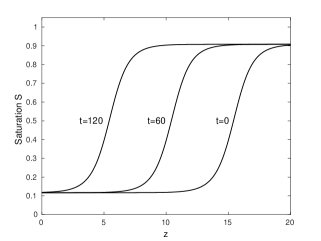
- Tests schemes on structured and unstructured meshes with varying time steps and mesh sizes.
Experimental results
Research questions
- RQ1Can second-order semi-implicit time schemes improve accuracy and efficiency over first-order implicit schemes for the Richards equation?
- RQ2How do different weak formulations (S-only, S-q, S-ψ) compare in terms of convergence rate, accuracy, and computational cost?
- RQ3Does the proposed semi-implicit $(S,\psi)$-scheme maintain second-order accuracy while avoiding convergence failures common in Newton-type solvers?
- RQ4How does the scheme perform under full saturation conditions, especially when the capillary pressure function degenerates?
- RQ5What is the impact of mesh refinement and time step size on the convergence behavior of the $(S,\psi)$-scheme?
Key findings
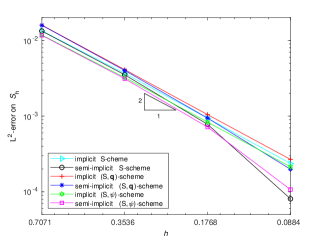
- The semi-implicit $(S,\psi)$-scheme achieves second-order accuracy in time and demonstrates superior convergence behavior compared to other schemes.
- The $L^2$-error convergence rate for saturation $S_h$ is approximately $k=1.8$, and for pressure head $\psi_h$, it is $k=1.3$.
- Errors in pressure head are about 70 times larger than those in saturation, indicating higher sensitivity in pressure approximation.
- The implicit $(S,\psi)$-scheme allows larger time steps than first-order methods while maintaining accuracy.
- The semi-implicit $(S,\psi)$-scheme is more robust than implicit schemes when nonlinearities cause convergence failure in Newton iterations.
- The $(S,\psi)$-scheme outperforms both $S$-schemes and $(S,\bm{q})$-schemes in accuracy and computational efficiency across all test cases.
Read this paper
Open the full text in the Nubint reader and ask about any passage as you read.
Read this paper on NubintThis review was generated by AI from the original paper. Please check the paper before citing it.