
[Paper Review] Implicit Neural Representation in Medical Imaging: A Comparative Survey
This survey provides a comprehensive analysis of implicit neural representations (INRs) in medical imaging, evaluating their application across tasks like reconstruction, segmentation, and registration. By leveraging neural networks to parameterize medical signals as continuous functions, INRs offer resolution-agnostic, memory-efficient, and differentiable representations that outperform traditional discrete methods in handling ill-posed medical imaging problems.
Implicit neural representations (INRs) have gained prominence as a powerful paradigm in scene reconstruction and computer graphics, demonstrating remarkable results. By utilizing neural networks to parameterize data through implicit continuous functions, INRs offer several benefits. Recognizing the potential of INRs beyond these domains, this survey aims to provide a comprehensive overview of INR models in the field of medical imaging. In medical settings, numerous challenging and ill-posed problems exist, making INRs an attractive solution. The survey explores the application of INRs in various medical imaging tasks, such as image reconstruction, segmentation, registration, novel view synthesis, and compression. It discusses the advantages and limitations of INRs, highlighting their resolution-agnostic nature, memory efficiency, ability to avoid locality biases, and differentiability, enabling adaptation to different tasks. Furthermore, the survey addresses the challenges and considerations specific to medical imaging data, such as data availability, computational complexity, and dynamic clinical scene analysis. It also identifies future research directions and opportunities, including integration with multi-modal imaging, real-time and interactive systems, and domain adaptation for clinical decision support. To facilitate further exploration and implementation of INRs in medical image analysis, we have provided a compilation of cited studies along with their available open-source implementations on \href{https://github.com/mindflow-institue/Awesome-Implicit-Neural-Representations-in-Medical-imaging}. Finally, we aim to consistently incorporate the most recent and relevant papers regularly.
Motivation & Objective
- To systematically review the application of implicit neural representations (INRs) in medical imaging tasks such as reconstruction, segmentation, and registration.
- To analyze the advantages of INRs—such as resolution-agnostic representation, memory efficiency, and differentiability—within the context of medical data.
- To identify key challenges in medical INR applications, including computational complexity, data scarcity, and dynamic scene modeling.
- To highlight open research directions, including integration with multi-modal imaging, real-time systems, and domain adaptation for clinical decision support.
- To compile and link open-source implementations of surveyed INR methods to support reproducibility and further research.
Proposed method
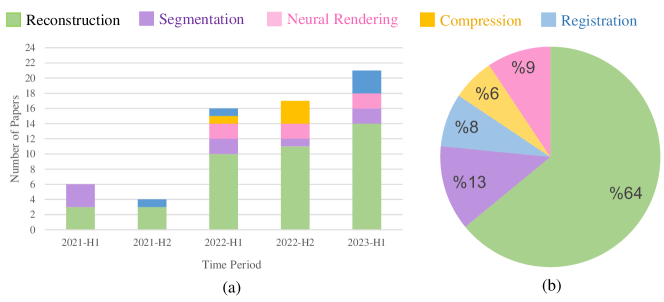
- Surveying 64 research papers from 2021–2023 to map trends in INR applications across medical imaging tasks.
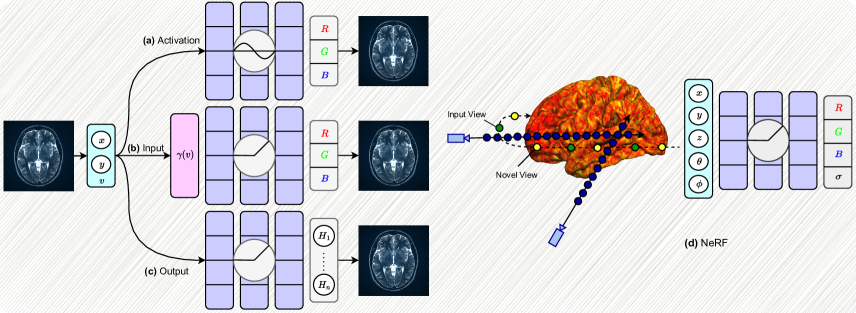
- Classifying INR architectures by design (e.g., SIREN-based, NeRF-based) and application domain (e.g., 3D reconstruction, novel view synthesis).
- Analyzing the use of Fourier feature encoding to mitigate spectral bias in INRs, especially in high-frequency medical signal representation.
- Evaluating the role of differentiable, continuous functions in enabling optimization with regularization (e.g., Jacobian, bending energy) for tasks like image registration.
- Comparing INR performance against traditional discrete representations (e.g., voxel grids, point clouds) in terms of memory usage and reconstruction fidelity.
- Categorizing and summarizing open-source implementations of INR methods from cited works to support reproducibility and tool development.
Experimental results
Research questions
- RQ1How do implicit neural representations improve performance in medical image reconstruction compared to conventional discrete representations?
- RQ2What are the key architectural choices (e.g., activation functions, input encoding) that enhance INR performance in medical imaging tasks?
- RQ3In what ways do INRs address challenges such as limited data, low-dose scanning, and dynamic anatomical motion in clinical settings?
- RQ4What are the major computational and practical barriers to deploying INRs in real-time or clinical decision support systems?
- RQ5How can INRs be extended to support multi-modal imaging, video-based reconstruction, and interactive medical visualization?
Key findings
- INRs demonstrate resolution-agnostic signal representation, enabling high-quality reconstruction at arbitrary resolutions without increased memory cost.
- The use of Fourier features and SIREN activations significantly reduces spectral bias, improving performance in reconstructing fine anatomical details in 3D medical scans.
- INRs achieve superior memory efficiency compared to voxel-based or grid-based representations, scaling with signal complexity rather than resolution.
- Differentiable INRs support advanced regularization in tasks like image registration, enabling the integration of physical constraints such as hyperelasticity and bending energy.
- Despite advantages, training INRs for 3D medical volumes remains computationally expensive, with training times increasing substantially with model depth and input dimensionality.
- Open-source implementations of INR methods in medical imaging are increasingly available, facilitating reproducibility and accelerating research in the field.
Read this paper
Open the full text in the Nubint reader and ask about any passage as you read.
Read this paper on NubintThis review was generated by AI from the original paper. Please check the paper before citing it.