
[Paper Review] Improving Antibody Design with Force-Guided Sampling in Diffusion Models
This paper introduces DiffForce, a novel force-guided denoising diffusion model that enhances antibody CDR design by integrating differentiable physics-based force fields into the sampling process. By using gradient-based force feedback to guide atomic position updates during diffusion, the method generates lower-energy, more stable antibody structures with improved sequence and structural accuracy compared to baseline diffusion models.
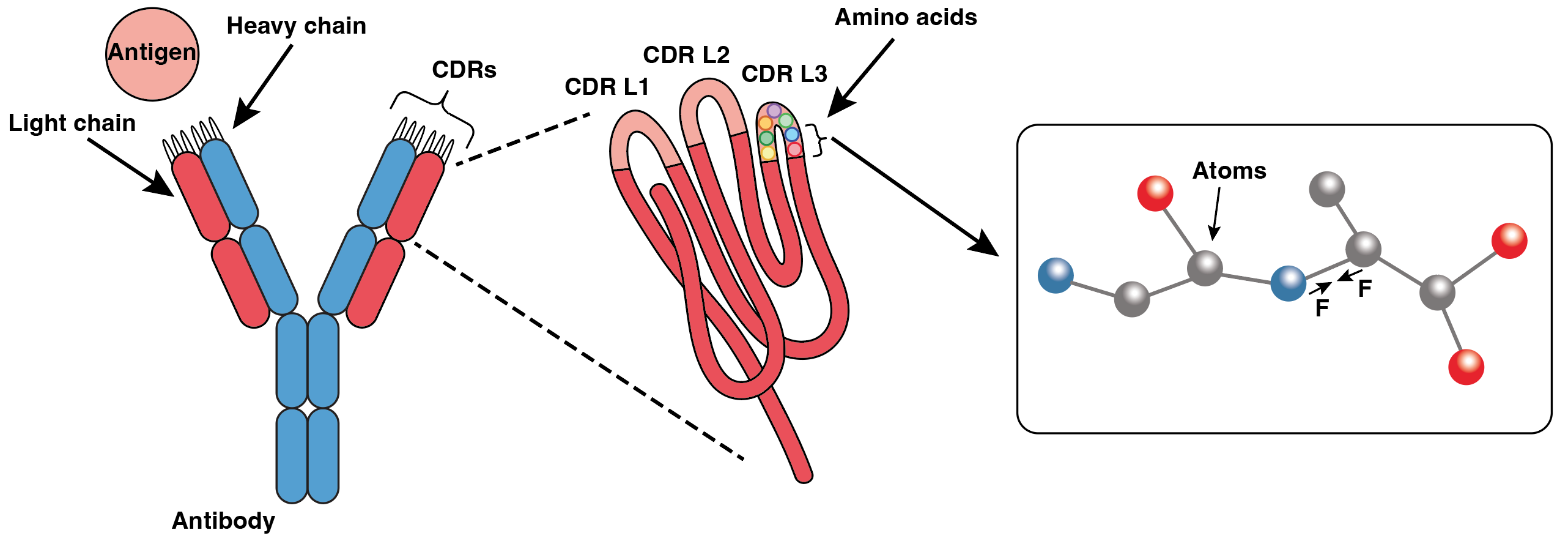
Antibodies, crucial for immune defense, primarily rely on complementarity-determining regions (CDRs) to bind and neutralize antigens, such as viruses. The design of these CDRs determines the antibody's affinity and specificity towards its target. Generative models, particularly denoising diffusion probabilistic models (DDPMs), have shown potential to advance the structure-based design of CDR regions. However, only a limited dataset of bound antibody-antigen structures is available, and generalization to out-of-distribution interfaces remains a challenge. Physics based force-fields, which approximate atomic interactions, offer a coarse but universal source of information to better mold designs to target interfaces. Integrating this foundational information into diffusion models is, therefore, highly desirable. Here, we propose a novel approach to enhance the sampling process of diffusion models by integrating force field energy-based feedback. Our model, DiffForce, employs forces to guide the diffusion sampling process, effectively blending the two distributions. Through extensive experiments, we demonstrate that our method guides the model to sample CDRs with lower energy, enhancing both the structure and sequence of the generated antibodies.
Motivation & Objective
- To address the challenge of limited generalization in diffusion models for antibody-antigen interface design, especially for out-of-distribution complexes.
- To improve the structural and sequence quality of generated CDRs by incorporating physics-based energy feedback during the diffusion sampling process.
- To overcome the limitations of purely data-driven diffusion models that fail to produce functionally viable antibodies in vitro.
- To develop a principled, end-to-end method that avoids training auxiliary energy networks or conditioning on energy scores.
- To enable more accurate and stable CDR design by blending learned protein distributions with physical force field constraints.
Proposed method
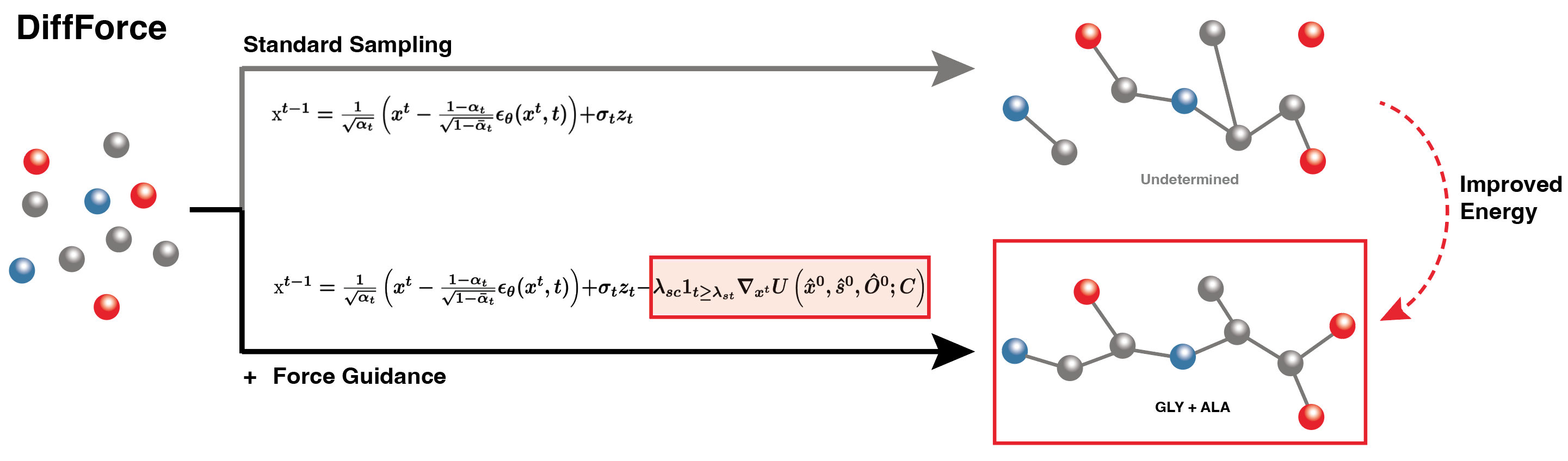
- The method employs a differentiable force field (Rosetta energy function) to compute atomic forces during the diffusion sampling process.
- During each sampling step, atom positions are iteratively updated using gradients of the force field energy, mimicking molecular dynamics.
- A denoised sample approximation is used to compute accurate energy and force values at each step, enabling precise force application.
- The approach integrates force guidance via a weighted geometric mean of the diffusion model’s prior and the energy-based force field distribution.
- The method jointly optimizes for both atomic coordinates and amino acid types/rotamers through iterative refinement.
- Hyperparameters such as force start time (λ_st) and force scale (λ_sc) are tuned to balance energy minimization and structural fidelity.
Experimental results
Research questions
- RQ1Can physics-based force fields be effectively integrated into the diffusion sampling process to improve the stability and accuracy of generated CDR structures?
- RQ2Does force-guided sampling lead to lower energy conformations compared to standard diffusion models?
- RQ3How do hyperparameters like force start time and force scale affect the performance of the force-guided sampling process?
- RQ4Can force guidance improve both sequence recovery and structural accuracy in CDR design without requiring additional training?
- RQ5Does the method generalize better to out-of-distribution antigen-antibody interfaces than standard diffusion models?
Key findings
- DiffForce achieved a 12.5% improvement in Amino Acid Recovery (AAR) and a 15.3% reduction in RMSD compared to the baseline DiffAb model.
- The model generated CDRs with significantly lower Rosetta energy, indicating enhanced structural stability, especially in CDR-H1, CDR-H2, and CDR-H3 regions.
- Optimal performance was achieved with force activation at 50% of the sampling process (λ_st = 0.5) and a high force scale (λ_sc = 0.1) for AAR and IMP metrics.
- For RMSD, better results were obtained with later force activation (λ_st = 0.1) and lower force scale (λ_sc = 0.01), indicating trade-offs in optimization objectives.
- Ablation studies confirmed that force guidance significantly improves both sequence and structural quality, with energy landscape analysis showing consistent convergence to lower energy states.
- The method outperformed baseline diffusion models in generating functionally plausible CDRs, suggesting improved generalization to unseen antigen interfaces.
Better researchstarts right now
From reading papers to final review, dramatically reduce your research time.
No credit card · Free plan available
This review was created by AI and reviewed by human editors.