
[Paper Review] Improving Performance of End-to-End ASR on Numeric Sequences
This paper improves end-to-end ASR performance on numeric sequences by training in the spoken domain and using neural denormalization, significantly reducing WER—up to 8× reduction on long numeric sequences—through synthetic TTS data and a lightweight neural correction model, outperforming conventional FST-based denormalization in on-device settings.
Recognizing written domain numeric utterances (e.g. I need $1.25.) can be challenging for ASR systems, particularly when numeric sequences are not seen during training. This out-of-vocabulary (OOV) issue is addressed in conventional ASR systems by training part of the model on spoken domain utterances (e.g. I need one dollar and twenty five cents.), for which numeric sequences are composed of in-vocabulary numbers, and then using an FST verbalizer to denormalize the result. Unfortunately, conventional ASR models are not suitable for the low memory setting of on-device speech recognition. E2E models such as RNN-T are attractive for on-device ASR, as they fold the AM, PM and LM of a conventional model into one neural network. However, in the on-device setting the large memory footprint of an FST denormer makes spoken domain training more difficult. In this paper, we investigate techniques to improve E2E model performance on numeric data. We find that using a text-to-speech system to generate additional numeric training data, as well as using a small-footprint neural network to perform spoken-to-written domain denorming, yields improvement in several numeric classes. In the case of the longest numeric sequences, we see reduction of WER by up to a factor of 8.
Motivation & Objective
- Address the out-of-vocabulary (OOV) problem in end-to-end ASR for long numeric sequences such as phone numbers, postal codes, and monetary values.
- Overcome the limitations of rule-based FST denormalizers in memory-constrained on-device applications.
- Improve performance on numeric ASR by leveraging synthetic data and neural correction models in a low-footprint, scalable way.
- Evaluate the effectiveness of spoken-domain training combined with neural denormalization for long-tail numeric utterances.
Proposed method
- Generate synthetic training data using a text-to-speech (TTS) system to augment coverage of rare and long numeric sequences in written domain.
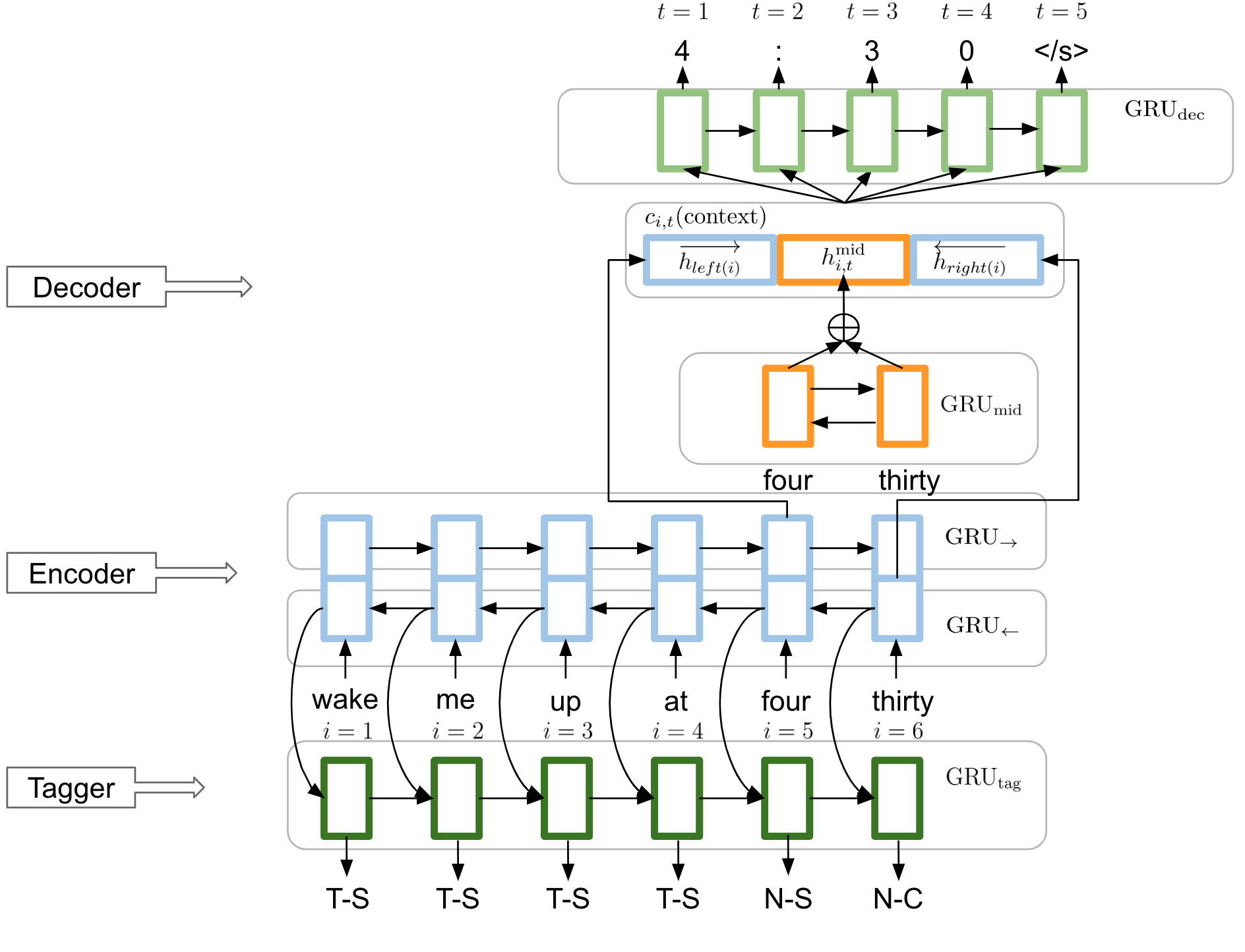
- Train a neural correction model (neural denormer) on written-domain ground-truth and RNN-T hypothesis pairs to learn to correct formatting and transcription errors.
- Train the RNN-T model in the spoken domain (e.g., 'four fifteen' instead of '4:15') to avoid OOV issues during inference.
- Implement a lightweight neural denormer with a bidirectional GRU encoder and attention-based decoder, optimized for low memory usage in on-device deployment.
- Compare neural denormalization against traditional FST-based denormalization in both written and spoken domain training setups.
- Use separate TTS systems (WaveNet and concatenative) to generate test set audio, ensuring evaluation robustness across TTS styles.
Experimental results
Research questions
- RQ1Can synthetic TTS-generated training data improve end-to-end ASR performance on rare and long numeric sequences?
- RQ2Does training the RNN-T model in the spoken domain mitigate OOV issues for numeric utterances compared to written-domain training?
- RQ3Can a neural denormalizer outperform rule-based FST denormalizers in terms of WER reduction, especially for long numeric sequences?
- RQ4What is the combined effect of spoken-domain training, synthetic TTS data, and neural denormalization on ASR performance across different numeric types?
- RQ5How does the neural denormalizer perform on real audio and curated test sets with difficult verbalizations?
Key findings
- The combination of spoken-domain training, synthetic TTS data, and a neural denormalizer reduced WER by up to 8× on long numeric sequences in a curated test set.
- In the spoken domain with neural denormalization (S2), WER was reduced by 83% on large numbers and 75% on short numbers compared to baseline.
- The neural correction model improved WER by 49% on large numbers and 75% on small numbers when combined with TTS data, outperforming written-domain approaches.
- Spoken-domain training with neural denormalization eliminated the majority of formatting and denormalization errors seen in FST-based systems, which often failed on complex or rare numeric verbalizations.
- The neural denormer achieved significant WER reduction without degrading performance on real audio or general numeric test sets, confirming its robustness.
- Error analysis showed that written-domain models frequently confused parts of numeric sequences with similar-sounding words (e.g., '180.50' → '180 - $50 in inr'), while spoken-domain models with neural denormalization largely avoided such errors.
Read this paper
Open the full text in the Nubint reader and ask about any passage as you read.
Read this paper on NubintThis review was generated by AI from the original paper. Please check the paper before citing it.