
[Paper Review] Inference for Rank-Rank Regressions
This paper develops a consistent asymptotic variance estimator for OLS in rank-rank regressions, showing that standard homoskedastic and robust variance estimators are inconsistent due to dependence on the copula structure of income distributions. The authors derive a general asymptotic theory for rank-based regressions, extend it to clustered, mixed-rank, and ranked-regressor models, and demonstrate that incorrect variance estimation leads to confidence intervals that are either too wide or too narrow, altering conclusions about intergenerational mobility.
The slope coefficient in a rank-rank regression is a popular measure of intergenerational mobility. In this article, we first show that commonly used inference methods for this slope parameter are invalid. Second, when the underlying distribution is not continuous, the OLS estimator and its asymptotic distribution may be highly sensitive to how ties in the ranks are handled. Motivated by these findings we develop a new asymptotic theory for the OLS estimator in a general class of rank-rank regression specifications without imposing any assumptions about the continuity of the underlying distribution. We then extend the asymptotic theory to other regressions involving ranks that have been used in empirical work. Finally, we apply our new inference methods to two empirical studies on intergenerational mobility, highlighting the practical implications of our theoretical findings.
Motivation & Objective
- To identify and correct the inconsistency of standard variance estimators (homoskedastic and Eicker-White) in rank-rank regressions, which depend on the copula structure of income distributions.
- To develop a general asymptotic theory for OLS estimators in rank-rank regressions without assuming continuous distributions or absence of covariates.
- To extend the asymptotic theory to clustered rank-rank regressions, regressions with ranked outcomes and non-ranked regressors, and regressions with non-ranked outcomes and ranked regressors.
- To propose consistent variance estimators for all these models, enabling valid inference in empirical studies of intergenerational mobility.
- To demonstrate empirically that incorrect standard errors lead to confidence intervals that are substantially too long or too short, affecting conclusions about mobility differences across regions or countries.
Proposed method
- Derive the asymptotic distribution of the OLS estimator in rank-rank regressions under general conditions, including non-continuous distributions and the presence of covariates.
- Establish that the probability limits of homoskedastic and Eicker-White variance estimators diverge from the true asymptotic variance depending on the copula of the ranked variables.
- Propose a consistent estimator of the asymptotic variance by accounting for the dependence structure and tie-handling mechanisms in the ranks.
- Extend the theory to three additional regression types: clustered rank-rank regressions (ranks computed over a common scale), regressions with ranked outcome and non-ranked regressor, and regressions with non-ranked outcome and ranked regressor.
- Implement the estimators in an R package (csranks) and provide a Stata command in development for empirical use.
- Calibrate simulation experiments and apply the methods to three real-world datasets: U.S. intergenerational mobility, replication of lab experiments, and regional mobility comparisons.
Experimental results
Research questions
- RQ1Why do standard homoskedastic and robust variance estimators fail to consistently estimate the asymptotic variance in rank-rank regressions?
- RQ2How does the shape of the copula between parent and child income distributions affect the bias in commonly used variance estimators?
- RQ3What is the correct asymptotic distribution of the OLS estimator in rank-rank regressions when distributions are non-continuous or covariates are included?
- RQ4How do confidence intervals based on correct variance estimators differ from those based on standard estimators in empirical applications?
- RQ5To what extent do these differences in inference affect conclusions about intergenerational mobility across U.S. commuting zones or between countries?
Key findings
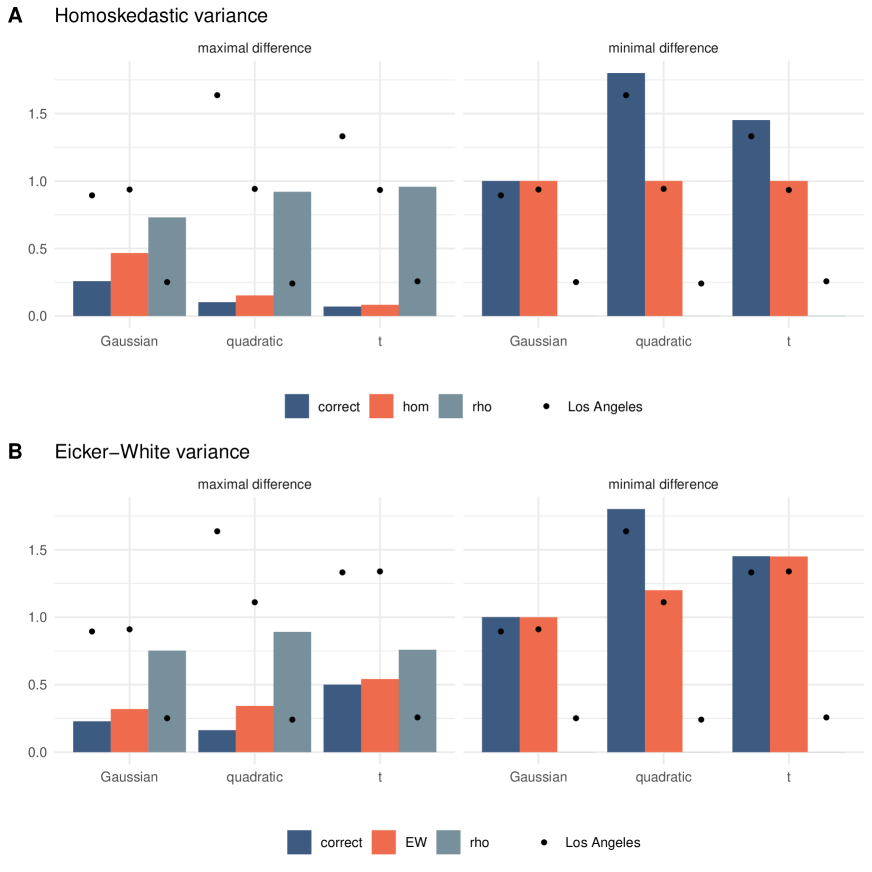
- The probability limits of homoskedastic and Eicker-White variance estimators can be substantially too large or too small depending on the copula of the income distributions, invalidating standard inference.
- For the 1940–1980 father-son cohort, the homoskedastic standard error was up to 30% larger than the correct standard error, leading to overly conservative confidence intervals.
- In the replication of 18 lab experiments, the homoskedastic standard error was about 2.5 times larger than the correct standard error for one key measure, making confidence intervals twice as wide.
- The Eicker-White estimator also produced confidence intervals that were too long in several cases, with some estimates 50% larger than the correct ones.
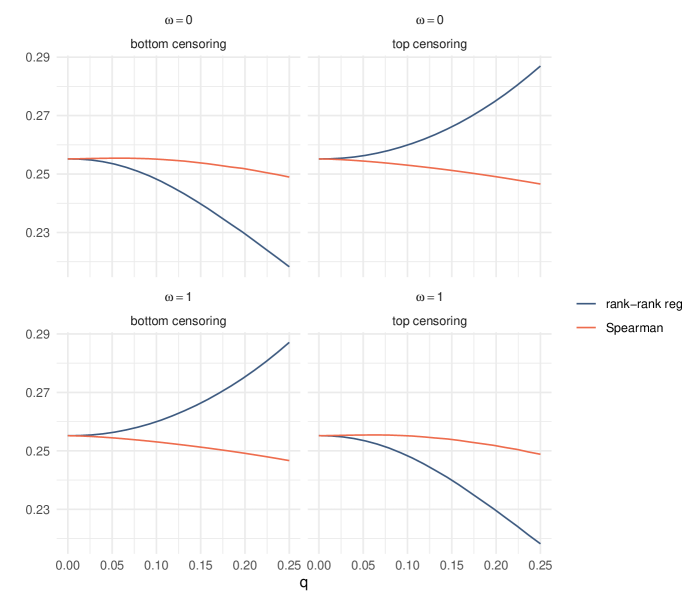
- When ties were handled differently (e.g., ω=0), some homoskedastic and Eicker-White confidence intervals became substantially shorter than the correct intervals, especially for binary regressors.
- Confidence intervals based on Spearman’s rank correlation (assuming continuous margins) were centered at different values than the rank-rank slope and were invalid when pointmasses were present in the data.
Read this paper
Open the full text in the Nubint reader and ask about any passage as you read.
Read this paper on NubintThis review was generated by AI from the original paper. Please check the paper before citing it.