
[Paper Review] InSpaceType: Reconsider Space Type in Indoor Monocular Depth Estimation
This paper introduces InSpaceType, a high-resolution RGBD dataset for indoor monocular depth estimation, and reveals severe performance imbalance across space types in existing methods. It demonstrates that models pretrained on NYUv2 perform poorly on rare or large spaces like libraries or large rooms, highlighting critical robustness and safety concerns in real-world deployment due to hidden biases in training data and evaluation protocols.
Indoor monocular depth estimation has attracted increasing research interest. Most previous works have been focusing on methodology, primarily experimenting with NYU-Depth-V2 (NYUv2) Dataset, and only concentrated on the overall performance over the test set. However, little is known regarding robustness and generalization when it comes to applying monocular depth estimation methods to real-world scenarios where highly varying and diverse functional extit{space types} are present such as library or kitchen. A study for performance breakdown into space types is essential to realize a pretrained model's performance variance. To facilitate our investigation for robustness and address limitations of previous works, we collect InSpaceType, a high-quality and high-resolution RGBD dataset for general indoor environments. We benchmark 12 recent methods on InSpaceType and find they severely suffer from performance imbalance concerning space types, which reveals their underlying bias. We extend our analysis to 4 other datasets, 3 mitigation approaches, and the ability to generalize to unseen space types. Our work marks the first in-depth investigation of performance imbalance across space types for indoor monocular depth estimation, drawing attention to potential safety concerns for model deployment without considering space types, and further shedding light on potential ways to improve robustness. See \url{https://depthcomputation.github.io/DepthPublic} for data and the supplementary document. The benchmark list on the GitHub project page keeps updates for the lastest monocular depth estimation methods.
Motivation & Objective
- To investigate the robustness of monocular depth estimation models across diverse indoor space types, which are often overlooked in prior benchmarking.
- To address the limitations of existing datasets like NYUv2, which suffer from low resolution, high noise, and lack of space-type breakdown.
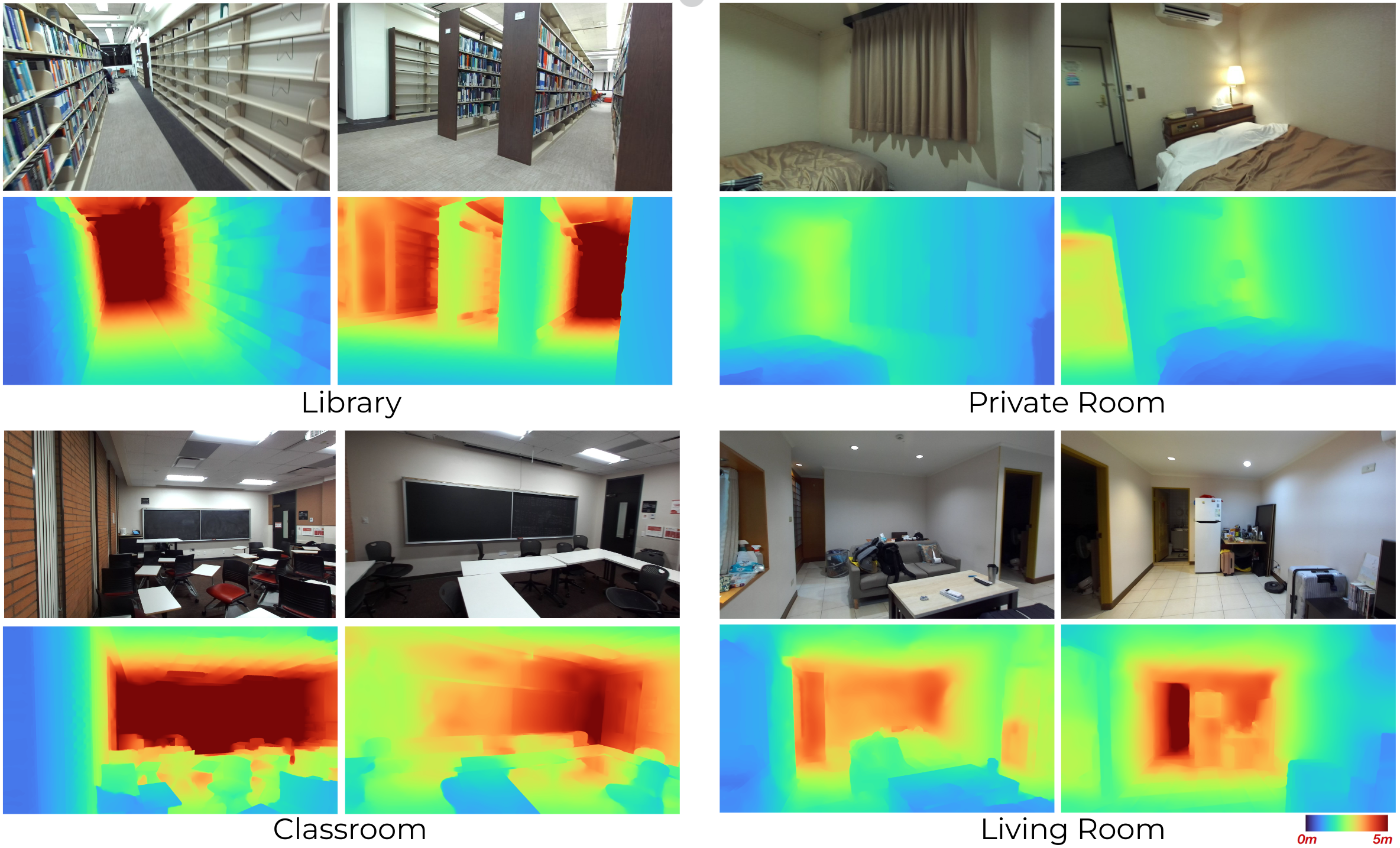
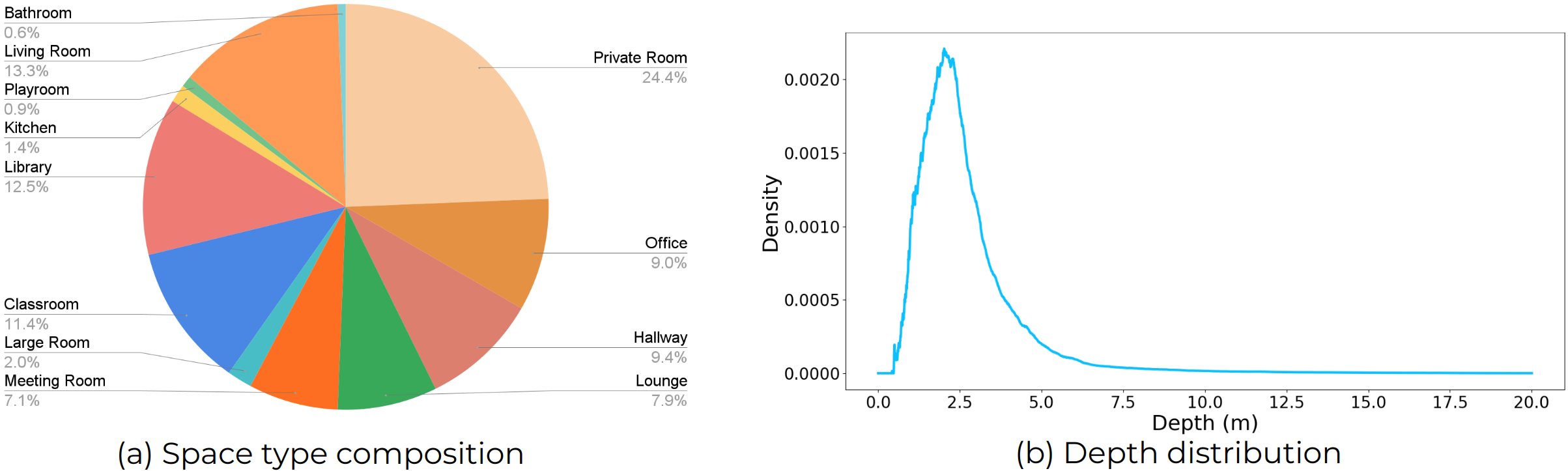
- To propose a hierarchical space type classification and collect InSpaceType, a high-quality, high-resolution RGBD dataset covering 12 common indoor environments.
- To evaluate 12 state-of-the-art depth estimation methods on InSpaceType and analyze performance variance across space types.
- To examine generalization to unseen space types and evaluate mitigation strategies for performance imbalance.
Proposed method
- Proposed a hierarchical space type classification system with 12 categories (e.g., private room, kitchen, library, large room) to enable fine-grained analysis of model performance.
- Collected InSpaceType using a modern stereo camera system (1242×2208 resolution), producing high-quality, aligned RGB and depth images with reduced noise.
- Benchmarked 12 recent monocular depth estimation models (supervised and self-supervised) on InSpaceType for zero-shot performance across space types.
- Analyzed performance variance using metrics like δ₁, AbsRel, RMSE, and SqRel, with breakdowns per space type and group-level evaluation.
- Evaluated three mitigation strategies—class re-weighting, class-balanced sampling, and meta-learning—to reduce performance imbalance.
- Conducted cross-group generalization studies by grouping space types into three functional groups (G1: household, G2: office, G3: large/spacious) and measuring zero-shot transfer performance.
Experimental results
Research questions
- RQ1How does the performance of monocular depth estimation models vary across different indoor space types, especially when evaluated beyond average metrics?
- RQ2To what extent do existing datasets like NYUv2 and synthetic datasets (e.g., Matterport3D, Replica) introduce bias toward specific space types?
- RQ3Can standard mitigation techniques such as re-weighting, sampling, or meta-learning effectively reduce performance imbalance across space types?
- RQ4How well do models generalize to unseen space types, particularly when transferring knowledge between functionally distinct groups?
- RQ5What are the key factors—such as object diversity, scene clutter, or scale mismatch—that hinder generalization across space types?
Key findings
- Models pre-trained on NYUv2 show severe performance imbalance: δ₁ reaches 92.05 in private rooms (head type) but drops to 54.93 in large rooms (tail type), indicating strong bias toward common spaces.
- Generalization to unseen space types is highly challenging, with δ₁ dropping from 98.12 (intra-group) to 59.02 (inter-group) when transferring from G1 (household) to G3 (large/spacious) spaces.
- Training on large or spacious rooms (G3) yields slightly better generalization to smaller rooms than the reverse, suggesting some transferability from complex to simpler scenes.
- Synthetic datasets like SimSIN and Hypersim fail to capture real-world clutter and small-object complexity in spaces like kitchens, leading to poor performance on such types.
- The best-performing mitigation strategy—meta-learning—still results in significant performance gaps, with δ₁ dropping to 66.01 in the worst inter-group case (G2 → Far), indicating persistent generalization challenges.
- InSpaceType reveals that current evaluation protocols overlook critical performance variance across space types, raising safety concerns for real-world deployment of depth models.
Read this paper
Open the full text in the Nubint reader and ask about any passage as you read.
Read this paper on NubintThis review was generated by AI from the original paper. Please check the paper before citing it.