
[Paper Review] Interactions in information spread: quantification and interpretation using stochastic block models
This paper proposes the Interacting Mixed Membership Stochastic Block Model (IMMSBM), a probabilistic framework that quantifies pairwise interactions between entities—such as hashtags, symptoms, or products—in information spread and outcome prediction. By modeling how combinations of entities influence outcomes beyond individual virality, the method improves prediction performance by up to 150% in relative probability changes compared to non-interacting models, demonstrating that interactions are critical for accurate inference in social networks, medical diagnosis, and recommender systems.
In most real-world applications, it is seldom the case that a given observable evolves independently of its environment. In social networks, users' behavior results from the people they interact with, news in their feed, or trending topics. In natural language, the meaning of phrases emerges from the combination of words. In general medicine, a diagnosis is established on the basis of the interaction of symptoms. Here, we propose a new model, the Interactive Mixed Membership Stochastic Block Model (IMMSBM), which investigates the role of interactions between entities (hashtags, words, memes, etc.) and quantifies their importance within the aforementioned corpora. We find that interactions play an important role in those corpora. In inference tasks, taking them into account leads to average relative changes with respect to non-interactive models of up to 150\% in the probability of an outcome. Furthermore, their role greatly improves the predictive power of the model. Our findings suggest that neglecting interactions when modeling real-world phenomena might lead to incorrect conclusions being drawn.
Motivation & Objective
- To address the gap in modeling interactions between entities (e.g., hashtags, symptoms, products) in information diffusion and outcome prediction.
- To quantify the contribution of pairwise interactions to outcome probabilities beyond individual entity virality.
- To develop a scalable, interpretable model that enhances predictive performance in real-world datasets such as social media, medical corpora, and music platforms.
- To provide a framework for explaining how and why certain combinations of entities lead to specific outcomes, improving model interpretability in social science and AI applications.
Proposed method
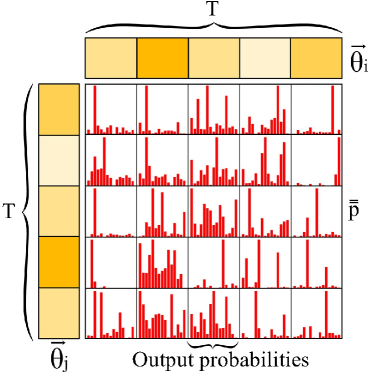
- The IMMSBM extends the Mixed Membership Stochastic Block Model (MMSBM) by introducing a bilinear interaction term between entity clusters, modeling how pairs of clusters jointly influence outcome probabilities.
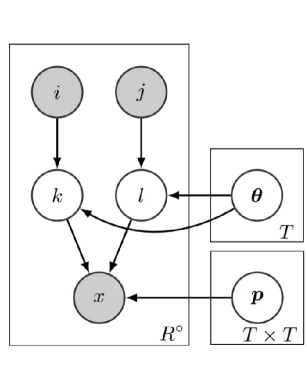
- The model uses a generative process where each outcome is determined by the interaction of two entities' cluster memberships, parameterized by a matrix $ V_{k,l} $ that captures the strength of interaction between cluster $ k $ and $ l $.
- An efficient Expectation-Maximization (EM) algorithm is developed to estimate model parameters, enabling scalability to large datasets.
- The model distinguishes between the intrinsic virality of individual entities and the additional effect of their interaction, allowing for disentangled quantification of each component.
- Cluster memberships are inferred via a mixed-membership approach, where each entity belongs to multiple clusters with varying probabilities, enabling flexible representation of complex semantic relationships.
- The model's interpretability is enhanced by manual labeling of clusters based on composition, and by analyzing interaction heatmaps and membership entropy to assess cluster coherence and interaction patterns.
Experimental results
Research questions
- RQ1How do pairwise interactions between entities such as hashtags, symptoms, or products influence the probability of an outcome in information spread?
- RQ2To what extent do interactions improve predictive performance compared to models that consider only individual entity virality?
- RQ3Which specific pairs of entity clusters exhibit the strongest or most meaningful interactions in real-world corpora?
- RQ4How can interaction effects be quantified and visualized to enhance model interpretability and explainability?
- RQ5What is the role of cluster membership entropy in assessing the coherence and interpretability of the inferred interaction structure?
Key findings
- Incorporating pairwise interactions into the model led to average relative increases of up to 150% in the predicted probability of outcomes compared to non-interacting models.
- The model significantly improved prediction performance across diverse corpora, including PubMed (disease symptoms), Reddit (user discussions), Twitter (hashtags), and Spotify (music playlists).
- Interaction matrices $ V_{k,l} $ revealed that only a small subset of clusters interact meaningfully, with most clusters showing no significant interaction effects.
- The diagonal entries of $ V_{k,l} $ were consistently low, indicating that self-interactions (same cluster pair) contribute little beyond individual virality, while cross-cluster interactions often reduce or redirect outcome probabilities.
- Membership entropy was low across all corpora (0.320–0.561), indicating that entities were predominantly assigned to one or two clusters, enhancing interpretability and enabling meaningful manual labeling of clusters.
- The model demonstrated that neglecting interactions leads to incorrect conclusions, as interactions can drastically alter outcome probabilities—e.g., combining 'earache' and 'speech disorder' shifts diagnosis from ear to brain disease.
Read this paper
Open the full text in the Nubint reader and ask about any passage as you read.
Read this paper on NubintThis review was generated by AI from the original paper. Please check the paper before citing it.