
[Paper Review] Internal tide generation from non-uniform barotropic body forcing
This paper develops a Coupled-Mode System (CMS) for modeling internal tide generation from non-uniform barotropic tides over variable topography, using a body-forcing formulation with local eigenfunction expansion. It analytically recovers the Weak Topography Approximation (WTA) for small slopes and numerically solves the CMS for arbitrary topographies, showing that non-uniform tides locally influence baroclinic fields and that energy conversion rates in strongly supercritical regimes converge to knife-edge or step-like topography limits.
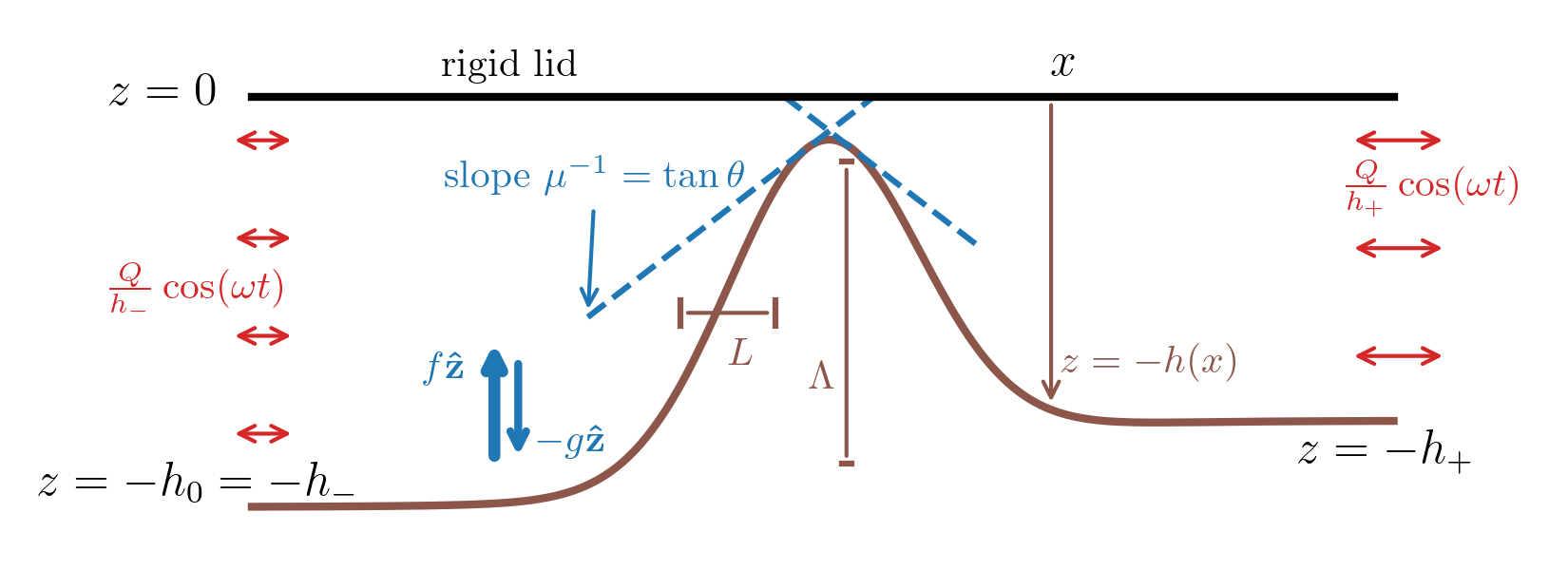
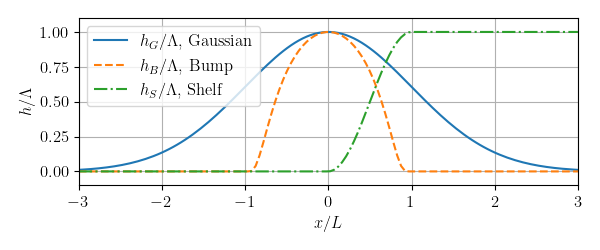
We model linear, inviscid, internal tides generated by the interaction of a barotropic tide with one-dimensional topography. Starting from the body-forcing formulation of the hydrodynamic problem, we derive a Coupled-Mode System (CMS) using a local eigenfunction expansion of the stream function. For infinitesimal topography, we solve this CMS analytically, recovering the classical Weak Topography Approximation (WTA) formula for the barotropic-to-baroclinic energy conversion rate. For arbitrary topographies, we solve this CMS numerically. The CMS enjoys faster convergence with respect to existing modal solutions and can be applied in the subcritical and supercritical regimes for both ridges and shelf profiles. We show that the non-uniform barotropic tide affects the baroclinic field locally over topographies with large slopes and we study the dependence of the radiated energy conversion rate on the criticality. We show that non-radiating or weakly radiating topographies are common in the subcritical regime. We also assess the region of validity of the WTA approximation for the commonly used Gaussian ridge and a compactly supported bump ridge studied here for the first time. Finally, we provide numerical evidence showing that in the strongly supercritical regime the energy conversion rate for a ridge (resp. shelf) approaches the value obtained by the knife-edge (resp. step) topography.
Motivation & Objective
- To develop a more accurate and efficient method for modeling internal tide generation from non-uniform barotropic tides over complex topography.
- To extend the Weak Topography Approximation (WTA) to non-uniform forcing and assess its validity for realistic topographic profiles.
- To investigate the dependence of barotropic-to-baroclinic energy conversion on topographic criticality and spatial structure.
- To provide a numerically robust framework applicable to both subcritical and supercritical topographies, including ridges and shelves.
- To determine the asymptotic behavior of energy conversion rates in the strongly supercritical regime, comparing with idealized step and knife-edge topographies.
Proposed method
- Formulates the internal tide problem using the body-forcing approach derived from Garrett & Gerkema (2007), ensuring consistency with non-hydrostatic dynamics.
- Applies a local eigenfunction expansion of the stream function to derive a Coupled-Mode System (CMS), transforming the PDE into a system of ODEs.
- Solves the CMS analytically for infinitesimal topography, recovering the classical WTA formula for energy conversion rate.
- Solves the CMS numerically for arbitrary topography profiles, including Gaussian ridges and compactly supported bump ridges.
- Uses Fourier transforms and asymptotic analysis to compute far-field energy fluxes and conversion rates from modal amplitudes.
- Reconstructs free-surface elevation from baroclinic pressure fields via a boundary value problem on the surface, using rigid-lid approximation.
Experimental results
Research questions
- RQ1How does non-uniform barotropic forcing affect the local structure and radiated energy of internal tides over variable topography?
- RQ2What is the validity range of the Weak Topography Approximation (WTA) for realistic topographic profiles like Gaussian ridges and compactly supported bumps?
- RQ3How does the energy conversion rate depend on topographic criticality, particularly in subcritical and supercritical regimes?
- RQ4What are the asymptotic limits of the energy conversion rate in the strongly supercritical regime, and do they converge to those of idealized step or knife-edge topographies?
- RQ5Can the Coupled-Mode System (CMS) achieve faster convergence than traditional modal solutions for complex topographies?
Key findings
- The Coupled-Mode System (CMS) achieves faster convergence than existing modal solutions and is applicable in both subcritical and supercritical regimes for ridges and shelves.
- Non-uniform barotropic tides locally modulate the baroclinic field, especially over topographies with large slopes, indicating that spatial variation in forcing cannot be neglected.
- Non-radiating or weakly radiating topographies are common in the subcritical regime, suggesting that energy conversion is suppressed for small slopes.
- The WTA approximation breaks down for topographies with significant spatial variation, and its validity is assessed numerically for Gaussian ridges and a newly studied compactly supported bump ridge.
- In the strongly supercritical regime, the energy conversion rate for a ridge asymptotically approaches that of a knife-edge topography, and for a shelf, it approaches that of a step topography.
- The analytical recovery of the WTA formula from the CMS confirms consistency with classical theory and validates the framework’s accuracy for small slopes.
Read this paper
Open the full text in the Nubint reader and ask about any passage as you read.
Read this paper on NubintThis review was generated by AI from the original paper. Please check the paper before citing it.