
[Paper Review] Introduction to Latent Variable Energy-Based Models: A Path Towards Autonomous Machine Intelligence
This paper introduces latent variable energy-based models (LVEBM) as a foundational framework for achieving autonomous machine intelligence, proposing the hierarchical joint embedding predictive architecture (H-JEPA) to enable self-supervised world model learning. By combining energy-based modeling with structured latent variables, H-JEPA enables efficient, generalizable, and uncertainty-aware prediction of complex world states, forming a path toward human-level AI with minimal supervision.
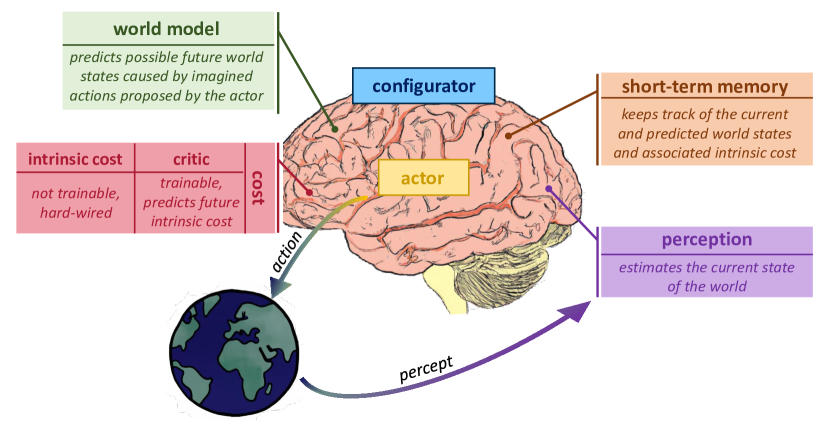
Current automated systems have crucial limitations that need to be addressed before artificial intelligence can reach human-like levels and bring new technological revolutions. Among others, our societies still lack Level 5 self-driving cars, domestic robots, and virtual assistants that learn reliable world models, reason, and plan complex action sequences. In these notes, we summarize the main ideas behind the architecture of autonomous intelligence of the future proposed by Yann LeCun. In particular, we introduce energy-based and latent variable models and combine their advantages in the building block of LeCun's proposal, that is, in the hierarchical joint embedding predictive architecture (H-JEPA).
Motivation & Objective
- To address the limitations of current ML systems in achieving human-level generalization and autonomy.
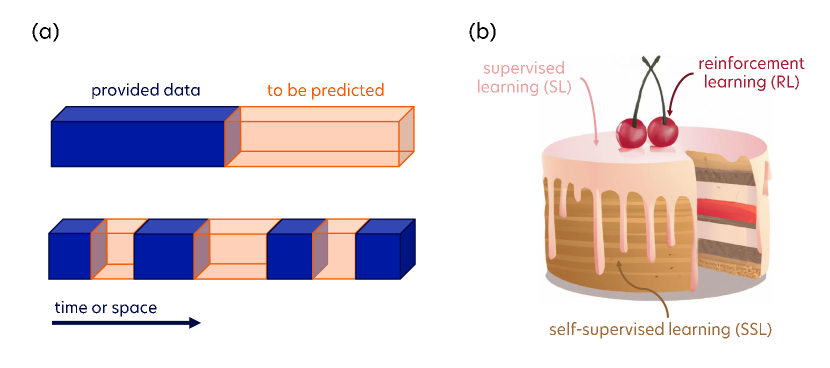
- To propose a new paradigm for autonomous intelligence based on self-supervised learning and world model prediction.
- To integrate energy-based models with latent variables to enable robust, structured representation learning.
- To develop a scalable, hierarchical architecture (H-JEPA) that supports long-horizon reasoning and planning.
- To enable models to learn reliable world models, reason, and plan complex action sequences with minimal data.
Proposed method
- Uses energy-based models (EBMs) to define unnormalized probability distributions via energy functions, enabling flexible modeling of complex data distributions.
- Introduces latent variable energy-based models (LVEBMs) by marginalizing over hidden variables, allowing the model to capture abstract, disentangled representations.
- Employs the hierarchical joint embedding predictive architecture (H-JEPA) to jointly predict future states and latent representations across multiple levels of abstraction.
- Applies contrastive and regularized training methods to optimize energy functions, minimizing energy for correct predictions and maximizing it for incorrect ones.
- Uses variance-invariance-covariance regularization (VICReg) to stabilize training and improve representation quality in self-supervised learning.
- Transforms energies into probabilities via Gibbs distributions, with marginalization over latent variables to derive conditional and joint distributions.
Experimental results
Research questions
- RQ1How can energy-based models be extended with latent variables to improve representation learning and generalization?
- RQ2What architectural design enables efficient, scalable, and hierarchical world model learning for autonomous agents?
- RQ3How can self-supervised learning with energy-based models support reliable uncertainty estimation and long-horizon reasoning?
- RQ4What training objectives and regularization techniques are most effective for learning structured latent representations in complex environments?
- RQ5Can the H-JEPA framework enable autonomous systems to learn and plan complex action sequences with minimal supervision?
Key findings
- The H-JEPA framework enables self-supervised learning of hierarchical world models that support long-horizon prediction and planning.
- Latent variable energy-based models allow for structured, disentangled representations that improve generalization and uncertainty estimation.
- Contrastive and regularized training methods stabilize learning and improve performance on downstream tasks.
- The use of energy functions with latent variables enables flexible, differentiable modeling of complex data distributions.
- Marginalization over latent variables allows the model to derive meaningful conditional probabilities, forming the basis for reasoning and prediction.
- The framework supports transfer learning and adaptation to new tasks without extensive retraining, mimicking human-like sample efficiency.
Read this paper
Open the full text in the Nubint reader and ask about any passage as you read.
Read this paper on NubintThis review was generated by AI from the original paper. Please check the paper before citing it.