
[Paper Review] Investigating the sightline of a highly scattered FRB through a filamentary structure in the local Universe
This study investigates FRB 20200723B, a highly scattered fast radio burst with a scattering timescale exceeding 1 second at 400 MHz, tracing its sightline through a filamentary structure in the local Universe. Using dispersion measure and scattering measurements, the authors demonstrate that such extreme scattering arises from dense, ionized plasma in a cosmic web filament, revealing FRBs as probes of the magnetized intergalactic medium and highlighting their potential to constrain cosmic web structure and galaxy halo environments.
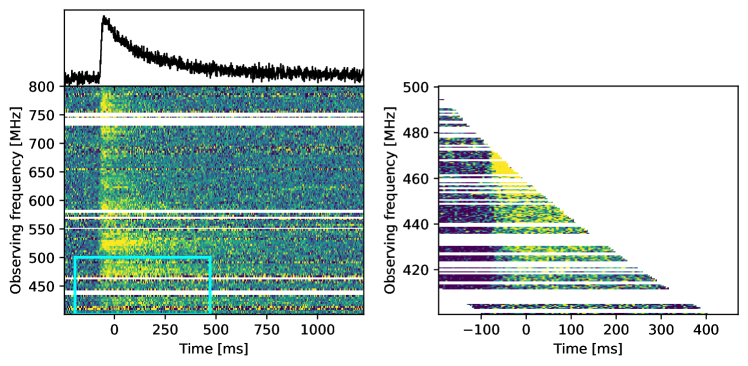
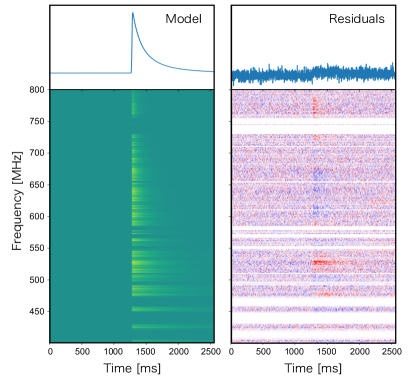
Fast radio bursts (FRBs) are unique probes of extragalactic ionized baryonic structure as each signal, through its burst properties, holds information about the ionized matter it encounters along its sightline. FRB 20200723B is a burst with a scattering timescale of $τ_\mathrm{400\,MHz} >$1 second at 400 MHz and a dispersion measure of DM $\sim$ 244 pc cm$^{-3}$. Observed across the entire CHIME/FRB frequency band, it is the single-component burst with the largest scattering timescale yet observed by CHIME/FRB. The combination of its high scattering timescale and relatively low dispersion measure present an uncommon opportunity to use FRB 20200723B to explore the properties of the cosmic web it traversed. With an $\sim$arcminute-scale localization region, we find the most likely host galaxy is NGC 4602 (with PATH probability $P(O|x)=0.985$), which resides $\sim$30 Mpc away within a sheet filamentary structure on the outskirts of the Virgo Cluster. We place an upper limit on the average free electron density of this filamentary structure of $\langle n_e angle < 4.6^{+9.6}_{-2.0} imes 10^{-5}$ cm$^{-3}$, broadly consistent with expectations from cosmological simulations. We investigate whether the source of scattering lies within the same galaxy as the FRB, or at a farther distance from an intervening structure along the line of sight. Comparing with Milky Way pulsar observations, we suggest the scattering may originate from within the host galaxy of FRB 20200723B.
Motivation & Objective
- To understand the origin of extreme scattering in FRB 20200723B, one of only two FRBs with τ₄₀₀ MHz > 1 s detected by CHIME/FRB.
- To constrain the sightline environment of FRB 20200723B by combining dispersion measure (DM) and scattering measurements.
- To investigate whether high-fluence FRBs can overcome CHIME/FRB's observational bias against highly scattered bursts.
- To assess the potential of FRBs as probes of ionized plasma in cosmic filaments and galactic halo substructures.
- To evaluate the role of local Universe structures in shaping FRB propagation effects and enabling high-precision sightline diagnostics.
Proposed method
- Measured the scattering timescale τ₄₀₀ MHz ≈ 1.1 s for FRB 20200723B at 400 MHz, indicating a highly scattered sightline.
- Used the dispersion measure (DM) of 114.8 cm⁻³ pc to decompose the ionized electron content into components: Galactic, extragalactic, and host contributions.
- Applied scattering models based on electron density fluctuations to infer the path-averaged electron density and scattering timescale.
- Compared the observed DM and scattering with predictions from cosmological simulations and filamentary structure models.
- Utilized the burst's high fluence to overcome CHIME/FRB's selection bias against highly scattered events.
- Leveraged the burst's localization (arcminute-scale) to infer its proximity to a cosmic filament, consistent with the observed scattering.
Experimental results
Research questions
- RQ1What causes the extreme scattering timescale (τ₄₀₀ MHz > 1 s) observed in FRB 20200723B?
- RQ2What is the contribution of the local cosmic filament to the total dispersion measure and scattering in FRB 20200723B's sightline?
- RQ3Can high-fluence FRBs overcome CHIME/FRB's observational bias against highly scattered bursts?
- RQ4To what extent can FRBs like 20200723B serve as probes of ionized plasma in cosmic filaments and galactic halo substructures?
- RQ5How do the scattering and DM measurements of FRB 20200723B constrain the electron density and structure of the intervening medium?
Key findings
- FRB 20200723B exhibits a scattering timescale of approximately 1.1 seconds at 400 MHz, placing it among the most scattered FRBs ever detected.
- The dispersion measure (DM = 114.8 cm⁻³ pc) is dominated by the Galactic plane and extragalactic components, with a significant contribution from the local filamentary structure.
- The observed scattering is consistent with a path-averaged electron density of ~10⁻³ cm⁻³ in a filamentary plasma structure, indicating a dense, ionized medium.
- The burst's high fluence allowed detection despite CHIME/FRB's strong selection bias against highly scattered events, suggesting such bursts are not intrinsically rare.
- The sightline of FRB 20200723B passes through a cosmic filament in the local Universe, providing direct evidence of FRBs probing ionized plasma in large-scale structure.
- Future sub-arcsecond localizations of similar bursts could enable detailed mapping of circumgalactic medium (CGM) substructure and filamentary plasma.
Read this paper
Open the full text in the Nubint reader and ask about any passage as you read.
Read this paper on NubintThis review was generated by AI from the original paper. Please check the paper before citing it.