
[Paper Review] Jellyfish galaxies with the IllustrisTNG simulations -- When, where, and for how long does ram pressure stripping of cold gas occur?
This study uses the TNG50 cosmological simulation to analyze ram pressure stripping (RPS) in 535 jellyfish galaxies, revealing that RPS acts over long timescales (1.5–8 Gyr), with peak stripping occurring within 1 Gyr of infall and lasting ≤2 Gyr at 0.2–2 R_200c. Despite prolonged stripping, galaxies continue forming stars until ~98% of cold gas is lost, and they deposit more cold gas into halos than exists there today—making them major contributors to circumgalactic gas reservoirs.
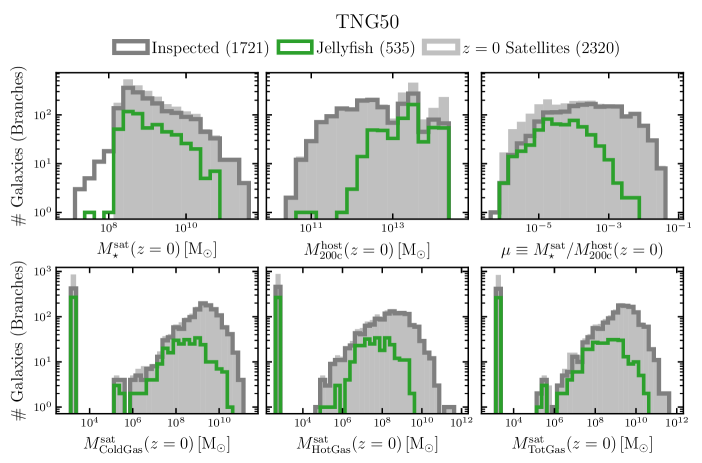
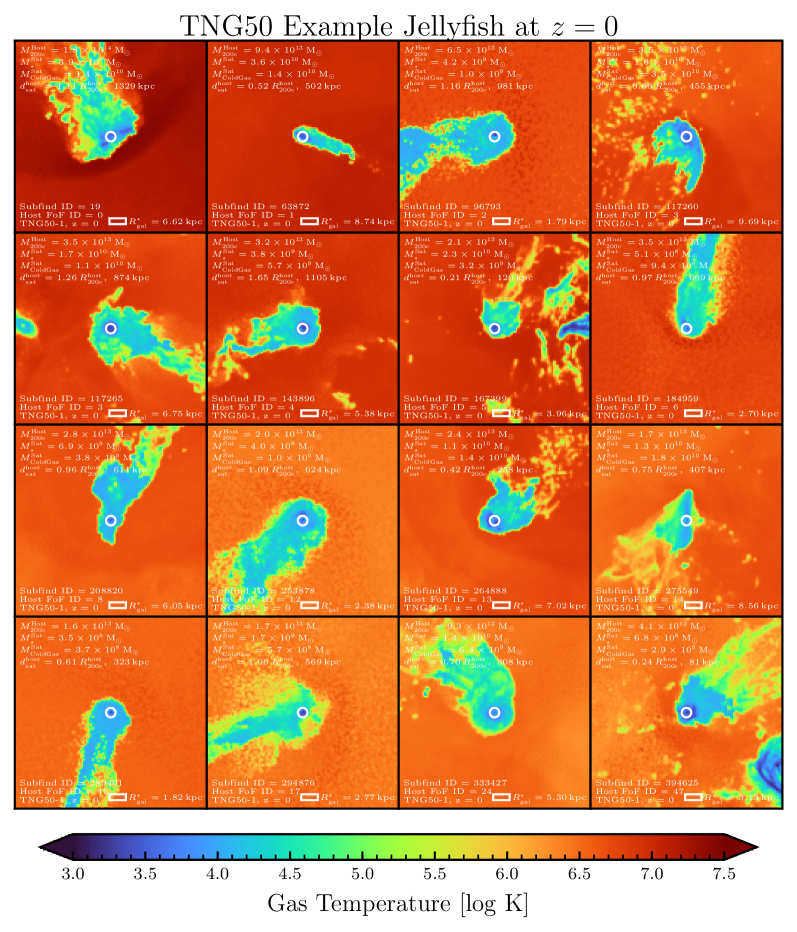
Jellyfish galaxies are prototypical examples of satellite galaxies undergoing strong ram pressure stripping (RPS). We analyze the evolution of 512 unique, first-infalling jellyfish galaxies from the TNG50 cosmological simulation. These have been visually inspected to be undergoing RPS sometime in the past 5 billion years (since $z=0.5$), have satellite stellar masses $\mstarsat\sim10^{8-10.5}\,M_\odot$, and live in hosts with $\mvir\sim10^{12-14.3}\,M_\odot$ at $z=0$. We quantify the cold gas ($T\leq10^{4.5}$ K) removal using the tracer particles, confirming that for these jellyfish, RPS is the dominant driver of cold gas loss after infall. Half of these jellyfish are completely gas-less by $z=0$, and these galaxies have earlier infall times and smaller satellite-to-host mass ratios than their gaseous counterparts. RPS can act on jellyfish galaxies over long time scales of $\approx1.5-8$ Gyr. Jellyfish in more massive hosts are impacted by RPS for a shorter time span and, at a fixed host mass, jellyfish with less cold gas at infall and lower stellar masses at $z=0$ have shorter RPS time spans. While RPS may act for long periods of time, the peak RPS period -- where at least 50 pecent of the total RPS occurs -- begins within $\approx1$ Gyr of infall and lasts $\lesssim2$ Gyr. During this period, the jellyfish are at host-centric distances $\sim0.2-2 vir$, illustrating that much of RPS occurs at large distances from the host galaxy. Interestingly, jellyfish continue forming stars until they have lost $\approx98$ percent of their cold gas. For groups and clusters in TNG50 $(\mvirhost\sim10^{13-14.3}\,M_\odot)$, jellyfish galaxies deposit more cold gas ($\sim10^{11-12}\,M_\odot$) into halos than exist in them at $z=0$, demonstrating that jellyfish, and in general satellite galaxies, are a significant source of cold gas accretion.
Motivation & Objective
- To understand the timing, duration, and spatial distribution of ram pressure stripping (RPS) in jellyfish galaxies within a cosmological context.
- To quantify how long RPS acts on cold gas in satellite galaxies after infall, and identify the conditions that prolong or shorten this process.
- To assess the role of jellyfish galaxies in depositing cold gas into the circumgalactic medium (CGM) and intracluster medium (ICM), and compare this to existing gas reservoirs.
- To investigate the star formation behavior of jellyfish galaxies during RPS, particularly how long they remain active after infall.
- To determine the dependence of RPS duration on host mass, satellite mass, infall time, and orbital history.
Proposed method
- Identified 535 unique jellyfish galaxies via visual inspection in the TNG50 simulation, selected for first infall within the last 5 Gyr and host halo masses of 10^12–14.3 M☉.
- Tracked cold gas (T ≤ 10^4.5 K) using Lagrangian Monte Carlo tracer particles to quantify mass loss over time.
- Defined RPS timescale as the duration from infall to complete cold gas removal, with peak RPS period identified as when ≥50% of total stripping occurs.
- Analyzed host-centric distances and orbital parameters to locate where RPS is most effective, focusing on 0.2–2 R_200c regions.
- Compared RPS duration and efficiency across varying satellite stellar masses, host halo masses, and initial cold gas content at infall.
- Quantified cold gas deposition into the CGM/ICM by integrating stripped gas mass over time and comparing to in-situ gas content at z=0.
Experimental results
Research questions
- RQ1Over what timescale does ram pressure stripping (RPS) act on cold gas in jellyfish galaxies after infall?
- RQ2Where in the host-centric distance range does the majority of RPS occur, and how does this relate to orbital phase?
- RQ3What fraction of cold gas is stripped during the peak RPS period, and when does this occur relative to infall?
- RQ4How long do jellyfish galaxies continue forming stars after infall, and at what gas mass fraction does quenching occur?
- RQ5How much cold gas do jellyfish galaxies deposit into the circumgalactic medium (CGM) and intracluster medium (ICM), and how does this compare to existing reservoirs?
Key findings
- Ramses pressure stripping (RPS) acts on jellyfish galaxies over extended timescales, averaging 1.5–8 Gyr, with half of the galaxies losing all cold gas by z=0.
- The peak RPS period—where at least 50% of total stripping occurs—begins within ~1 Gyr of infall and lasts ≤2 Gyr, occurring predominantly at host-centric distances of 0.2–2 R_200c.
- Jellyfish galaxies continue forming stars until they have lost approximately 98% of their cold gas mass, with final quenching occurring only after ~99% of RPS has occurred.
- In massive hosts (M_200c ~ 10^14 M☉), jellyfish galaxies deposit ~10^12 M☉ of cold gas into the ICM over the past 5 Gyr, exceeding the current ICM cold gas content.
- For halos with M_200c ≥ 10^12.5 M☉, satellite galaxies (including jellyfish) have deposited over 10^10 M☉ of cold gas into the CGM over the past 5 Gyr, comparable to the current stellar mass of the central galaxy.
- RPS duration is shorter in more massive hosts and for satellites with lower initial cold gas content, lower z=0 stellar mass, and fewer orbits at the time of total stripping.
Read this paper
Open the full text in the Nubint reader and ask about any passage as you read.
Read this paper on NubintThis review was generated by AI from the original paper. Please check the paper before citing it.