
[Paper Review] Just Ask for Calibration: Strategies for Eliciting Calibrated Confidence Scores from Language Models Fine-Tuned with Human Feedback
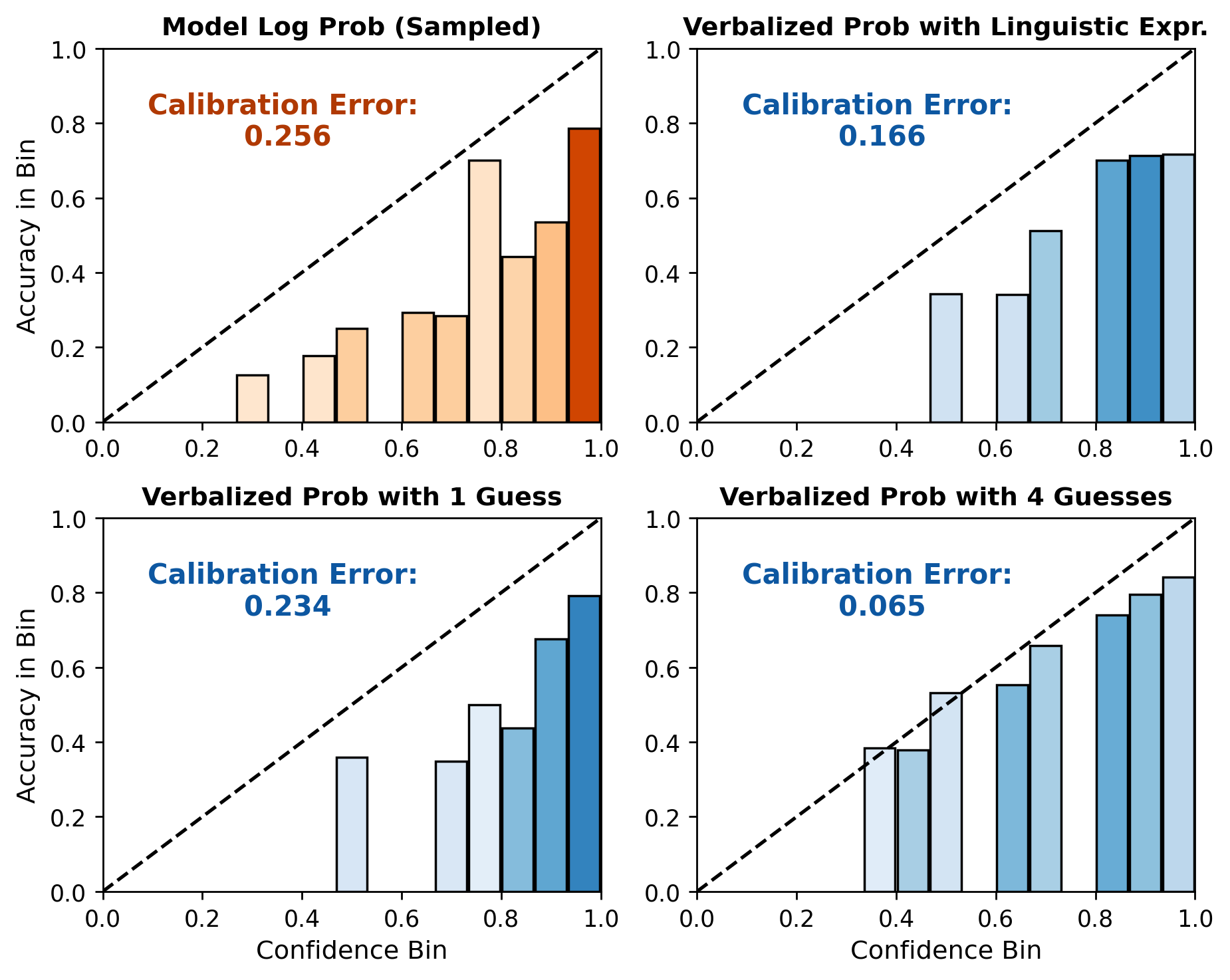
This paper proposes prompting fine-tuned language models to verbalize confidence scores—either as numerical probabilities or linguistic expressions of uncertainty—resulting in significantly better-calibrated predictions than their native log probabilities. For models like GPT-3.5-turbo, GPT-4, and Claude 2, verbalized confidences reduce expected calibration error by over 50%, especially when combined with multi-hypothesis prompting, offering a practical, zero-shot method to improve reliability in real-world deployment.
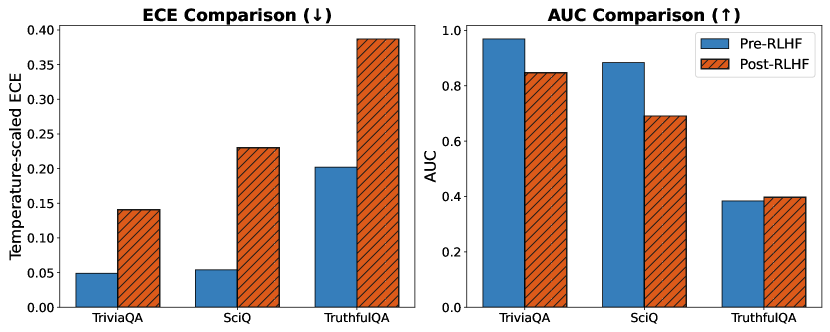
A trustworthy real-world prediction system should produce well-calibrated confidence scores; that is, its confidence in an answer should be indicative of the likelihood that the answer is correct, enabling deferral to an expert in cases of low-confidence predictions. Recent studies have shown that unsupervised pre-training produces large language models (LMs) whose conditional probabilities are remarkably well-calibrated. However, the most widely-used LMs are fine-tuned with reinforcement learning from human feedback (RLHF-LMs), and some studies have suggested that RLHF-LMs produce conditional probabilities that are very poorly calibrated. In light of this perceived weakness, we conduct a broad evaluation of methods for extracting confidence scores from RLHF-LMs. For RLHF-LMs such as ChatGPT, GPT-4, and Claude, we find that verbalized confidences emitted as output tokens are typically better-calibrated than the model's conditional probabilities on the TriviaQA, SciQ, and TruthfulQA benchmarks, often reducing the expected calibration error by a relative 50%.
Motivation & Objective
- To address the poor calibration of confidence scores in reinforcement learning from human feedback (RLHF)-fine-tuned language models, which often overestimate prediction certainty.
- To evaluate whether verbalized confidence scores—expressed as numbers or words—can yield better-calibrated outputs than model-estimated log probabilities.
- To investigate whether prompting strategies such as generating multiple answer choices improve the calibration of verbalized confidence.
- To determine if zero-shot prompting can achieve better calibration than model probabilities without additional fine-tuning.
- To assess the generalization of these findings across diverse models (e.g., GPT-3.5-turbo, GPT-4, Claude 2, Llama-2-70b-chat) and benchmarks (TriviaQA, SciQ, TruthfulQA).
Proposed method
- Prompting RLHF-fine-tuned LMs to output confidence scores in natural language, such as 'highly likely' or '70% confident', directly in token space.
- Using a zero-shot prompting strategy where models are prompted to generate multiple answer hypotheses before assigning a confidence score, inspired by psychological techniques to reduce overconfidence.
- Evaluating verbalized confidence using standard calibration metrics: expected calibration error (ECE), Brier score (BS), and area under the ROC curve (AUC).
- Applying temperature scaling to further improve calibration of verbalized probabilities, particularly for models like GPT-3.5-turbo and GPT-4.
- Using a held-out calibration set to optimize likelihood expressions (e.g., 'moderately likely' mapped to a probability) for improved calibration, referred to as 'Ling. 1S-opt'.
- Comparing verbalized confidence scores against model log probabilities, entropy, and other baselines across multiple benchmarks and models.
Experimental results
Research questions
- RQ1Can RLHF-fine-tuned language models like GPT-3.5-turbo, GPT-4, and Claude 2 produce better-calibrated confidence estimates by verbalizing their uncertainty rather than relying on internal log probabilities?
- RQ2Does prompting models to generate multiple answer choices before assigning a confidence score improve the calibration of their verbalized confidence?
- RQ3How does the calibration of verbalized numerical probabilities compare to verbalized linguistic expressions of uncertainty (e.g., 'likely', 'unlikely') across different models and datasets?
- RQ4To what extent does temperature scaling improve the calibration of verbalized confidence scores in RLHF-LMs?
- RQ5How does the verbalization capability of open-source models like Llama-2-70b-chat compare to closed-source models such as GPT-4 and Claude 2 in terms of confidence calibration?
Key findings
- For GPT-3.5-turbo, GPT-4, and Claude 2, verbalized confidence scores reduced expected calibration error (ECE) by over 50% compared to model log probabilities on the SciQ benchmark.
- Verbalized numerical probabilities were consistently better-calibrated than model log probabilities across all evaluated models and benchmarks, with the strongest improvement observed on the adversarial TruthfulQA dataset.
- Generating and evaluating multiple answer choices before assigning confidence significantly improved calibration, reducing ECE by up to 50% relative to single-hypothesis prompting.
- Temperature scaling further enhanced calibration of verbalized probabilities, particularly for GPT-3.5-turbo and GPT-4, though the effect varied across models.
- Claude 2 demonstrated stronger verbalization capabilities than Claude 1, and GPT-4 outperformed GPT-3.5-turbo in verbalized confidence calibration, though both were superior to their own log probabilities.
- Llama-2-70b-chat showed weaker verbalization performance than closed-source models but still improved calibration over its log probabilities, especially on TruthfulQA, suggesting potential for open-source model refinement.
Read this paper
Open the full text in the Nubint reader and ask about any passage as you read.
Read this paper on NubintThis review was generated by AI from the original paper. Please check the paper before citing it.