
[Paper Review] Justifiable Artificial Intelligence: Engineering Large Language Models for Legal Applications
This paper introduces Justifiable Artificial Intelligence (JAI) as an alternative to Explainable AI for legal applications of Large Language Models (LLMs). By grounding LLM outputs in verifiable evidence from trustworthy sources—both supporting and opposing claims—JAI enables legal professionals to assess and validate AI-generated reasoning, enhancing trust and accountability despite LLMs' inherent 'hallucinations' and opacity.
In this work, I discuss how Large Language Models can be applied in the legal domain, circumventing their current drawbacks. Despite their large success and acceptance, their lack of explainability hinders legal experts to trust in their output, and this happens rightfully so. However, in this paper, I argue in favor of a new view, Justifiable Artificial Intelligence, instead of focusing on Explainable Artificial Intelligence. I discuss in this paper how gaining evidence for and against a Large Language Model's output may make their generated texts more trustworthy - or hold them accountable for misinformation.
Motivation & Objective
- Address the lack of trust in LLMs within the legal domain due to their opacity and tendency to hallucinate.
- Propose a shift from Explainable AI (XAI) to Justifiable AI (JAI), focusing on evidence-based validation rather than model interpretability.
- Enable legal experts to evaluate LLM outputs by providing verifiable sources for and against generated claims.
- Mitigate risks of misinformation and bias in legal AI applications through systematic evidence citation.
- Position JAI as a practical framework for responsible deployment of LLMs in high-stakes legal contexts.
Proposed method
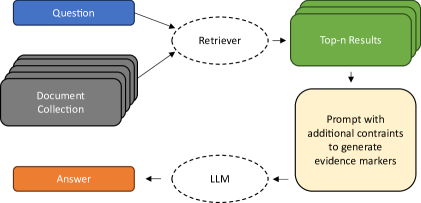
- Integrate information retrieval and entailment classification to identify relevant legal sources supporting or contradicting an LLM’s claim.
- Use retrieval-augmented generation (RAG) techniques to ground LLM outputs in cited, trustworthy legal documents.
- Apply fact-checking pipelines to validate the accuracy of LLM-generated statements using external evidence.
- Construct a dual-evidence framework: present both supporting and opposing sources to enable balanced evaluation.
- Leverage existing NLP techniques such as semantic similarity and natural language inference (NLI) to assess relevance and consistency of retrieved evidence.
- Design a system where LLMs are not only generators but also auditors, capable of citing and justifying their outputs with traceable sources.
Experimental results
Research questions
- RQ1How can LLMs in legal applications be made more trustworthy despite their lack of explainability?
- RQ2What alternative to Explainable AI (XAI) can ensure accountability and verifiability in legal LLM outputs?
- RQ3How can evidence from reliable legal sources be systematically retrieved and cited to justify LLM-generated claims?
- RQ4What are the technical and ethical challenges in implementing a justifiable AI framework for legal reasoning?
- RQ5Can a dual-evidence approach (supporting and opposing sources) improve user trust and decision-making in legal AI systems?
Key findings
- Justifiable Artificial Intelligence (JAI) offers a viable alternative to Explainable AI (XAI) by emphasizing verifiable evidence over model transparency.
- LLM-generated claims can be validated by retrieving and citing trustworthy legal sources that support or refute them.
- The framework enables legal professionals to assess the credibility of AI outputs by examining the evidence, reducing reliance on unverified assertions.
- Current LLMs suffer from hallucinations and lack of data provenance, which JAI helps mitigate through evidence citation.
- JAI does not require full model interpretability but instead ensures accountability through traceable, citable sources.
- The integration of fact-checking and information retrieval with LLMs can significantly improve the reliability of legal AI applications.
Read this paper
Open the full text in the Nubint reader and ask about any passage as you read.
Read this paper on NubintThis review was generated by AI from the original paper. Please check the paper before citing it.