
[Paper Review] JWST/MIRI reveals the true number density of massive galaxies in the early Universe
The study uses JWST/MIRI data from the PRIMER program to robustly recalibrate stellar masses of high-z galaxies, showing a reduced number density of massive systems at z>5 and revealing a redshift- and mass-dependent rise in baryon-to-star conversion efficiency within LCDM.
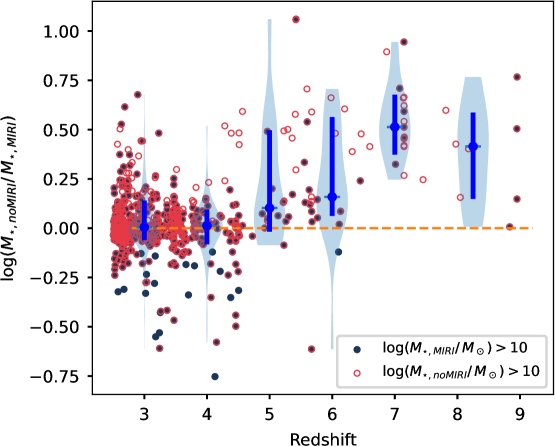
Early JWST studies reporting an unexpected abundance of massive galaxies at $z \sim 5$--$8$ challenge galaxy formation models in the $Λ$CDM framework. Previous stellar mass ($M_\star$) estimates suffered from large uncertainties due to the lack of rest-frame near-infrared data. Using deep JWST/NIRCam and MIRI photometry from PRIMER, we systematically analyze massive galaxies at $z \sim 3$--$8$, leveraging rest-frame $\gtrsim 1\,μ$m constraints. We find MIRI is critical for robust $M_\star$ measurements for massive galaxies at $z > 5$: excluding MIRI overestimates $M_\star$ by $\sim 0.4$ dex on average for $M_\star > 10^{10}\,M_\odot$ galaxies, with no significant effects at lower masses. This reduces number densities of $M_\star > 10^{10}\,M_\odot$ ($10^{10.3}\,M_\odot$) galaxies by $\sim 36\%$ ($55\%$). MIRI inclusion also reduces ``Little Red Dot'' (LRD) contamination in massive galaxy samples, lowering the LRD fraction from $\sim 32\%$ to $\sim 13\%$ at $M_\star > 10^{10.3}\,M_\odot$. Assuming pure stellar origins, LRDs exhibit $M_\star \sim 10^{9 ext{--}10.5}\,M_\odot$ with MIRI constraints, rarely exceeding $10^{10.5}\,M_\odot$. Within standard $Λ$CDM, our results indicate a moderate increase in the baryon-to-star conversion efficiency ($ε$) toward higher redshifts and masses at $z > 3$. For the most massive $z \sim 8$ galaxies, $ε\sim 0.3$, compared to $ε\lesssim 0.2$ for typical galaxies at $z < 3$. This result is consistent with models where high gas densities and short free-fall times suppress stellar feedback in massive high-$z$ halos.
Motivation & Objective
- Motivate the need to accurately measure stellar masses of massive high-redshift galaxies using rest-frame >1 µm photometry.
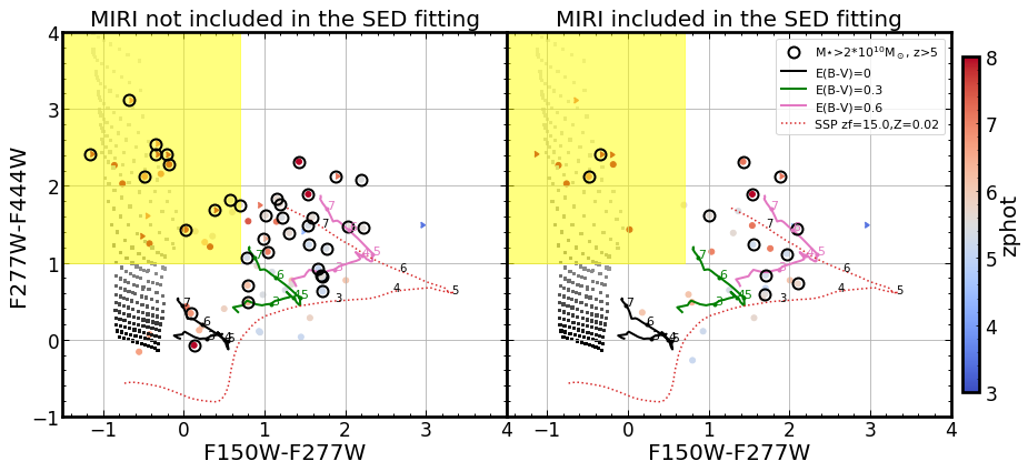
- Demonstrate how inclusion of JWST/MIRI data changes SED-fitting results and reduces overestimates of M* at z>4.
- Quantify the cumulative stellar mass density of massive galaxies (M*>10^9 Msun) from z~3–9 and compare with LCDM predictions.
- Infer the redshift- and mass-dependence of the baryon-to-star conversion efficiency (ε) and interpret in the context of feedback-free starburst models.
Proposed method
- Construct a large multiwavelength catalog using HST, JWST/NIRCam, and JWST/MIRI data from the PRIMER survey over CANDELS-COSMOS/UDS fields.
- Perform photometric redshift estimation with EAZY with and without MIRI photometry.
- Estimate stellar masses with BAGPIPES and FAST++ using different template sets and redshift inputs (with and without MIRI).
- Assess mass completeness and quantify Eddington bias by convolving a Schechter function with a Gaussian kernel and fitting to data.
- Compute the cumulative stellar mass density and compare to halo-based expectations to derive the implied ε(M*, z).
Experimental results
Research questions
- RQ1What is the true number density of massive galaxies (M* > 10^10 M⊙) at z ~ 3–9 when rest-frame >1 µm photometry is included?
- RQ2How does including MIRI photometry affect derived stellar masses and the inferred evolution of the stellar mass function at high redshift?
- RQ3What is the implied baryon-to-star conversion efficiency ε as a function of stellar mass and redshift under LCDM?
- RQ4Do the observed massive high-z galaxies align with models like feedback-free starbursts or require extreme efficiencies?
Key findings
- Including MIRI photometry significantly reduces the number and mass densities of massive galaxies at z>5 compared to fits without MIRI.
- For galaxies with M* > 10^10.3 M⊙ at z > 5, M* is substantially lower when MIRI is included, reducing overestimation due to age–attenuation degeneracy and emission-line contamination.
- The observed cumulative stellar mass density is consistent with LCDM predictions without extreme baryon conversion efficiency, while ε increases with both M* and z.
- At z~8, the needed ε is around 0.3 versus ~0.14 for typical low-z galaxies, suggesting a higher efficiency in the early universe.
- Results are consistent with feedback-free starburst (FFB) models where high gas densities and short free-fall times suppress stellar feedback.
- The study provides a framework where ε(z, M*) rises with redshift and mass, aligning with FFB predictions under ε_max ≈ 0.2.
Read this paper
Open the full text in the Nubint reader and ask about any passage as you read.
Read this paper on NubintThis review was generated by AI from the original paper. Please check the paper before citing it.