
[Paper Review] JWST UNCOVER: Discovery of $z>9$ Galaxy Candidates Behind the Lensing Cluster Abell 2744
This study presents the discovery of 19 high-redshift galaxy candidates at z > 9 in the JWST UNCOVER survey, using deep NIRCam and NIRISS imaging combined with dropout selection and photometric redshifts. The sample includes 16 candidates at 9 < z < 12 and 3 at 12 < z < 13, with eight deemed very robust; these galaxies exhibit low stellar masses (log(M⋆/M⊙) ≈ 6.8–9.5), young ages (10–100 Myr), low star formation rates (0.2–7 M⊙ yr⁻¹), and blue UV slopes (β ≈ −1.8 to −2.4), consistent with early galaxy formation models and indicating rapid evolution in the mass-luminosity relation and UV slope with redshift.
We present the results of a search for high-redshift ($z>9$) galaxy candidates in the JWST UNCOVER survey, using deep NIRCam and NIRISS imaging in 7 bands over $\sim45$ arcmin$^2$ and ancillary HST observations. The NIRCam observations reach a $5-σ$ limiting magnitude of $\sim 29.2$ AB. The identification of high$-z$ candidates relies on a combination of a dropout selection and photometric redshifts. We find 16 candidates at $99$. A few galaxies at $z\sim9-10$ appear to show a clear Balmer break between the F356W and F444W/F410M bands, which helps constrain their stellar mass. We estimate blue UV continuum slopes between $β=-1.8$ and $-2.3$, typical for early galaxies at $z>9$ but not as extreme as the bluest recently discovered sources. We also find evidence for a rapid redshift-evolution of the mass-luminosity relation and a redshift-evolution of the UV continuum slope for a given range of intrinsic magnitude, in line with theoretical predictions. These findings suggest that deeper JWST observations are needed to reach the fainter galaxy population at those early epochs, and follow-up spectroscopy will help better constrain the physical properties and star formation histories of a larger sample of galaxies.
Motivation & Objective
- To identify and characterize high-redshift galaxy candidates at z > 9 using deep near-infrared imaging from JWST's NIRCam and NIRISS instruments.
- To overcome the redshift-distance limit of Hubble by leveraging strong gravitational lensing in the Abell 2744 cluster to amplify faint, distant galaxies.
- To assess the physical properties of early galaxies, including stellar mass, star formation rate, age, and dust attenuation, using SED fitting with BEAGLE and photometric redshifts.
- To investigate the redshift evolution of the UV continuum slope (β) and mass-luminosity relation in the early universe, comparing results with theoretical models.
- To evaluate the robustness of high-redshift candidates by combining dropout selection with independent photometric redshift codes (Eazy and BEAGLE).
Proposed method
- Utilized deep multi-band imaging (7 bands) from JWST's NIRCam and NIRISS instruments, reaching a 5σ limiting magnitude of ∼29.2 AB in the observed frame.
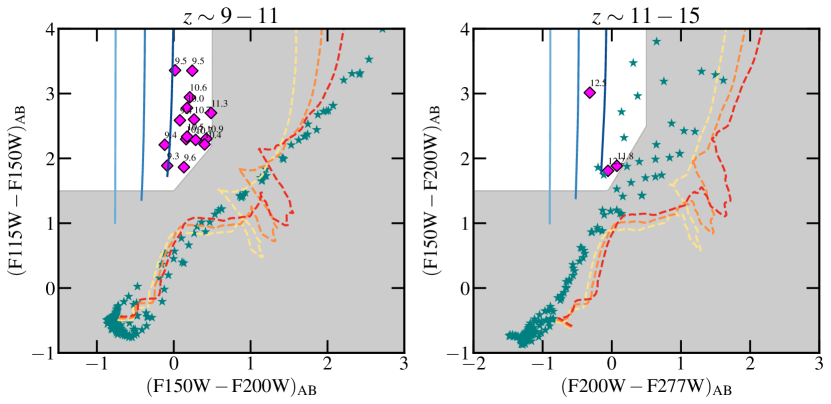
- Applied a dropout selection technique based on the absence of flux in shortward bands (e.g., F356W) relative to longer bands (e.g., F444W), characteristic of Lyman break galaxies at high redshift.
- Employed two independent photometric redshift codes—Eazy and BEAGLE—to estimate redshifts and assess uncertainties, ensuring robustness of candidate selection.
- Conducted SED fitting with BEAGLE, fixing redshifts and varying stellar mass, age, star formation rate (SFR), and dust attenuation (τV), to derive physical properties.
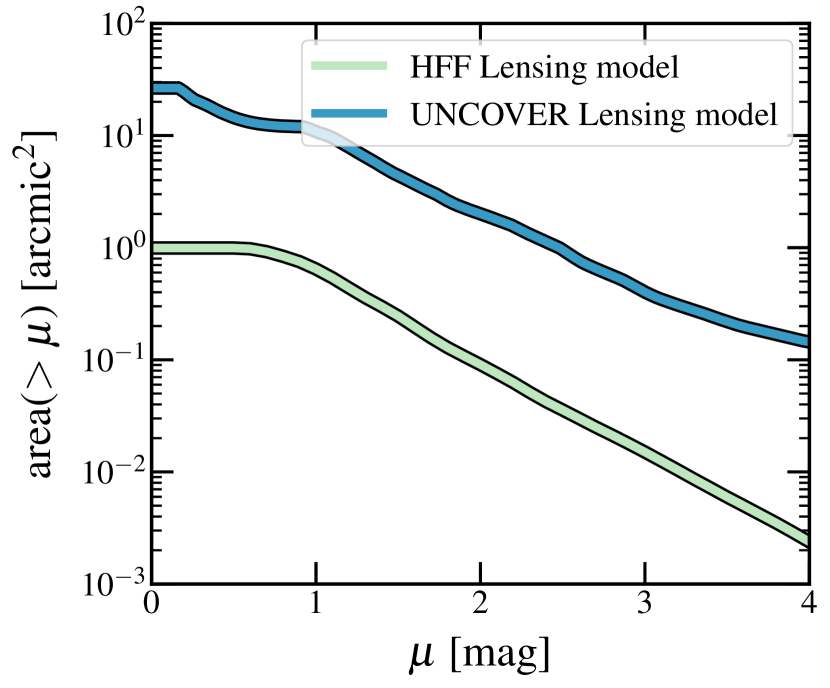
- Corrected observed magnitudes for gravitational lensing amplification (μ = 1.2 to 11.5) to estimate intrinsic luminosities and stellar masses.
- Compared observed UV continuum slopes (β) and mass-luminosity relations with theoretical predictions and lower-redshift empirical relations to assess evolution.
Experimental results
Research questions
- RQ1What is the number density and intrinsic luminosity distribution of galaxies at z > 9 in the early universe, as revealed by deep lensed imaging?
- RQ2How do the physical properties—such as stellar mass, star formation rate, age, and dust content—of z > 9 galaxies compare to theoretical expectations and lower-redshift observations?
- RQ3To what extent do the UV continuum slopes (β) and mass-luminosity relations evolve rapidly with redshift at z > 9, and how do they align with current models?
- RQ4How robust are the high-redshift galaxy candidates identified via dropout and photometric redshift techniques, especially in light of potential low-redshift interlopers?
- RQ5What is the role of strong gravitational lensing in enabling the detection of faint, low-mass galaxies at z > 10, and how does it affect the inferred galaxy population properties?
Key findings
- The study identifies 16 galaxy candidates at 9 < z < 12 and 3 at 12 < z < 13, with eight classified as very robust based on photometric and morphological criteria.
- Lensing-corrected UV magnitudes span a wide range from M_UV ≈ −22 to −17.6 mag, indicating a diverse population of luminosities.
- Stellar masses are low, with log(M⋆/M⊙) ranging from 6.8 to 9.5, consistent with dwarf or protogalactic systems.
- Galaxies have young ages between 10 and 100 Myr and low star formation rates of 0.2–7 M⊙ yr⁻¹, indicating ongoing but modest star formation.
- UV continuum slopes (β) range from −1.8 to −2.4, typical for early galaxies but not as extreme as the bluest sources found in other early JWST surveys.
- Evidence is found for rapid redshift evolution in both the mass-luminosity relation and the β–M_UV relation, consistent with theoretical predictions and earlier observational trends.
Read this paper
Open the full text in the Nubint reader and ask about any passage as you read.
Read this paper on NubintThis review was generated by AI from the original paper. Please check the paper before citing it.