
[Paper Review] Kilohertz Gravitational Waves From Binary Neutron Star Mergers: Numerical-relativity Informed Postmerger Model
This paper introduces NRPMw, an analytical gravitational-wave model for post-merger signals from binary neutron star mergers, calibrated using 618 numerical relativity simulations across diverse equations of state. By employing complex Gaussian wavelets and EOS-insensitive relations, NRPMw achieves fitting factors >0.9 on an independent validation set, enabling high-fidelity Bayesian inference for third-generation detectors like the Einstein Telescope.
We present ${ t NRPMw}$, an analytical model of gravitational-waves from neutron star merger remnants informed using 618 numerical relativity (NR) simulations. ${ t NRPMw}$ is designed in the frequency domain using a combination of complex Gaussian wavelets. The wavelet's parameters are calibrated to equations of state (EOS) insensitive relations from NR data. The NR simulations are computed with 21 EOS (7 of which are finite-temperature microphysical models, and 3 of which contain quark phase transitions or hyperonic degrees of freedom) and span total binary masses $M\in[2.4,3.4]~{ m M}_\odot$, mass ratios up to $q=2$, and (nonprecessing) dimensionless spins magnitudes up to ${0.2}$. The theoretical uncertainties of the EOS-insensitive relations are incorporated in ${ t NRPMw}$ using recalibration parameters that enhance the flexibility and accuracy of the model. ${ t NRPMw}$ is NR-faithful with fitting factors ${\gtrsim}0.9$ computed on an independent validation set of 102 simulations.
Motivation & Objective
- To develop a high-fidelity, analytical model for post-merger gravitational-wave signals from binary neutron star mergers to support Bayesian inference with third-generation detectors.
- To improve upon previous models by incorporating a broader range of equations of state, including finite-temperature and quark-hadron phase transition models.
- To calibrate wavelet parameters using EOS-insensitive relations derived from 618 numerical relativity simulations, enhancing model flexibility and accuracy.
- To incorporate theoretical uncertainties in the EOS-insensitive relations via recalibration parameters, improving robustness across diverse astrophysical scenarios.
- To validate the model’s fidelity using an independent set of 102 simulations, ensuring reliability for future gravitational-wave data analysis.
Proposed method
- The model uses complex Gaussian wavelets in the frequency domain to represent the post-merger gravitational-wave signal, enabling efficient and accurate spectral decomposition.
- Wavelet parameters are calibrated to EOS-insensitive relations derived from 618 numerical relativity simulations covering total masses M ∈ [2.4, 3.4] M⊙, mass ratios up to q = 2, and spin magnitudes up to 0.2.
- The calibration includes mass-scaled quantities such as Mf₂(R₁.₈/M), which improves universality and generalizability across binary systems.
- Theoretical uncertainties in the EOS-insensitive relations are encoded via recalibration parameters, increasing model flexibility and robustness.
- Fitting factors >0.9 are computed on an independent validation set of 102 simulations, confirming NR faithfulness.
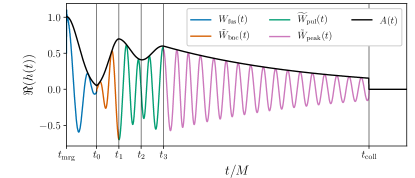
- The model is built upon an effective-one-body framework for the inspiral-merger phase, with NRPMw specifically modeling the post-merger emission.
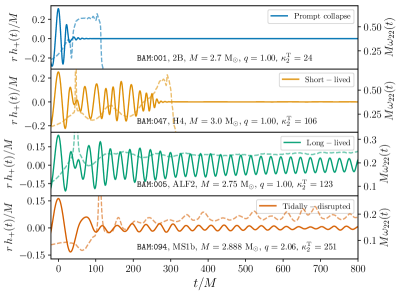
Experimental results
Research questions
- RQ1Can a wavelet-based analytical model accurately represent kilohertz post-merger gravitational-wave signals from binary neutron star mergers?
- RQ2How well do EOS-insensitive relations, such as f₂(R₁.₈/M), predict the post-merger peak frequency across diverse equations of state?
- RQ3What is the impact of including the R₁.₄/R₁.₈ ratio as an additional fitting parameter in the calibration of post-merger spectral features?
- RQ4To what extent does the inclusion of theoretical uncertainties in the EOS-insensitive relations improve model fidelity and robustness?
- RQ5Can the model achieve fitting factors >0.9 on an independent validation set, confirming its suitability for Bayesian gravitational-wave data analysis?
Key findings
- NRPMw achieves fitting factors >0.9 on an independent validation set of 102 numerical relativity simulations, confirming its NR faithfulness.
- The most robust and reliable quasiuniversal relation is Mf₂(R₁.₈/M), which correlates strongly with high-density equation of state properties.
- Calibration using mass-scaled quantities (e.g., Mf₂(R₁.₈/M)) improves the universality and trend consistency compared to non-scaled versions.
- The inclusion of R₁.₄/R₁.₈ as a fitting parameter slightly reduces χ² but is not favored by BIC or AIC, indicating limited statistical benefit.
- The model successfully incorporates theoretical uncertainties via recalibration parameters, enhancing flexibility without sacrificing accuracy.
- Simulations from the CoRe database show deviations that cannot be fully resolved by adding R₁.₄/R₁.₈, suggesting intrinsic limitations in current quasiuniversal relations.
Read this paper
Open the full text in the Nubint reader and ask about any passage as you read.
Read this paper on NubintThis review was generated by AI from the original paper. Please check the paper before citing it.