
[Paper Review] Kinematics of Antlia 2 and Crater 2 from The Southern Stellar Stream Spectroscopic Survey (S5)
This study presents new spectroscopic data from the S⁵ survey, revealing clear velocity gradients in Antlia 2 and a tentative gradient in Crater 2, consistent with tidal disruption. The kinematics, combined with Gaia EDR3 astrometry and reflex motion from the Large Magellanic Cloud, support a tidal origin for these ultra-diffuse dwarf spheroidals, though updated metallicity suggests minimal stellar mass loss—challenging current dynamical models.
We present new spectroscopic observations of the diffuse Milky Way satellite galaxies Antlia 2 and Crater 2, taken as part of the Southern Stellar Stream Spectroscopic Survey (S5). The new observations approximately double the number of confirmed member stars in each galaxy and more than double the spatial extent of spectroscopic observations in Antlia 2. A full kinematic analysis, including Gaia EDR3 proper motions, detects a clear velocity gradient in Antlia 2 and a tentative velocity gradient in Crater 2. The velocity gradient magnitudes and directions are consistent with particle stream simulations of tidal disruption. Furthermore, the orbit and kinematics of Antlia 2 require a model that includes the reflex motion of the Milky Way induced by the Large Magellanic Cloud. We also find that Antlia 2's metallicity was previously overestimated, so it lies on the empirical luminosity-metallicity relation and is likely only now experiencing substantial stellar mass loss. Current dynamical models of Antlia 2 require it to have lost over 90% of its stars to tides, in tension with the low stellar mass loss implied by the updated metallicity. Overall, the new kinematic measurements support a tidal disruption scenario for the origin of these large and extended dwarf spheroidal galaxies.
Motivation & Objective
- Investigate the kinematics of the ultra-diffuse Milky Way satellites Antlia 2 and Crater 2 to test tidal disruption as an origin for their large sizes and low densities.
- Address the tension between high tidal mass loss predicted by dynamical models and low stellar mass loss inferred from metallicity.
- Assess the role of the Large Magellanic Cloud’s reflex motion in shaping Antlia 2’s orbit and kinematics.
- Reconcile the observed velocity gradients with particle stream simulations of tidal disruption.
Proposed method
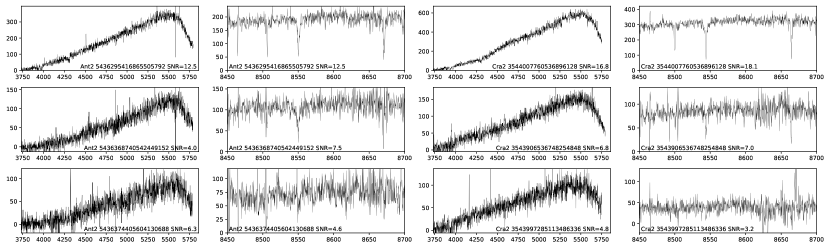
- Acquired new spectroscopic observations of member stars in Antlia 2 and Crater 2 using the Anglo-Australian Telescope (AAT) with AAOmega and 2dF.
- Combined spectroscopic data with Gaia EDR3 proper motions to perform a full kinematic analysis, including reflex correction for the Milky Way’s motion due to the LMC.
- Fitted velocity gradients to the line-of-sight velocities, aligning them with the major axis and proper motion to test tidal stream models.
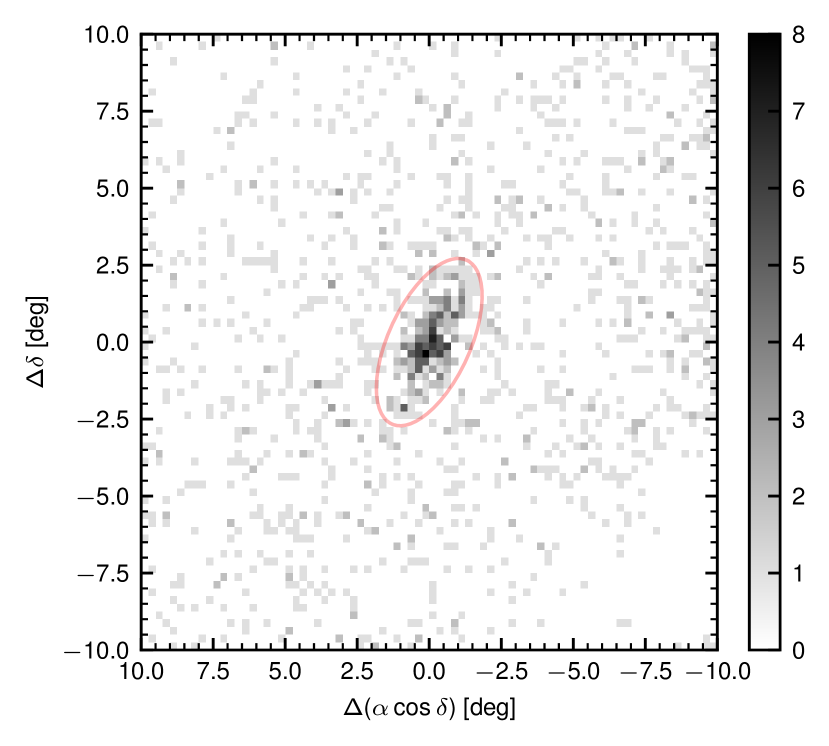
- Revised the luminosity and spatial parameters of Antlia 2 using updated Gaia EDR3 astrometry, increasing its estimated luminosity.
- Constructed metallicity distribution functions and compared them to empirical luminosity-metallicity relations to reassess stellar mass loss.
- Used particle stream simulations to test whether observed kinematic gradients match tidal disruption scenarios.
Experimental results
Research questions
- RQ1Do Antlia 2 and Crater 2 exhibit kinematic signatures consistent with tidal disruption, such as velocity gradients aligned with their major axes?
- RQ2Is the reflex motion of the Milky Way induced by the Large Magellanic Cloud necessary to reproduce Antlia 2’s observed orbit and kinematics?
- RQ3Does the updated metallicity of Antlia 2 place it on the empirical luminosity-metallicity relation, implying minimal stellar mass loss?
- RQ4Can current dynamical models reconcile the observed high tidal mass loss with the low stellar mass loss inferred from metallicity?
- RQ5Are the kinematic features of Antlia 2 and Crater 2 best explained by tidal disruption or alternative formation mechanisms?
Key findings
- A clear velocity gradient in Antlia 2, aligned with its major axis and proper motion, is detected, strongly supporting a tidal disruption origin.
- A tentative velocity gradient is found in Crater 2, also aligned with its proper motion, consistent with tidal effects.
- The spatial extent of spectroscopic observations in Antlia 2 has more than doubled, improving kinematic coverage.
- Antlia 2’s metallicity is revised downward by 0.2 dex, placing it on the empirical luminosity-metallicity relation and indicating minimal stellar mass loss.
- The orbit and kinematics of Antlia 2 require inclusion of the Milky Way’s reflex motion due to the Large Magellanic Cloud to match simulations.
- Current dynamical models predict over 90% stellar mass loss for Antlia 2, conflicting with the low mass loss implied by its updated metallicity.
Read this paper
Open the full text in the Nubint reader and ask about any passage as you read.
Read this paper on NubintThis review was generated by AI from the original paper. Please check the paper before citing it.