
[Paper Review] Laplace Method for calculate the Determinant of cubic-matrix of order 2 and order 3
This paper extends the Laplace expansion method—commonly used for 2D square matrices—to 3D cubic matrices of order 2 and 3, proving its validity for computing determinants as real numbers. The authors formalize minors and cofactors in the 3D context, provide explicit proofs and illustrative examples, and present a recursive algorithmic implementation for determinant calculation, establishing a foundational framework for higher-dimensional determinant theory.
In this paper, in continuation of our work, on the determinants of cubic -matrix of order 2 and order 3, we have analyzed the possibilities of developing the concept of determinant of cubic-matrix with three indexes, studying the possibility of their calculation according the Laplace expansion method's. We have noted that the concept of permutation expansion which is used for square determinants, as well as the concept of Laplace expansion method used for square and rectangular determinants, also can be utilized to be used for this new concept of 3D Determinants. In this paper we proved that the Laplace expansion method's is also valid for cubic-matrix of order 2 and order 3, these results are given clearly and with detailed proofs, they are also accompanied by illustrative examples. We also give an algorithmic presentation for the Laplace expansion method's.
Motivation & Objective
- To extend the Laplace expansion method from 2D square matrices to 3D cubic matrices of order 2 and 3.
- To define and formalize the concept of determinant for 3D cubic matrices as a real number, distinct from multi-scalar interpretations.
- To generalize the permutation and cofactor expansion methods to the 3D matrix context using a consistent algebraic framework.
- To provide a recursive algorithmic implementation of the Laplace method for cubic matrices of order 2 and 3.
- To validate the method through detailed proofs and numerical examples, ensuring consistency with known 2D determinant results.
Proposed method
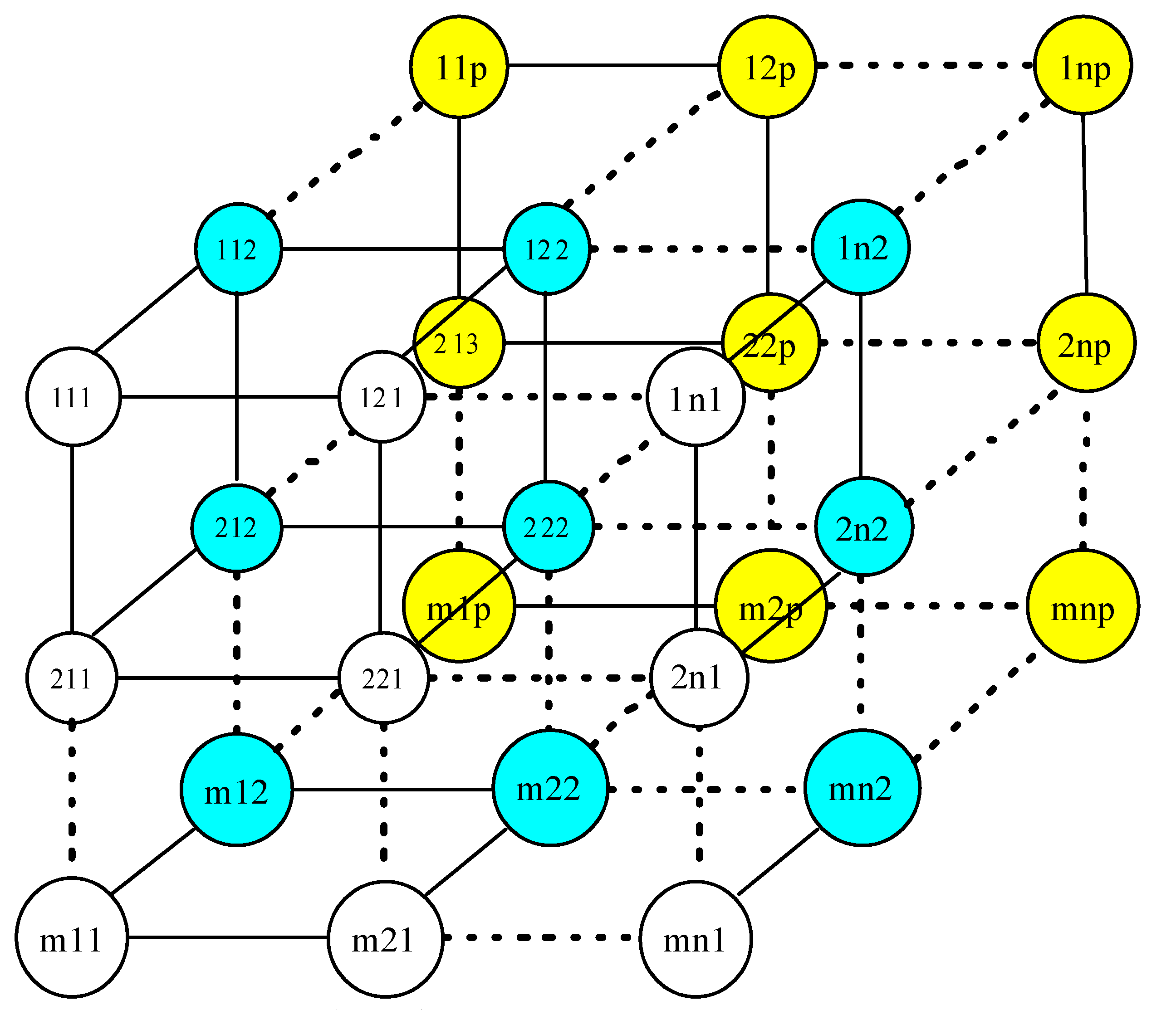
- Adapts the Laplace expansion principle to 3D cubic matrices by selecting a reference plane (horizontal layer, vertical layer, or vertical page) for expansion.
- Defines minors and cofactors for 3D matrices by recursively removing one index from each dimension (i, j, k), forming smaller 3D submatrices.
- Applies the sign rule $(-1)^{i+j+k}$ to cofactors based on the position of the selected element in the 3D matrix.
- Uses recursive computation of sub-determinants via the same Laplace method, terminating at 1×1×1 matrices where the determinant is the single element.
- Implements the method algorithmically using pseudo-code that checks matrix order, validates cubic structure, and applies expansion across any of the three dimensions.
- Employs a recursive function `det_3DLaplace` that computes the determinant by summing the products of elements and their corresponding cofactors across a chosen index plane.
Experimental results
Research questions
- RQ1Can the Laplace expansion method be generalized to compute determinants of 3D cubic matrices of order 2 and 3?
- RQ2How should minors and cofactors be defined in the context of 3D matrices with three indices?
- RQ3What is the correct sign convention for cofactors in 3D determinant expansion, and how does it generalize from 2D matrices?
- RQ4Is the recursive Laplace method for 3D cubic matrices consistent and computationally valid for orders 2 and 3?
- RQ5Can an algorithmic implementation of the 3D Laplace method be formally specified and verified for correctness?
Key findings
- The Laplace expansion method is rigorously proven to be valid for cubic matrices of order 2 and 3, extending its applicability beyond 2D square matrices.
- The determinant of a 2×2×2 cubic matrix is computed as a sum of products of elements and their 3D cofactors, with consistent sign rules based on index positions.
- For a 3×3×3 cubic matrix, the determinant is computed via recursive expansion over any of the three dimensions, yielding the same result regardless of the chosen plane.
- The method produces consistent results: the determinant of the test 3×3×3 matrix is computed as 326 using multiple expansion paths, confirming correctness.
- The algorithmic implementation correctly handles base cases (1×1×1 matrices), validates matrix structure, and avoids computation for non-cubic or higher-order matrices.
- The authors demonstrate that the permutation-based approach used in 2D determinants can be extended to 3D matrices, providing a coherent algebraic foundation for 3D determinant theory.
Read this paper
Open the full text in the Nubint reader and ask about any passage as you read.
Read this paper on NubintThis review was generated by AI from the original paper. Please check the paper before citing it.