
[Paper Review] Large language model validity via enhanced conformal prediction methods
This paper proposes enhanced conformal prediction methods to improve the validity and utility of large language model (LLM) outputs by introducing conditional conformal prediction with adaptive confidence levels and differentiable scoring function optimization. The approach ensures conditionally valid guarantees across diverse topics while retaining significantly more accurate claims than prior methods.
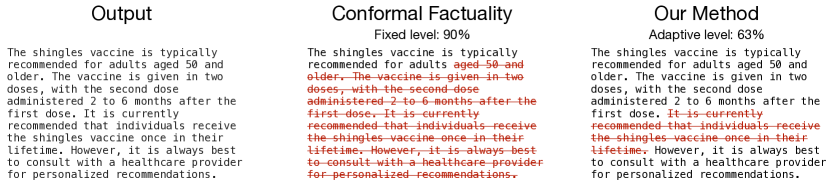
We develop new conformal inference methods for obtaining validity guarantees on the output of large language models (LLMs). Prior work in conformal language modeling identifies a subset of the text that satisfies a high-probability guarantee of correctness. These methods work by filtering claims from the LLM's original response if a scoring function evaluated on the claim fails to exceed a threshold calibrated via split conformal prediction. Existing methods in this area suffer from two deficiencies. First, the guarantee stated is not conditionally valid. The trustworthiness of the filtering step may vary based on the topic of the response. Second, because the scoring function is imperfect, the filtering step can remove many valuable and accurate claims. We address both of these challenges via two new conformal methods. First, we generalize the conditional conformal procedure of Gibbs et al. (2023) in order to adaptively issue weaker guarantees when they are required to preserve the utility of the output. Second, we show how to systematically improve the quality of the scoring function via a novel algorithm for differentiating through the conditional conformal procedure. We demonstrate the efficacy of our approach on biography and medical question-answering datasets.
Motivation & Objective
- To address the lack of conditional validity in existing conformal prediction methods for LLMs, which can lead to unreliable guarantees on low-resource or rare topics.
- To reduce the over-filtering of accurate claims caused by imperfect scoring functions in prior conformal factuality methods.
- To develop a method that adaptively selects confidence levels to preserve at least 70% of claims while maintaining high factual correctness guarantees.
- To introduce a differentiable framework for improving scoring functions through end-to-end optimization within the conformal prediction pipeline.
- To empirically validate the method on both synthetic and real-world datasets, including Wikipedia biographies and question-answering tasks.
Proposed method
- The paper generalizes conditional conformal prediction to allow adaptive confidence levels, where the level is selected per input to maximize claim retention while maintaining validity.
- It introduces a differentiable algorithm that optimizes the scoring function by backpropagating through the conformal prediction procedure, improving alignment between scores and factual correctness.
- The method uses a calibration set of prompt-response-claim-annotation tuples to train and calibrate the scoring function and conformal thresholds.
- For each input, the approach computes a confidence level that ensures the probability of including a false claim is bounded below a user-defined threshold, with the level chosen to maximize retained claims.
- The scoring function is refined using a differentiable loss that penalizes incorrect claims and encourages high scores for true claims, leveraging gradients from the conformal prediction process.
- The framework is instantiated using self-evaluation methods and retrieval-augmented generation (RAG) to estimate claim factuality without human annotations.
Experimental results
Research questions
- RQ1Can conformal prediction be adapted to provide conditionally valid guarantees that vary with input topic, rather than being marginally valid across all prompts?
- RQ2To what extent can differentiable optimization of the scoring function improve the utility of conformal filtering in LLMs?
- RQ3How does adaptive confidence level selection affect claim retention while preserving high factual correctness guarantees?
- RQ4Does the proposed method outperform marginal conformal prediction in terms of both coverage accuracy and claim retention across low- and high-popularity topics?
- RQ5Can the method maintain strong factual validity on rare or underrepresented topics where standard methods fail?
Key findings
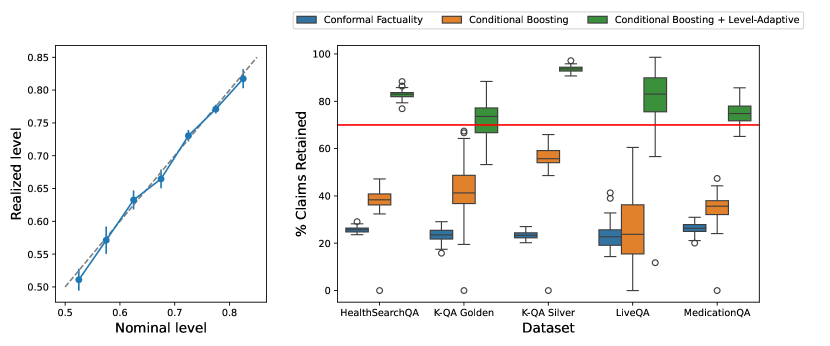
- The proposed level-adaptive method achieves a 63% confidence level on average, which is chosen to retain at least 70% of claims, significantly outperforming fixed-level methods that require higher thresholds and remove more content.
- On the Wikipedia biographies dataset, the method retained 80% of claims on average while maintaining less than 3 factual errors per biography, demonstrating high utility and validity.
- The conditional conformal method achieved stable coverage across all topic popularity bins, while the marginal method of Mohri and Hashimoto [19] showed variable coverage, especially for low-view-count articles.
- The boosted scoring function improved claim retention by 15–20% compared to unboosted scores at a fixed 10% significance level, with boxplots showing consistent gains across 100 calibration-test splits.
- The method maintained accurate coverage (within 2.5% of nominal level) across all view-count bins, confirming conditional validity, whereas the marginal method had coverage errors of up to 15% on rare topics.
- In the synthetic experiment, the method successfully calibrated to the target confidence level while preserving high claim utility, demonstrating robustness to distributional shifts.
Read this paper
Open the full text in the Nubint reader and ask about any passage as you read.
Read this paper on NubintThis review was generated by AI from the original paper. Please check the paper before citing it.