
[Paper Review] Laser-power consumption of soliton formation in a bidirectional Kerr resonator
The paper demonstrates a nanophotonic bidirectional Kerr resonator with a reflector that achieves near-unit laser-power conversion efficiency for soliton microcombs, reaching 65% CE and 97% pump consumption at 40 mW input. It combines coherent backscattering and on-chip reflection to gate energy flow and form stable solitons in normal-dispersion PhCRs.
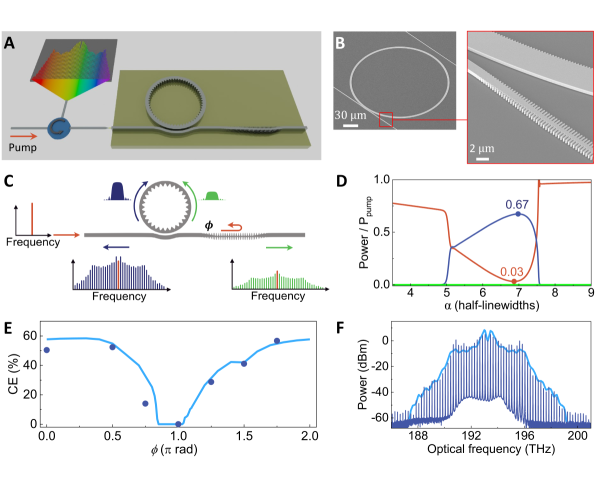
Laser sources power extreme data transmission as well as computing acceleration, access to ultrahigh-speed signaling, and sensing for chemicals, distance, and pattern recognition. The ever-growing scale of these applications drives innovation in multi-wavelength lasers for massively parallel processing. We report a nanophotonic Kerr-resonator circuit that consumes the power of an input laser and generates a soliton frequency comb at approaching unit efficiency. By coupling forward and backward propagation, we realize a bidirectional Kerr resonator that supports universal phase matching but also opens excess loss by double-sided emission. Therefore, we induce reflection of the resonator's forward, external-coupling port to favor backward propagation, resulting in efficient, one-sided soliton formation. Coherent backscattering with nanophotonics provides the control to put arbitrary phase-matching and efficient laser-power consumption on equal footing in Kerr resonators. In the overcoupled-resonator regime, we measure 65% conversion efficiency of a 40 mW input pump laser, and the nonlinear circuit consumes 97% of the pump, generating the maximum possible comb power. Our work opens up high-efficiency soliton formation in integrated photonics, exploring how energy flows in nonlinear circuits and enabling laser sources for advanced transmission, computing, quantum sensing, and artificial-intelligence applications.
Motivation & Objective
- Motivate high-density, energy-efficient soliton microcomb sources for integrated photonics.
- Show that coherent backscattering enables universal phase matching and enables control of energy flow in Kerr resonators.
- Demonstrate near-unit pump utilization by using a reflector to route forward pump power into backward-propagating solitons.
- Quantify how reflector phase and coupling (R and phi) affect conversion efficiency and threshold.
- Demonstrate compatibility with ITU-T grids and a chip-scale DFB laser for practical deployment.
Proposed method
- Model the forward and backward fields in a bidirectional Kerr resonator using the Lugiato-Lefever equation (LLE) with forward-backward coupling and a pump reflector.
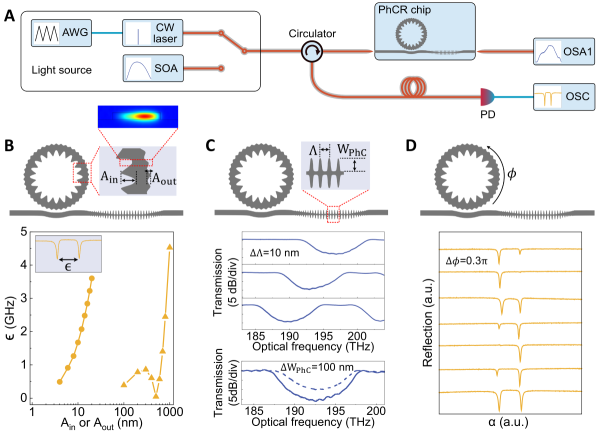
- Introduce a PhCR with split-mode coherence and a reflector on the coupling waveguide to control interference and energy flow.
- Define conversion efficiency CE = P_comb/P_pump and simulate power flow (P_f, P_b, P_comb^f, P_comb^b) as a function of detuning alpha and coupling K.
- Experimentally fabricate Ta2O5 PhCR devices with azimuthal width modulation and a reflector, and vary the reflection phase phi by rotating the PhCR.
- Characterize the split-mode parameters (epsilon), reflection bandwidth, and reflector reflectivity R to optimize CE and pump consumption.
- Compare measurements to LLE simulations to validate energy-flow control and soliton formation dynamics.
Experimental results
Research questions
- RQ1Can coherent backscattering in a bidirectional Kerr resonator enable universal phase matching for soliton microcombs in normal dispersion while enabling high energy efficiency?
- RQ2What reflector design (R) and phase (phi) settings maximize pump-to-comb conversion efficiency and minimize unused pump power?
- RQ3How do forward and backward pump components contribute to soliton formation and overall energy consumption?
- RQ4Can the system achieve soliton coherent states with high spectral flatness and compatibility with ITU-T grids and chip-scale DFB lasers?
- RQ5What practical device metrics (threshold, yield, and stability) arise when targeting high CE in chip-scale nanophotonic circuits?
Key findings
- A bidirectional Kerr resonator with a reflector achieves up to 65% conversion efficiency and 97% pump consumption for soliton generation at 40 mW pump power.
- Backward propagation is favored for soliton excitation, and coherent backscattering enables effective phase matching in normal dispersion PhCRs.
- Reflector-assisted control of energy flow reduces unwanted forward pumping and enables near-unit energy usage of the input laser.
- Experiments show 200 GHz soliton trains with 20 comb lines above 0.5 mW and mode-to-mode power variation within 10 dB, aligned to ITU-T grids with <2.6 GHz mismatch across 27 modes.
- Simulation and experiment agree closely on CE dependence on the phase phi, with optimal phi yielding high CE and low unused pump power.
- Threshold power is reduced by ~2.9x with the reflector compared to a PhCR without a reflector under similar coupling, due to bidirectional pump distribution and energy routing.
- Device fabrication yields show CE around 50% with ~40 mW pump for 11 devices on a chip, illustrating variation but overall robustness and compatibility with chip-scale lasers.
Read this paper
Open the full text in the Nubint reader and ask about any passage as you read.
Read this paper on NubintThis review was generated by AI from the original paper. Please check the paper before citing it.