
[Paper Review] latrend: A Framework for Clustering Longitudinal Data
The paper introduces latrend, an R package that provides a unified framework for clustering longitudinal data, enabling seamless comparison of multiple methods with minimal coding. It integrates 18 established clustering methods from packages like dtwclust, flexmix, lcmm, and mclust, allowing researchers to standardize, evaluate, and extend longitudinal cluster analysis efficiently.
Clustering of longitudinal data is used to explore common trends among subjects over time for a numeric measurement of interest. Various R packages have been introduced throughout the years for identifying clusters of longitudinal patterns, summarizing the variability in trajectories between subject in terms of one or more trends. We introduce the R package "latrend" as a framework for the unified application of methods for longitudinal clustering, enabling comparisons between methods with minimal coding. The package also serves as an interface to commonly used packages for clustering longitudinal data, including "dtwclust", "flexmix", "kml", "lcmm", "mclust", "mixAK", and "mixtools". This enables researchers to easily compare different approaches, implementations, and method specifications. Furthermore, researchers can build upon the standard tools provided by the framework to quickly implement new cluster methods, enabling rapid prototyping. We demonstrate the functionality and application of the latrend package on a synthetic dataset based on the therapy adherence patterns of patients with sleep apnea.
Motivation & Objective
- To address the challenge of selecting among numerous, heterogeneous R packages for longitudinal clustering, which requires significant effort to compare and evaluate.
- To reduce the coding burden for researchers by providing a standardized interface to multiple longitudinal clustering methods.
- To enable transparent, reproducible, and systematic comparison of clustering results across different algorithms and implementations.
- To support extensibility so users can implement new clustering methods or integrate additional packages with minimal effort.
- To facilitate exploratory data analysis in longitudinal studies by streamlining model specification, estimation, selection, and evaluation.
Proposed method
- The latrend framework provides a consistent API to interface with 18 existing R packages that implement longitudinal clustering methods, including dtwclust, flexmix, kml, lcmm, mclust, mixAK, and mixtools.
- It standardizes model specification, estimation, and evaluation across diverse methods, supporting both distance-based and model-based clustering approaches.
- The framework enables automatic comparison of clustering solutions using multiple internal validation metrics (e.g., adjusted Rand index, AIC, BIC) via integration with clusterCrit and mclustcomp packages.
- It supports parallel computation for computationally intensive methods like GBTM and GMM using the foreach package.
- The package is designed with extensibility in mind, allowing users to implement new clustering methods by conforming to a standardized interface.
- It handles longitudinal data with a single continuous response variable, organizing data into subject-level trajectories for analysis.
Experimental results
Research questions
- RQ1How can researchers efficiently compare multiple longitudinal clustering methods without writing extensive, method-specific code?
- RQ2What are the practical differences in clustering results when applying various established methods (e.g., GBTM, GMM, k-means with DTW) to the same longitudinal dataset?
- RQ3To what extent does the latrend framework reduce the effort required to prototype and evaluate longitudinal cluster models?
- RQ4How can a unified framework improve reproducibility and transparency in longitudinal cluster analysis across different research domains?
- RQ5What are the limitations of a standardized framework when dealing with complex model specifications such as priors or initialization strategies?
Key findings
- The latrend package successfully integrates 18 longitudinal clustering methods from existing R packages into a single, consistent interface, significantly reducing coding overhead.
- Researchers can compare clustering results across methods using standardized metrics such as AIC, BIC, and adjusted Rand index, enabling data-driven method selection.
- The framework supports parallelized estimation for computationally intensive methods like GBTM and GMM, improving scalability for large datasets.
- The package enables rapid prototyping of longitudinal cluster models, with the ability to easily extend the framework with new methods or package integrations.
- The framework is extensible in design and supports future enhancements, including multitrajectory modeling and categorical outcomes, though these are not yet implemented.
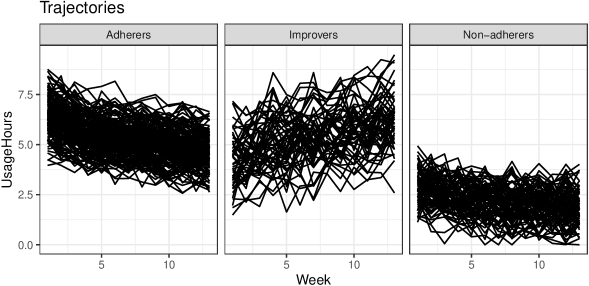
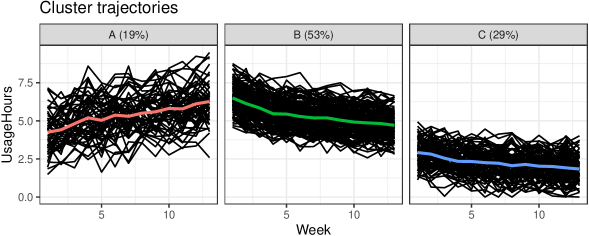
- The authors demonstrate the framework’s utility on a synthetic dataset modeling sleep apnea therapy adherence, showing its practical applicability in real-world research contexts.
Read this paper
Open the full text in the Nubint reader and ask about any passage as you read.
Read this paper on NubintThis review was generated by AI from the original paper. Please check the paper before citing it.