
[Paper Review] LDNet: Unified Listener Dependent Modeling in MOS Prediction for Synthetic Speech
LDNet proposes a unified listener-dependent (LD) modeling framework for mean opinion score (MOS) prediction in synthetic speech, directly predicting listener-specific quality scores using speech and listener identity. It introduces two inference methods—'all listeners' and 'mean listener'—with the latter showing superior stability and efficiency, especially when multiple ratings per sample are available, outperforming prior baselines like MBNet in both utterance- and system-level metrics on VCC2018 and a new large-scale dataset.
An effective approach to automatically predict the subjective rating for synthetic speech is to train on a listening test dataset with human-annotated scores. Although each speech sample in the dataset is rated by several listeners, most previous works only used the mean score as the training target. In this work, we present LDNet, a unified framework for mean opinion score (MOS) prediction that predicts the listener-wise perceived quality given the input speech and the listener identity. We reflect recent advances in LD modeling, including design choices of the model architecture, and propose two inference methods that provide more stable results and efficient computation. We conduct systematic experiments on the voice conversion challenge (VCC) 2018 benchmark and a newly collected large-scale MOS dataset, providing an in-depth analysis of the proposed framework. Results show that the mean listener inference method is a better way to utilize the mean scores, whose effectiveness is more obvious when having more ratings per sample.
Motivation & Objective
- To address data scarcity in deep learning-based MOS prediction by leveraging all available listener ratings instead of just mean scores.
- To unify listener-dependent modeling in MOS prediction through an end-to-end framework that jointly models speech and listener identity.
- To improve prediction stability and inference efficiency by introducing two novel inference strategies: 'all listeners' and 'mean listener' modes.
- To empirically validate the effectiveness of listener-dependent modeling, particularly under varying numbers of ratings per speech sample.
- To provide a flexible, lightweight architecture that outperforms existing methods like MBNet on benchmark datasets.
Proposed method
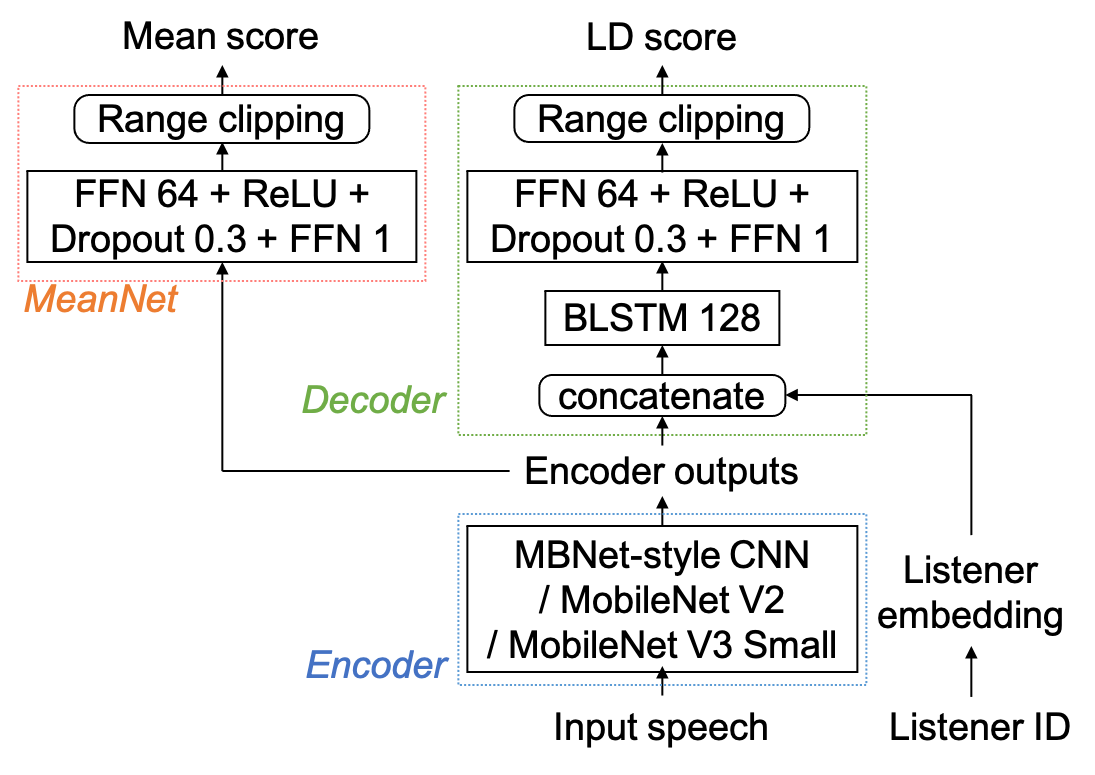
- LDNet is a unified deep learning framework that predicts listener-wise MOS scores by conditioning on both the input speech waveform and the listener ID.
- The model uses a lightweight encoder (e.g., MobileNetV3) and a simple feedforward network (FFN) decoder to reduce model size and training time.
- It supports two inference modes: 'all listeners' inference averages predictions across all training listeners for improved stability, and 'mean listener' inference uses a learned virtual listener for fast, efficient prediction.
- The 'mean listener' mode is trained to approximate the arithmetic mean of ratings, enabling direct use of mean scores without discarding bias components.
- The framework is trained using a combined loss that minimizes mean squared error (MSE) between predicted and actual listener scores.
- Model architecture is optimized for efficiency, with ablation studies showing that a strong encoder enables a minimal yet effective decoder.

Experimental results
Research questions
- RQ1Can a unified listener-dependent framework improve MOS prediction performance compared to mean-score-only baselines like MOSNet and MBNet?
- RQ2Does the 'all listeners' inference mode reduce prediction variance and improve robustness compared to mean net inference?
- RQ3Is the 'mean listener' inference mode more effective and efficient than traditional mean net inference, especially when multiple ratings per sample are available?
- RQ4How does the choice of encoder architecture (e.g., MobileNetV2 vs. MobileNetV3) affect model performance and training efficiency?
- RQ5Can listener-dependent modeling with a learned virtual mean listener (LDNet-ML) better utilize mean scores than multitask learning with a separate mean subnet (LDNet-MN)?
Key findings
- The 'all listeners' inference mode significantly reduces both utterance-level and system-level MSE compared to mean net inference, demonstrating improved prediction stability.
- On the VCC2018 benchmark, LDNet with 'mean listener' inference achieved a system-level SRCC of 0.881 and MSE of 0.157, outperforming the MBNet baseline.
- On the newly collected BVCC dataset, LDNet-ML with 'mean listener' inference achieved a system-level SRCC of 0.886 and MSE of 0.169, showing consistent improvements.
- The MobileNetV3 encoder reduced model size by 0.25M parameters and decreased training time by 33% compared to MobileNetV2, while maintaining or improving performance.
- The 'mean listener' inference mode was more effective than 'mean net' or 'mean bias' multitask learning (LDNet-MN), which showed performance degradation instead of improvement.
- The advantage of LDNet-ML was more pronounced on BVCC (8 ratings per sample) than on VCC2018 (4 ratings per sample), confirming that more ratings enhance the reliability of mean score utilization.
Read this paper
Open the full text in the Nubint reader and ask about any passage as you read.
Read this paper on NubintThis review was generated by AI from the original paper. Please check the paper before citing it.