
[Paper Review] Learning-Driven Lossy Image Compression; A Comprehensive Survey
This comprehensive survey reviews learning-driven lossy image compression techniques using deep learning architectures such as autoencoders, CNNs, GANs, and RNNs, focusing on end-to-end frameworks for still image compression. It identifies key challenges like striped region distortion, GPU memory overflow, aliasing, and lack of CPU/GPU compatibility, while highlighting recent advances and open research gaps in the field.
In the realm of image processing and computer vision (CV), machine learning (ML) architectures are widely applied. Convolutional neural networks (CNNs) solve a wide range of image processing issues and can solve image compression problem. Compression of images is necessary due to bandwidth and memory constraints. Helpful, redundant, and irrelevant information are three different forms of information found in images. This paper aims to survey recent techniques utilizing mostly lossy image compression using ML architectures including different auto-encoders (AEs) such as convolutional auto-encoders (CAEs), variational auto-encoders (VAEs), and AEs with hyper-prior models, recurrent neural networks (RNNs), CNNs, generative adversarial networks (GANs), principal component analysis (PCA) and fuzzy means clustering. We divide all of the algorithms into several groups based on architecture. We cover still image compression in this survey. Various discoveries for the researchers are emphasized and possible future directions for researchers. The open research problems such as out of memory (OOM), striped region distortion (SRD), aliasing, and compatibility of the frameworks with central processing unit (CPU) and graphics processing unit (GPU) simultaneously are explained. The majority of the publications in the compression domain surveyed are from the previous five years and use a variety of approaches.
Motivation & Objective
- To provide a comprehensive review of recent machine learning-based still image compression techniques, particularly those using end-to-end deep neural networks.
- To identify and analyze open research problems in learning-driven lossy image compression, including SRD, OOM, aliasing, and CPU/GPU compatibility.
- To evaluate the performance of various deep learning models—such as CAEs, VAEs, GANs, and RNNs—against conventional standards like JPEG and JPEG-2000.
- To guide future research by highlighting limitations in current frameworks and proposing directions for improvement in compression efficiency and visual quality.
Proposed method
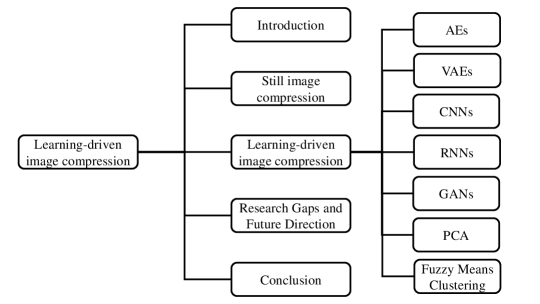
- Categorizes image compression methods based on deep learning architectures, including autoencoders (CAEs, VAEs), CNNs, RNNs, GANs, PCA, and fuzzy clustering.
- Analyzes end-to-end compression frameworks that integrate learned entropy models and hyper-priors for improved rate-distortion performance.
- Reviews the use of attention mechanisms and non-local operations in enhancing global feature modeling for better reconstruction quality.
- Examines the integration of generalized divisive normalization (GDN) and inverse GDN layers in hyper-prior models for entropy coding.
- Evaluates block-based and autoregressive entropy models, highlighting limitations in parallelization and computational efficiency.
- Compares model performance across different hardware platforms (CPU vs. GPU), identifying inconsistencies in inference when training and inference environments differ.
Experimental results
Research questions
- RQ1Which end-to-end learned image compression framework achieves the best compression efficiency in terms of rate-distortion trade-off?
- RQ2Which learned compression models produce superior visual quality in reconstructed images, especially in preserving fine textures and edges?
- RQ3What frameworks minimize GPU memory usage and support efficient inference on both CPU and GPU platforms?
- RQ4Which architectures enable faster response times and support real-time compression for high-resolution images?
- RQ5How can persistent issues like striped region distortion, aliasing, and out-of-memory errors be mitigated in deep learning-based compression?
Key findings
- Deep learning-based compression models, particularly those using CNNs and autoencoders, outperform traditional standards like JPEG-2000 in rate-distortion performance.
- Variational autoencoders (VAEs) and hyper-prior models improve entropy coding efficiency but often suffer from higher computational costs and memory usage.
- Stripped region distortion (SRD) is a significant and currently unresolved issue in reconstructed images from deep learning models, with no existing solution in the literature.
- Out-of-memory (OOM) problems frequently occur during full-resolution inference due to limited GPU memory, especially for high-resolution images.
- Aliasing effects—manifesting as directional pattern distortions—are prevalent in CNN- and CAE-based models, particularly at low bitrates.
- Current frameworks lack portability between CPU and GPU, leading to reconstruction failure when training and inference are performed on different hardware platforms.
Read this paper
Open the full text in the Nubint reader and ask about any passage as you read.
Read this paper on NubintThis review was generated by AI from the original paper. Please check the paper before citing it.