
[Paper Review] Learning gain differences between ChatGPT and human tutor generated algebra hints
The study compares learning gains from ChatGPT-generated algebra hints to human tutor hints, finding that human hints yield higher gains and that about 30% of ChatGPT hints were rejected for quality.
Large Language Models (LLMs), such as ChatGPT, are quickly advancing AI to the frontiers of practical consumer use and leading industries to re-evaluate how they allocate resources for content production. Authoring of open educational resources and hint content within adaptive tutoring systems is labor intensive. Should LLMs like ChatGPT produce educational content on par with human-authored content, the implications would be significant for further scaling of computer tutoring system approaches. In this paper, we conduct the first learning gain evaluation of ChatGPT by comparing the efficacy of its hints with hints authored by human tutors with 77 participants across two algebra topic areas, Elementary Algebra and Intermediate Algebra. We find that 70% of hints produced by ChatGPT passed our manual quality checks and that both human and ChatGPT conditions produced positive learning gains. However, gains were only statistically significant for human tutor created hints. Learning gains from human-created hints were substantially and statistically significantly higher than ChatGPT hints in both topic areas, though ChatGPT participants in the Intermediate Algebra experiment were near ceiling and not even with the control at pre-test. We discuss the limitations of our study and suggest several future directions for the field. Problem and hint content used in the experiment is provided for replicability.
Motivation & Objective
- Assess whether ChatGPT-generated hints can match human tutor hints in promoting learning gains in algebra.
- Evaluate the quality and reliability of ChatGPT-generated hints for algebra problems.
- Provide replicable content and methods for future work in LLM-based tutoring hints.
Proposed method
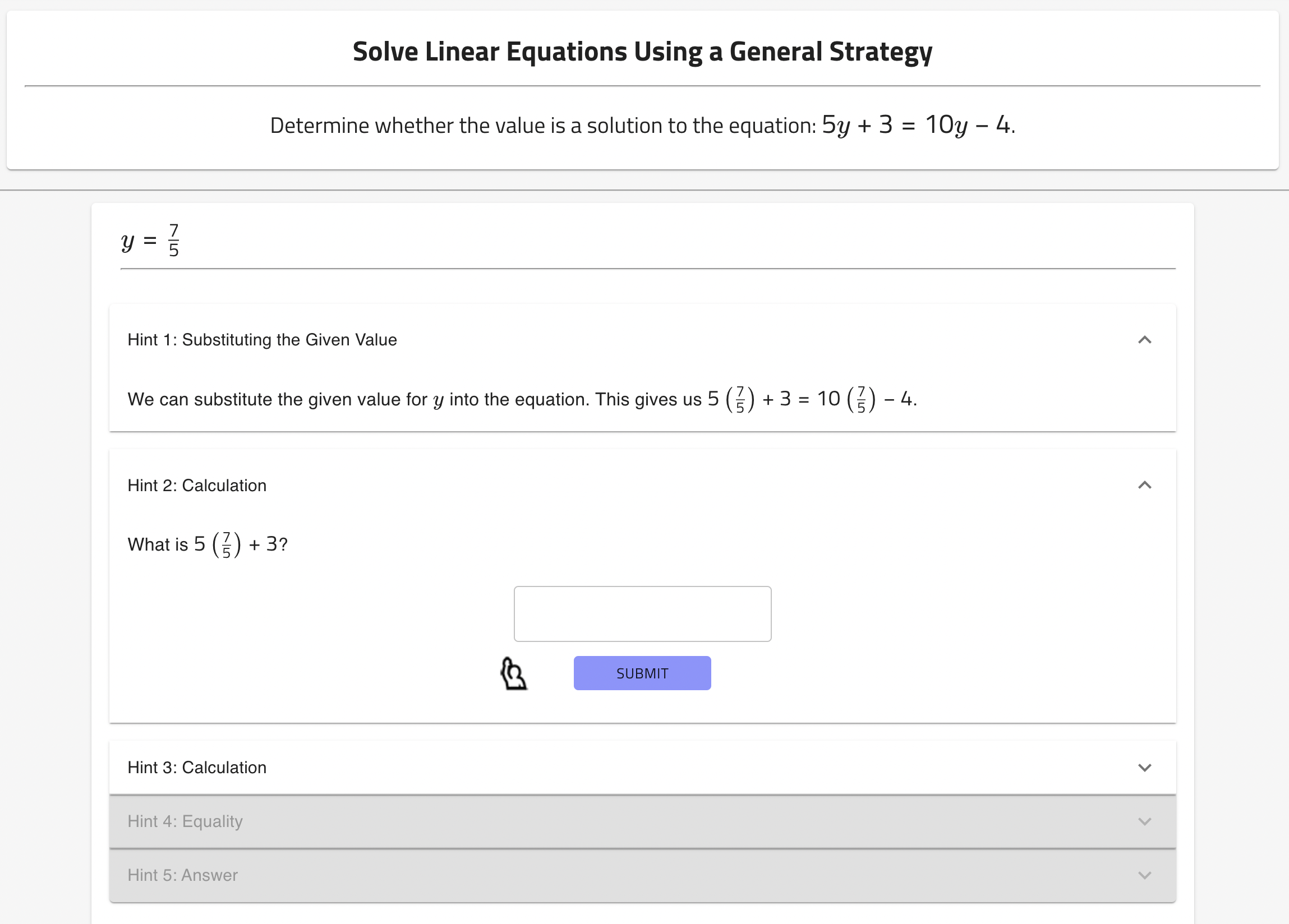
- Two-alternative, 2x2 experimental design with Elementary and Intermediate Algebra lessons.
- ChatGPT-generated hints generated via December 15, 2022 model using problem prompts from OATutor content.
- Manual human tutor hints as a control condition using OpenStax-derived content.
- Three-item pre-test, five-item acquisition phase, and three-item post-test (same items pre/post) per participant.
- Quality checks: correct answer, correct work steps, and no inappropriate language; disqualified if any check fails.

Experimental results
Research questions
- RQ1RQ1: How often does ChatGPT produce low-quality hints?
- RQ2RQ2: Do ChatGPT hints produce learning gains?
- RQ3RQ3: How do ChatGPT hints compare to human tutor hints in learning gain?
Key findings
- All conditions produced learning gains, but statistical significance was achieved only for the manual hints condition.
- Manual hints yielded higher learning gains than ChatGPT hints in both Elementary and Intermediate Algebra.
- In Intermediate Algebra, ChatGPT participants started near ceiling at pre-test (≈80%) and were not significantly different from post-test gains; control group remained significantly different from pre-test in both subjects.
- ChatGPT hints had a 30% rejection rate due to quality issues (wrong answer or incorrect steps).
- Time spent was similar across conditions, but ChatGPT required fewer hints due to limited, quality-filtered responses.
Read this paper
Open the full text in the Nubint reader and ask about any passage as you read.
Read this paper on NubintThis review was generated by AI from the original paper. Please check the paper before citing it.