
[Paper Review] Learning Invariant Molecular Representation in Latent Discrete Space
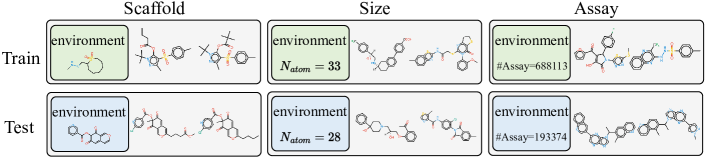
This paper proposes iMoLD, a novel framework for learning invariant molecular representations by first encoding molecules via a GNN and then separating invariant features in a discrete latent space using a residual vector quantization (RVQ) module. The method employs a task-agnostic self-supervised objective to identify causal, distribution-shift-robust features, achieving state-of-the-art OOD generalization across 18 molecular datasets, especially under covariate and concept shift scenarios.
Molecular representation learning lays the foundation for drug discovery. However, existing methods suffer from poor out-of-distribution (OOD) generalization, particularly when data for training and testing originate from different environments. To address this issue, we propose a new framework for learning molecular representations that exhibit invariance and robustness against distribution shifts. Specifically, we propose a strategy called ``first-encoding-then-separation'' to identify invariant molecule features in the latent space, which deviates from conventional practices. Prior to the separation step, we introduce a residual vector quantization module that mitigates the over-fitting to training data distributions while preserving the expressivity of encoders. Furthermore, we design a task-agnostic self-supervised learning objective to encourage precise invariance identification, which enables our method widely applicable to a variety of tasks, such as regression and multi-label classification. Extensive experiments on 18 real-world molecular datasets demonstrate that our model achieves stronger generalization against state-of-the-art baselines in the presence of various distribution shifts. Our code is available at https://github.com/HICAI-ZJU/iMoLD.
Motivation & Objective
- To address poor out-of-distribution (OOD) generalization in molecular representation learning, especially under distribution shifts from different data sources.
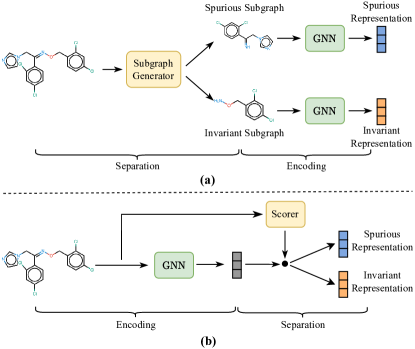
- To overcome limitations of existing 'first-separate-then-encode' methods that struggle with entangled molecular structures and require environmental assumptions.
- To develop a task-agnostic, robust framework applicable to diverse molecular tasks such as regression and multi-label classification.
- To improve generalization by identifying invariant, causal molecular features that remain stable across distribution shifts.
- To design a self-supervised objective that enables precise invariance identification without task-specific supervision.
Proposed method
- Proposes a 'first-encoding-then-separation' strategy: a GNN first encodes the full molecular graph into a latent representation before feature separation.
- Introduces a residual vector quantization (RVQ) module to discretize the latent space, reducing overfitting while preserving encoder expressivity.
- Employs a scorer GNN to identify and extract invariant substructures from the discrete latent representation.
- Designs a task-agnostic self-supervised learning objective to encourage identification of features invariant across environments.
- Uses a commitment loss to align the encoder output with the learned codebook, ensuring stable training.
- Applies the framework to diverse downstream tasks including regression and multi-label classification without architectural changes.
Experimental results
Research questions
- RQ1Can a 'first-encoding-then-separation' strategy outperform conventional 'first-separation-then-encoding' approaches in capturing invariant molecular features?
- RQ2How effective is residual vector quantization (RVQ) in improving OOD generalization without sacrificing representation capacity?
- RQ3To what extent does the proposed task-agnostic self-supervised objective enhance invariance identification across diverse molecular tasks?
- RQ4How does the model perform under various distribution shifts, including covariate and concept shifts?
- RQ5What is the contribution of each component (e.g., RVQ, invariant objective) to the final OOD generalization performance?
Key findings
- The proposed iMoLD framework achieves state-of-the-art performance on 18 real-world molecular datasets under multiple distribution shift scenarios, including covariate and concept shifts.
- On the GOOD-HIV-Scaffold dataset, removing the VQ module leads to significant performance degradation, demonstrating its critical role in OOD generalization.
- On the more complex GOOD-PCBA dataset, removing the residual connection causes a pronounced performance drop, indicating its importance in maintaining model capacity.
- The ablation study confirms that both the invariant learning objective $\mathcal{L}_{\textrm{inv}}$ and commitment loss $\mathcal{L}_{\textrm{cmt}}$ are indispensable for robust performance.
- t-SNE visualization shows that iMoLD produces more uniform feature distributions with smaller inter-environment distances (Wasserstein distance), confirming better invariance.
- iMoLD achieves higher validation scores with higher training scores, indicating reduced overfitting and stronger generalization compared to ERM baselines.
Read this paper
Open the full text in the Nubint reader and ask about any passage as you read.
Read this paper on NubintThis review was generated by AI from the original paper. Please check the paper before citing it.