
[Paper Review] Learning policies for resource allocation in business processes
This paper proposes two learning-based methods for optimizing resource allocation in business processes: Deep Reinforcement Learning (DRL) and a score-based value function approximation (SVFA). The DRL method learns adaptive policies through environment interaction, outperforming benchmarks by 13.1% on average in composite processes, while SVFA leverages curated features with learned weights to rank assignments.
Efficient allocation of resources to activities is pivotal in executing business processes but remains challenging. While resource allocation methodologies are well-established in domains like manufacturing, their application within business process management remains limited. Existing methods often do not scale well to large processes with numerous activities or optimize across multiple cases. This paper aims to address this gap by proposing two learning-based methods for resource allocation in business processes to minimize the average cycle time of cases. The first method leverages Deep Reinforcement Learning (DRL) to learn policies by allocating resources to activities. The second method is a score-based value function approximation approach, which learns the weights of a set of curated features to prioritize resource assignments. We evaluated the proposed approaches on six distinct business processes with archetypal process flows, referred to as scenarios, and three realistically sized business processes, referred to as composite business processes, which are a combination of the scenarios. We benchmarked our methods against traditional heuristics and existing resource allocation methods. The results show that our methods learn adaptive resource allocation policies that outperform or are competitive with the benchmarks in five out of six scenarios. The DRL approach outperforms all benchmarks in all three composite business processes and finds a policy that is, on average, 12.7% better than the best-performing benchmark.
Motivation & Objective
- Address the gap in data-driven business process optimization (BPO) that fails to scale to large processes with multiple cases and complex flows.
- Overcome limitations of existing methods like tabular Q-learning and heuristic-based approaches that do not generalize well across diverse process patterns.
- Develop scalable, adaptive learning-based resource allocation policies that optimize mean cycle time across multiple cases.
- Evaluate methods on both isolated archetypal process patterns and realistic composite processes to assess generalization and robustness.
- Demonstrate that DRL can learn effective policies without relying on handcrafted features, while SVFA leverages domain expertise for interpretable ranking.
Proposed method
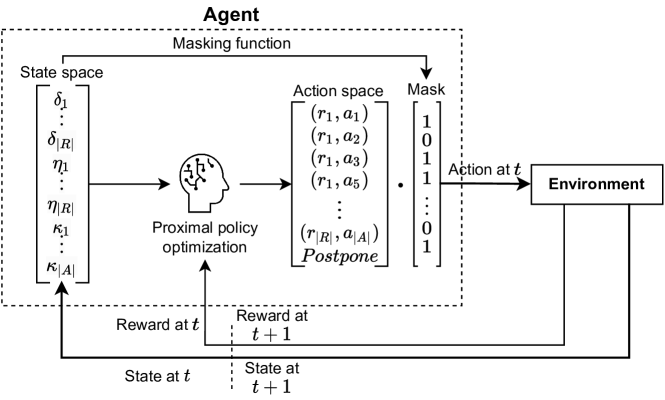
- Employ Deep Reinforcement Learning (DRL) where an agent learns optimal resource assignments by interacting with a simulation environment, using a neural network to approximate the Q-value function and automatically extract high-dimensional state features.
- Implement a score-based value function approximation (SVFA) method that uses a set of curated, domain-informed features (e.g., mean assignment time, resource utilization) to compute a score for each resource assignment.
- Train the SVFA model using supervised learning to predict the relative quality of assignments, with rewards derived from simulated cycle times.
- Use Bayesian optimization to tune hyperparameters in the DRL and SVFA models for improved performance.
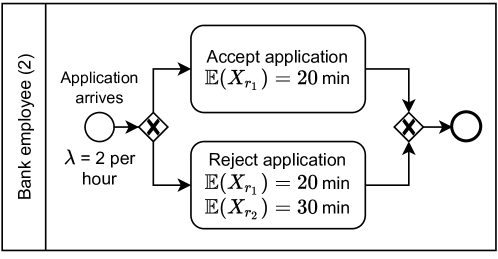
- Design six archetypal business process models (e.g., parallelism, choice, high utilization) and combine them into three realistic composite processes to test scalability and generalization.
- Benchmark both methods against three traditional heuristics (FIFO, SPT, LPT) and two existing BPO methods from the literature.
Experimental results
Research questions
- RQ1Can deep reinforcement learning learn adaptive resource allocation policies that generalize across diverse business process patterns and outperform traditional heuristics?
- RQ2How effective is a score-based value function approximation (SVFA) method that uses curated features and learned weights in ranking resource assignments?
- RQ3To what extent do learning-based methods scale and maintain performance when combined into complex, composite business processes with mixed flow patterns?
- RQ4How do the proposed methods compare to existing BPO approaches in terms of mean cycle time reduction across both isolated and integrated process scenarios?
- RQ5What role does the process prefix (i.e., execution history of a case) play in improving resource allocation decisions, and can it be leveraged in future extensions?
Key findings
- The DRL-based method outperformed all benchmarks in all three composite business processes, achieving an average improvement of 13.1% in mean cycle time over the best-performing baseline.
- In five out of six isolated process scenarios, the proposed learning methods matched or exceeded the performance of traditional heuristics and existing BPO methods.
- The SVFA method performed best on average in the isolated scenarios, but failed to generalize effectively to composite processes, where DRL significantly outperformed it.
- The First In, First Out (FIFO) heuristic outperformed both learning methods in the parallelism scenario, as it implicitly prioritizes case completion, highlighting a limitation in the current models’ handling of execution sequence.
- The study demonstrates that DRL can automatically learn relevant features from raw state information, making it highly adaptive to varying process structures without manual feature engineering.
- The results suggest that while SVFA offers interpretability through domain-crafted features, DRL’s end-to-end learning capability provides superior scalability and robustness in complex, real-world process configurations.
Read this paper
Open the full text in the Nubint reader and ask about any passage as you read.
Read this paper on NubintThis review was generated by AI from the original paper. Please check the paper before citing it.