
[Paper Review] Learning to Estimate Without Bias
This paper proposes a Bias Constrained Estimator (BCE) that integrates bias regularization into deep learning-based parameter estimation, ensuring asymptotically unbiased and minimum variance performance across all parameter values. By constraining the expected bias in the loss function, BCE asymptotically achieves the Cramér-Rao bound and outperforms standard learning-based estimators in SNR and covariance estimation tasks.
The Gauss Markov theorem states that the weighted least squares estimator is a linear minimum variance unbiased estimation (MVUE) in linear models. In this paper, we take a first step towards extending this result to non linear settings via deep learning with bias constraints. The classical approach to designing non-linear MVUEs is through maximum likelihood estimation (MLE) which often involves computationally challenging optimizations. On the other hand, deep learning methods allow for non-linear estimators with fixed computational complexity. Learning based estimators perform optimally on average with respect to their training set but may suffer from significant bias in other parameters. To avoid this, we propose to add a simple bias constraint to the loss function, resulting in an estimator we refer to as Bias Constrained Estimator (BCE). We prove that this yields asymptotic MVUEs that behave similarly to the classical MLEs and asymptotically attain the Cramer Rao bound. We demonstrate the advantages of our approach in the context of signal to noise ratio estimation as well as covariance estimation. A second motivation to BCE is in applications where multiple estimates of the same unknown are averaged for improved performance. Examples include distributed sensor networks and data augmentation in test-time. In such applications, we show that BCE leads to asymptotically consistent estimators.
Motivation & Objective
- To address the bias problem in deep learning-based parameter estimators that perform well on average but poorly for specific parameter values.
- To extend classical linear estimation theory (e.g., Gauss–Markov) to non-linear settings using deep learning with bias constraints.
- To develop a learning framework that ensures estimators are asymptotically unbiased and achieve minimum variance for every value of the unknown parameter.
- To improve performance in applications involving ensemble averaging, such as distributed sensor networks and test-time data augmentation.
Proposed method
- Introduces a bias-constrained loss function that penalizes the expected bias of the estimator across all parameter values during training.
- Uses a neural network architecture with iterative refinement, where the estimator updates its internal parameters (e.g., alpha and v vectors) over 50 iterations using a fully connected network.
- Employs a synthetic data generation pipeline where covariance parameters are sampled uniformly and multiple observations are generated from a zero-mean Gaussian distribution.
- Applies a modified loss combining hard label cross-entropy and bias regularization (L_bias) to enforce unbiasedness in the output across augmented data.
- Uses a temperature-scaled soft label generation process via a teacher network to produce high-quality soft labels for distillation.
- Trains the student network using a combination of hard label cross-entropy and bias regularization, with batch-wise bias computation to enforce zero mean bias over each batch.
Experimental results
Research questions
- RQ1Can deep learning-based estimators be made asymptotically unbiased across all parameter values while maintaining low variance?
- RQ2Does incorporating bias regularization into the loss function lead to estimators that achieve the Cramér-Rao bound asymptotically?
- RQ3How does the BCE framework improve performance in signal-to-noise ratio and covariance estimation compared to standard MSE-minimizing networks?
- RQ4Can BCE ensure consistency in ensemble averaging scenarios such as data augmentation or distributed sensor fusion?
Key findings
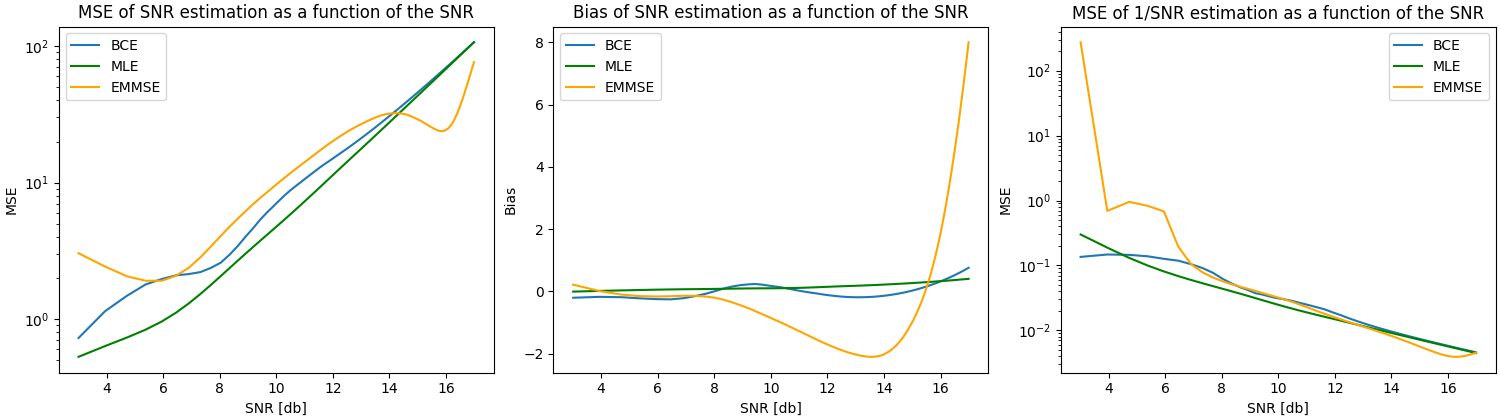
- The proposed Bias Constrained Estimator (BCE) asymptotically achieves minimum variance unbiased estimation (MVUE) for all parameter values, regardless of the prior distribution used in training.
- BCE asymptotically attains the Cramér-Rao bound, demonstrating that it achieves the theoretical lower bound on mean squared error for unbiased estimators.
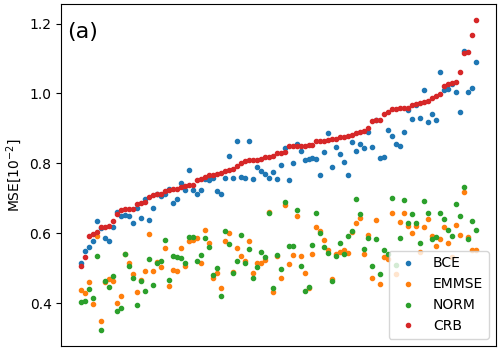
- In SNR estimation and covariance estimation tasks, BCE significantly outperforms standard MSE-minimizing deep learning estimators, especially in terms of bias reduction across diverse parameter values.
- In test-time data augmentation, BCE leads to asymptotically consistent estimators when multiple estimates are averaged, outperforming standard learning-based methods.
- The BCE framework with a temperature-scaled soft label distillation approach achieves higher accuracy and lower variance in CIFAR-10 image classification, with improved robustness across data augmentations.
- Empirical results show that BCE with λ=1000 in the bias loss achieves stable convergence and consistently reduces bias without degrading overall performance.
Read this paper
Open the full text in the Nubint reader and ask about any passage as you read.
Read this paper on NubintThis review was generated by AI from the original paper. Please check the paper before citing it.