
[Paper Review] Learning Visual Robotic Control Efficiently with Contrastive Pre-training and Data Augmentation
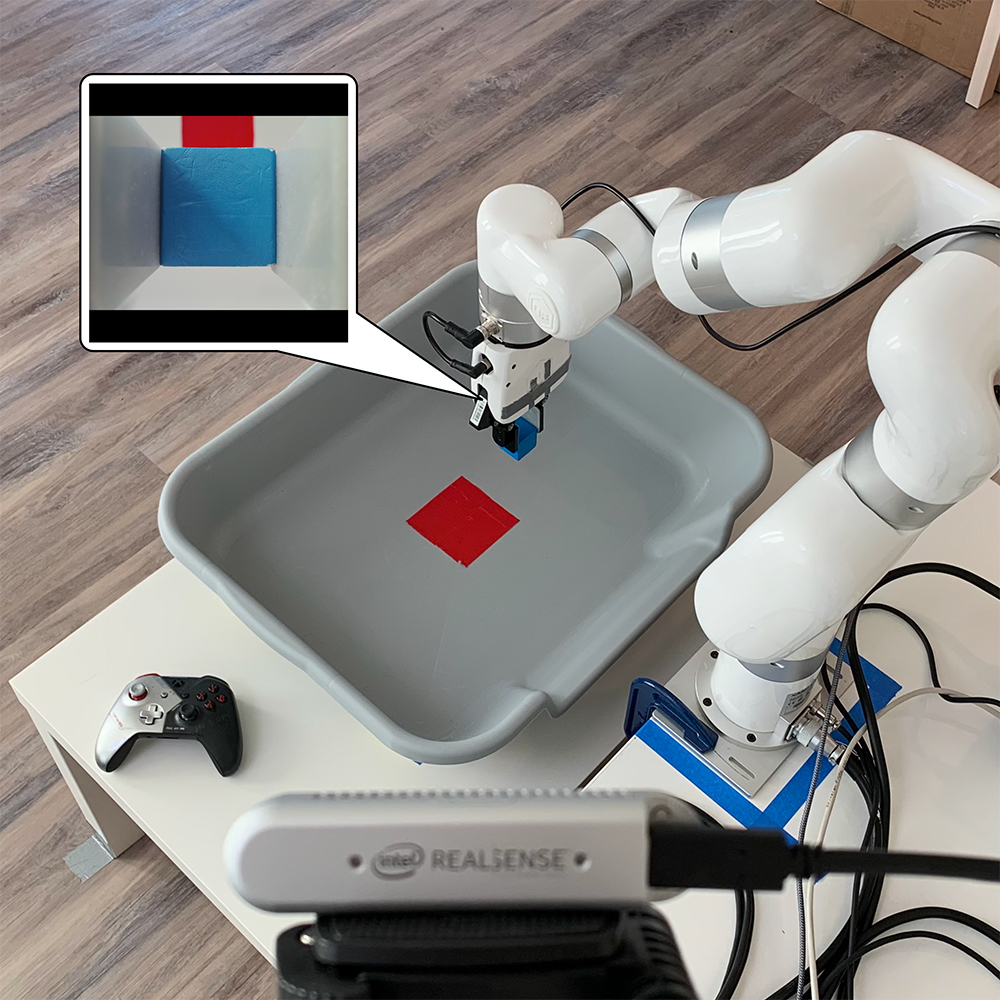
CoDER enables data-efficient visual robotic reinforcement learning by combining contrastive pre-training, online data augmentation, and a small number of demonstrations. Trained on real-robot data with only 10 demonstrations, it achieves sparse-reward manipulation tasks—such as reaching, flipping switches, and opening drawers—in just 30 minutes of real-world training time.
Recent advances in unsupervised representation learning significantly improved the sample efficiency of training Reinforcement Learning policies in simulated environments. However, similar gains have not yet been seen for real-robot reinforcement learning. In this work, we focus on enabling data-efficient real-robot learning from pixels. We present Contrastive Pre-training and Data Augmentation for Efficient Robotic Learning (CoDER), a method that utilizes data augmentation and unsupervised learning to achieve sample-efficient training of real-robot arm policies from sparse rewards. While contrastive pre-training, data augmentation, demonstrations, and reinforcement learning are alone insufficient for efficient learning, our main contribution is showing that the combination of these disparate techniques results in a simple yet data-efficient method. We show that, given only 10 demonstrations, a single robotic arm can learn sparse-reward manipulation policies from pixels, such as reaching, picking, moving, pulling a large object, flipping a switch, and opening a drawer in just 30 minutes of mean real-world training time. We include videos and code on the project website: https://sites.google.com/view/efficient-robotic-manipulation/home
Motivation & Objective
- Address the critical challenge of data inefficiency in real-robot reinforcement learning from pixel observations.
- Overcome the limitations of standard RL and imitation learning by combining unsupervised representation learning with efficient exploration.
- Enable sample-efficient policy learning on real robotic hardware without relying on simulation, motion capture, or dense rewards.
- Demonstrate that the synergy of contrastive pre-training, data augmentation, and few demonstrations enables fast, reliable policy training in real-world settings.
Proposed method
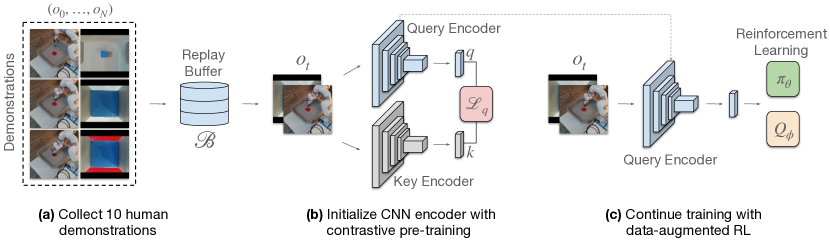
- Collect 10 expert demonstrations and store them in a replay buffer to initialize the learning process.
- Pre-train a convolutional encoder using instance-level contrastive learning on the demonstration data to learn viewpoint-invariant visual representations.
- Fine-tune the policy using off-policy deep reinforcement learning (SAC) with augmented observations from both online interactions and the initial demonstrations.
- Apply stochastic data augmentation (e.g., cropping, color jittering) to observations during RL training to improve robustness and representation learning.
- Use a sparse reward signal to train the policy end-to-end in the real world, minimizing reliance on engineered rewards or prior state information.
- Leverage the pre-trained encoder to improve sample efficiency by initializing the policy network with semantically meaningful visual features.
Experimental results
Research questions
- RQ1Can contrastive pre-training and data augmentation significantly improve sample efficiency in real-robot visual reinforcement learning?
- RQ2To what extent can a small number of demonstrations (e.g., 10) enable efficient policy learning when combined with unsupervised representation learning?
- RQ3Does the combination of pre-training, data augmentation, and off-policy RL outperform individual components in real-world robotic manipulation?
- RQ4How effective is this framework on diverse, sparse-reward manipulation tasks with minimal human intervention?
- RQ5Can this method generalize to real-world visual variations and complex manipulation tasks without simulation or dense supervision?
Key findings
- CoDER trains successful policies for 6 diverse manipulation tasks—including reaching, pushing, pulling a large object, flipping a switch, and opening a drawer—using only 10 demonstrations.
- The method achieves reliable performance in 15 to 50 minutes of total real-world training time per task, significantly reducing sample complexity compared to standard RL.
- The combination of contrastive pre-training, data augmentation, and demonstrations enables efficient learning where each component alone fails on real-robot tasks.
- CoDER achieves data efficiency comparable to methods that rely on dense rewards, Sim2Real transfer, or motion capture, but without requiring those components.
- The approach generalizes to small perturbations in object shape or position, though performance degrades under large visual domain shifts such as lighting or background changes.
- The method is lightweight and deployable on standard robotic hardware with two RGB cameras, a single GPU, and minimal setup—no depth sensors or complex infrastructure required.
Read this paper
Open the full text in the Nubint reader and ask about any passage as you read.
Read this paper on NubintThis review was generated by AI from the original paper. Please check the paper before citing it.