
[Paper Review] Legion: Automatically Pushing the Envelope of Multi-GPU System for Billion-Scale GNN Training
Legion is a multi-GPU GNN training system that automatically optimizes cache usage for billion-scale graph neural network training. It uses NVLink-aware hierarchical partitioning and a hotness-aware unified cache to minimize PCIe traffic and maximize throughput, achieving up to 4.32× speedup over state-of-the-art systems on large graphs.
Graph neural network(GNN) has been widely applied in real-world applications, such as product recommendation in e-commerce platforms and risk control in financial management systems. Several cache-based GNN systems have been built to accelerate GNN training in a single machine with multiple GPUs. However, these systems fail to train billion-scale graphs efficiently, which is a common challenge in the industry. In this work, we propose Legion, a system that automatically pushes the envelope of multi-GPU systems for accelerating billion-scale GNN training. First, we design a hierarchical graph partitioning mechanism that significantly improves the multi-GPU cache performance. Second, we build a unified multi-GPU cache that helps to minimize the PCIe traffic incurred by caching both graph topology and features with the highest hotness. Third, we develop an automatic caching management mechanism that adapts the multi-GPU cache plan according to the hardware specifications and various graphs to maximize the overall training throughput. Evaluations on various GNN models and multiple datasets show that Legion supports training billion-scale GNNs in a single machine and significantly outperforms the state-of-the-art cache-based systems on small graphs.
Motivation & Objective
- Address the poor scalability of existing cache-based GNN systems in multi-GPU environments, especially for billion-scale graphs.
- Overcome the limitations of cache replication and coarse-grained topology management in existing systems.
- Minimize PCIe data transfer by intelligently caching both graph topology and features based on access hotness.
- Automate cache management to adapt to diverse hardware configurations and graph workloads without user tuning.
- Enable efficient, end-to-end GNN training on single-machine multi-GPU systems for billion-scale graphs.
Proposed method
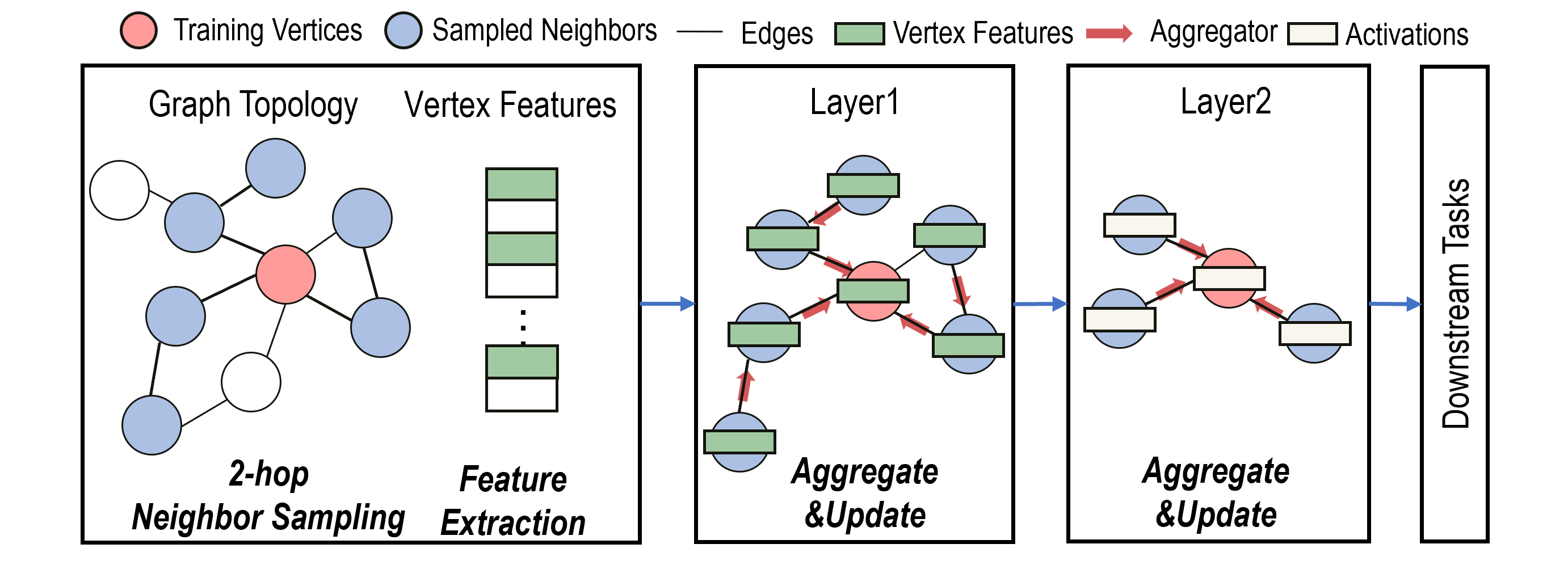
- Propose NVLink-aware hierarchical graph partitioning: first partition the graph with minimal edge-cut to assign exclusive partitions to NVLink cliques, then use hash partitioning to map training vertices to individual GPUs within each clique.
- Design a hotness-aware unified cache that stores both features and topology in a vertex-centric data structure, prioritizing data with the highest access frequency.
- Enable NVLink-enhanced cache sharing across GPUs within an NVLink clique to improve memory utilization and reduce redundant data storage.
- Implement an automatic cache management mechanism that dynamically plans cache allocation based on hardware specifications and graph characteristics.
- Use a hotness metric based on access frequency during a pre-sampling phase to guide cache placement and minimize cache misses.
- Integrate GPU-based graph sampling with unified caching to accelerate both sampling and feature extraction phases.
Experimental results
Research questions
- RQ1How can multi-GPU cache scalability be improved for billion-scale GNN training without excessive data replication?
- RQ2What is the optimal way to manage both topology and feature caching in a unified, GPU-efficient manner across multiple GPUs?
- RQ3Can a system automatically generate optimal cache plans without requiring manual tuning based on hardware or graph-specific knowledge?
- RQ4How does hierarchical partitioning based on NVLink topology improve cache performance and reduce PCIe bandwidth pressure?
- RQ5To what extent can unified, hotness-aware caching improve training throughput on large-scale graphs compared to existing systems?
Key findings
- Legion supports end-to-end training of billion-scale graphs on a single multi-GPU machine, overcoming the scalability limits of prior systems.
- The system achieves up to 4.32× speedup over state-of-the-art cache-based GNN systems on small and medium graphs, demonstrating superior throughput.
- With minimal cache ratios, Legion maintains high cache hit rates (as shown in Figures 9 and 11), indicating efficient cache utilization.
- The hierarchical partitioning reduces cache replication and preserves intra-partition data locality, improving overall memory efficiency.
- The automatic cache management mechanism eliminates the need for user-provided tuning, adapting effectively to diverse hardware and graph workloads.
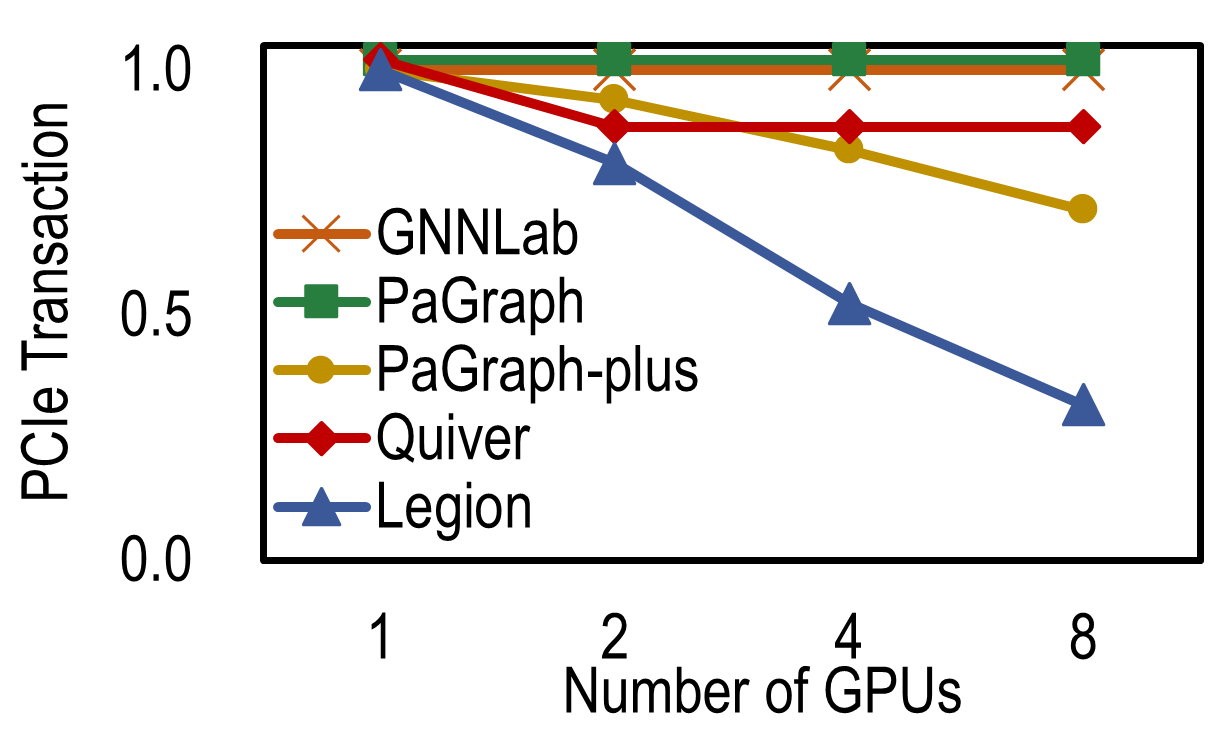
- The unified cache design reduces PCIe traffic by prioritizing high-hotness vertices for caching, significantly lowering data transfer overhead.
Read this paper
Open the full text in the Nubint reader and ask about any passage as you read.
Read this paper on NubintThis review was generated by AI from the original paper. Please check the paper before citing it.