
[Paper Review] Leveraging Generative AI Models for Synthetic Data Generation in Healthcare: Balancing Research and Privacy
This paper proposes using generative AI models—specifically GANs and VAEs—to create high-fidelity, anonymized synthetic healthcare data that preserves patient privacy while enabling robust research and AI model training. The approach leverages adversarial training and variational inference to generate realistic, diverse data that maintains statistical relationships from real electronic health records, offering a compliant alternative to real patient data under HIPAA and GDPR.
The widespread adoption of electronic health records and digital healthcare data has created a demand for data-driven insights to enhance patient outcomes, diagnostics, and treatments. However, using real patient data presents privacy and regulatory challenges, including compliance with HIPAA and GDPR. Synthetic data generation, using generative AI models like GANs and VAEs offers a promising solution to balance valuable data access and patient privacy protection. In this paper, we examine generative AI models for creating realistic, anonymized patient data for research and training, explore synthetic data applications in healthcare, and discuss its benefits, challenges, and future research directions. Synthetic data has the potential to revolutionize healthcare by providing anonymized patient data while preserving privacy and enabling versatile applications.
Motivation & Objective
- To address privacy and regulatory challenges in healthcare data sharing by generating synthetic patient data that preserves data utility.
- To evaluate the feasibility and quality of synthetic data generated via generative AI models for use in medical research and AI model training.
- To examine the integration of synthetic data with privacy-preserving techniques like differential privacy and federated learning.
- To identify and mitigate risks such as data bias, overfitting, and computational complexity in synthetic data generation.
- To provide a framework for ethical, scalable, and compliant synthetic data generation in health informatics.
Proposed method
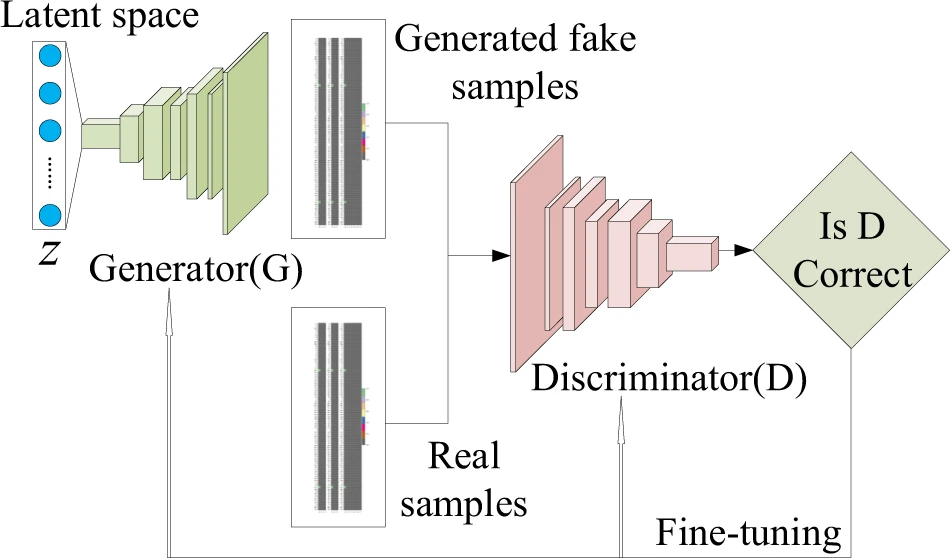
- Training Generative Adversarial Networks (GANs) using real EHR data, where a generator creates synthetic samples and a discriminator distinguishes them from real data through adversarial optimization.
- Employing Variational Autoencoders (VAEs) to learn a probabilistic latent representation of real patient data, enabling generation of new samples via latent space sampling.
- Applying a three-step process: (1) training on real-world EHRs, (2) generating synthetic instances with similar statistical properties, and (3) evaluating fidelity and utility using statistical and machine learning metrics.
- Integrating synthetic data with privacy-preserving techniques such as differential privacy and federated learning to enhance data protection.
- Using data augmentation to improve model generalization and performance in low-data or imbalanced healthcare scenarios.
- Evaluating synthetic data quality through metrics like statistical similarity, preservation of relationships, and performance in downstream AI tasks.
Experimental results
Research questions
- RQ1How well can GANs and VAEs generate synthetic patient data that preserves the statistical and relational structure of real electronic health records?
- RQ2To what extent does synthetic data support effective training and validation of AI models in healthcare without compromising patient privacy?
- RQ3What are the key challenges in maintaining data fidelity, diversity, and fairness when generating synthetic healthcare data?
- RQ4How can synthetic data be effectively combined with differential privacy and federated learning to enhance privacy guarantees?
- RQ5What are the practical benefits and limitations of synthetic data in reducing costs, time, and regulatory burden in healthcare research?
Key findings
- Generative AI models such as GANs and VAEs can produce high-quality synthetic patient data that closely mimics real EHRs in terms of statistical distribution and underlying relationships.
- Synthetic data enables effective data augmentation, improving the performance and generalization of AI models, especially in low-data or imbalanced scenarios.
- The integration of synthetic data with differential privacy and federated learning enhances privacy protection while maintaining data utility for collaborative research.
- Challenges remain in avoiding overfitting, preserving data diversity, and mitigating biases inherited from real-world data, which can affect model fairness and validity.
- Synthetic data significantly reduces the time and cost of data sharing and compliance by eliminating the need for manual anonymization and consent management.
- The approach supports a wide range of applications, including AI training, medical education, and public health surveillance, while ensuring compliance with HIPAA and GDPR.
Read this paper
Open the full text in the Nubint reader and ask about any passage as you read.
Read this paper on NubintThis review was generated by AI from the original paper. Please check the paper before citing it.