
[Paper Review] LEyes: A Lightweight Framework for Deep Learning-Based Eye Tracking using Synthetic Eye Images
LEyes is a lightweight, synthetic data generation framework for deep learning-based eye tracking that models only essential image features—pupil and corneal reflection (CR) positions—using simple light distributions. It enables efficient training of neural networks that achieve state-of-the-art performance in pupil and CR localization, outperforming existing methods and even commercial eye trackers on low-cost hardware.
Deep learning has bolstered gaze estimation techniques, but real-world deployment has been impeded by inadequate training datasets. This problem is exacerbated by both hardware-induced variations in eye images and inherent biological differences across the recorded participants, leading to both feature and pixel-level variance that hinders the generalizability of models trained on specific datasets. While synthetic datasets can be a solution, their creation is both time and resource-intensive. To address this problem, we present a framework called Light Eyes or "LEyes" which, unlike conventional photorealistic methods, only models key image features required for video-based eye tracking using simple light distributions. LEyes facilitates easy configuration for training neural networks across diverse gaze-estimation tasks. We demonstrate that models trained using LEyes are consistently on-par or outperform other state-of-the-art algorithms in terms of pupil and CR localization across well-known datasets. In addition, a LEyes trained model outperforms the industry standard eye tracker using significantly more cost-effective hardware. Going forward, we are confident that LEyes will revolutionize synthetic data generation for gaze estimation models, and lead to significant improvements of the next generation video-based eye trackers.
Motivation & Objective
- Address the challenge of data scarcity and annotation burden in deep learning-based gaze estimation by generating synthetic eye images.
- Overcome domain shift caused by hardware and biological variations in real eye images that limit model generalizability.
- Develop a lightweight, configurable framework for training deep learning models across diverse gaze-estimation tasks using minimal computational resources.
- Enable high-performance gaze estimation using low-cost hardware by training models on synthetic data that generalize well to real-world conditions.
- Provide a scalable and efficient alternative to photorealistic synthetic data generation, focusing only on key features required for P-CR eye tracking.
Proposed method
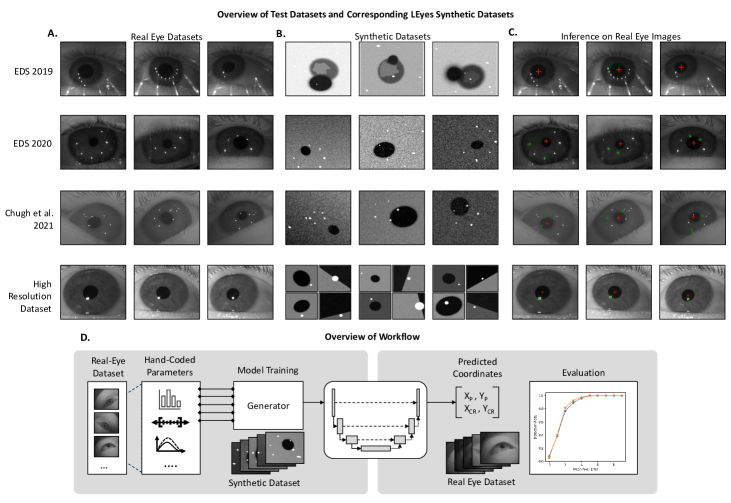
- Model key visual features—pupil and CR positions—using simple light distributions instead of photorealistic rendering.
- Define a parameterized generator that produces synthetic eye images based on statistical distributions of real eye image features (e.g., pupil intensity, CR position).
- Use a two-stage image processing pipeline: first, threshold-based segmentation to localize pupil and CR centers; second, CNN-based refinement using masked cutouts.
- Apply a black circular mask (48px radius) to CR cutouts and a gray elliptical mask (1.4× pupil ellipse size) to pupil cutouts before CNN inference.
- Train neural networks on synthetic data generated by LEyes and evaluate performance on real-world datasets using RMS-S2S precision and gaze accuracy metrics.
- Calibrate gaze signals using second-order polynomial models with first-order interactions, based on a 3×3 fixation grid for improved accuracy.
Experimental results
Research questions
- RQ1Can a lightweight synthetic data generation framework based on minimal visual features achieve performance comparable to or better than state-of-the-art methods in pupil and CR localization?
- RQ2To what extent does synthetic data from LEyes generalize across different hardware setups and biological variations in eye images?
- RQ3Can models trained on LEyes-generated data outperform industry-standard commercial eye trackers when deployed on low-cost hardware?
- RQ4How does the performance of LEyes-trained models compare to those trained on real datasets in terms of gaze accuracy and precision?
- RQ5What is the impact of using only essential image features (pupil and CR) versus full photorealistic rendering on model efficiency and generalization?
Key findings
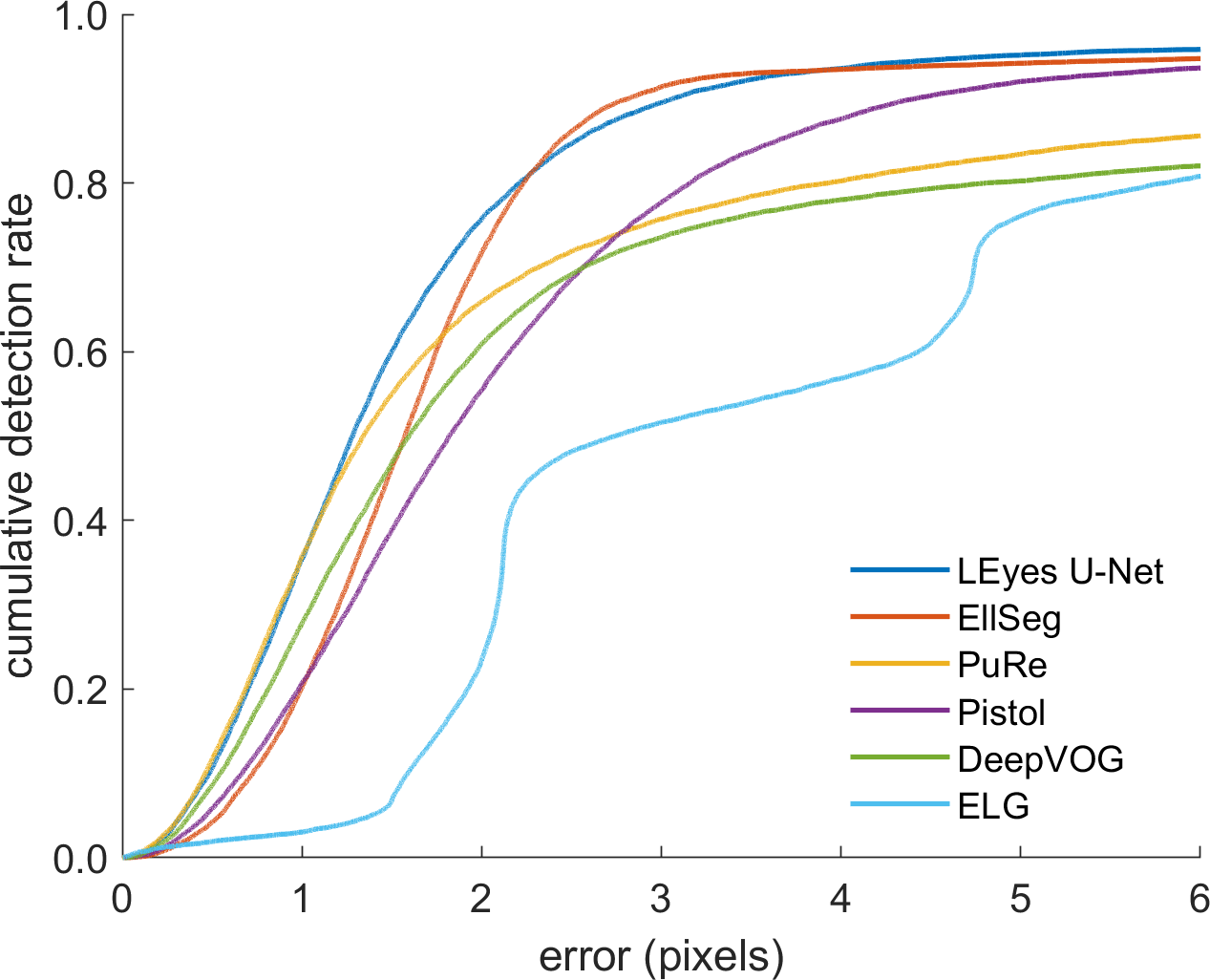
- Models trained on LEyes-generated synthetic data achieve state-of-the-art performance in pupil and CR localization across multiple benchmark datasets.
- The LEyes-trained model outperforms the industry-standard EyeTracker on low-cost hardware, demonstrating superior generalization and robustness.
- LEyes-generated data enable consistent performance across diverse recording conditions, reducing domain shift due to hardware and biological variation.
- The framework achieves high accuracy in gaze estimation, with RMS-S2S precision metrics comparable to or better than existing methods on real eye image data.
- The synthetic data generation process is computationally efficient and requires minimal annotation, significantly reducing data collection and labeling costs.
- The use of simple light distributions and feature-specific masking enables high model performance without the need for complex, resource-intensive photorealistic rendering.
Read this paper
Open the full text in the Nubint reader and ask about any passage as you read.
Read this paper on NubintThis review was generated by AI from the original paper. Please check the paper before citing it.