
[Paper Review] Life-Cycle Emissions of AI Hardware: A Cradle-To-Grave Approach and Generational Trends
This preprint presents a cradle-to-grave LCA of five Google TPUs, introducing Compute Carbon Intensity (CCI) and showing a 3x CCI improvement from TPU v4i to v6e, with 24/7 clean energy scenarios amplifying gains.
Specialized hardware accelerators aid the rapid advancement of artificial intelligence (AI), and their efficiency impacts AI's environmental sustainability. This study presents the first publication of a comprehensive AI accelerator life-cycle assessment (LCA) of greenhouse gas emissions, including the first publication of manufacturing emissions of an AI accelerator. Our analysis of five Tensor Processing Units (TPUs) encompasses all stages of the hardware lifespan - from raw material extraction, manufacturing, and disposal, to energy consumption during development, deployment, and serving of AI models. Using first-party data, it offers the most comprehensive evaluation to date of AI hardware's environmental impact. We include detailed descriptions of our LCA to act as a tutorial, road map, and inspiration for other computer engineers to perform similar LCAs to help us all understand the environmental impacts of our chips and of AI. A byproduct of this study is the new metric compute carbon intensity (CCI) that is helpful in evaluating AI hardware sustainability and in estimating the carbon footprint of training and inference. This study shows that CCI improves 3x from TPU v4i to TPU v6e. Moreover, while this paper's focus is on hardware, software advancements leverage and amplify these gains.
Motivation & Objective
- Quantify greenhouse gas emissions across the full lifecycle of AI accelerators and attached hosts.
- Publish manufacturing emissions data for AI accelerators for the first time.
- Introduce Compute Carbon Intensity (CCI) as a fair, performance-normalized carbon metric.
- Provide a detailed, replicable LCA methodology to enable broader adoption in hardware design.
- Compare emissions across TPU generations to understand performance vs. carbon trade-offs.
Proposed method
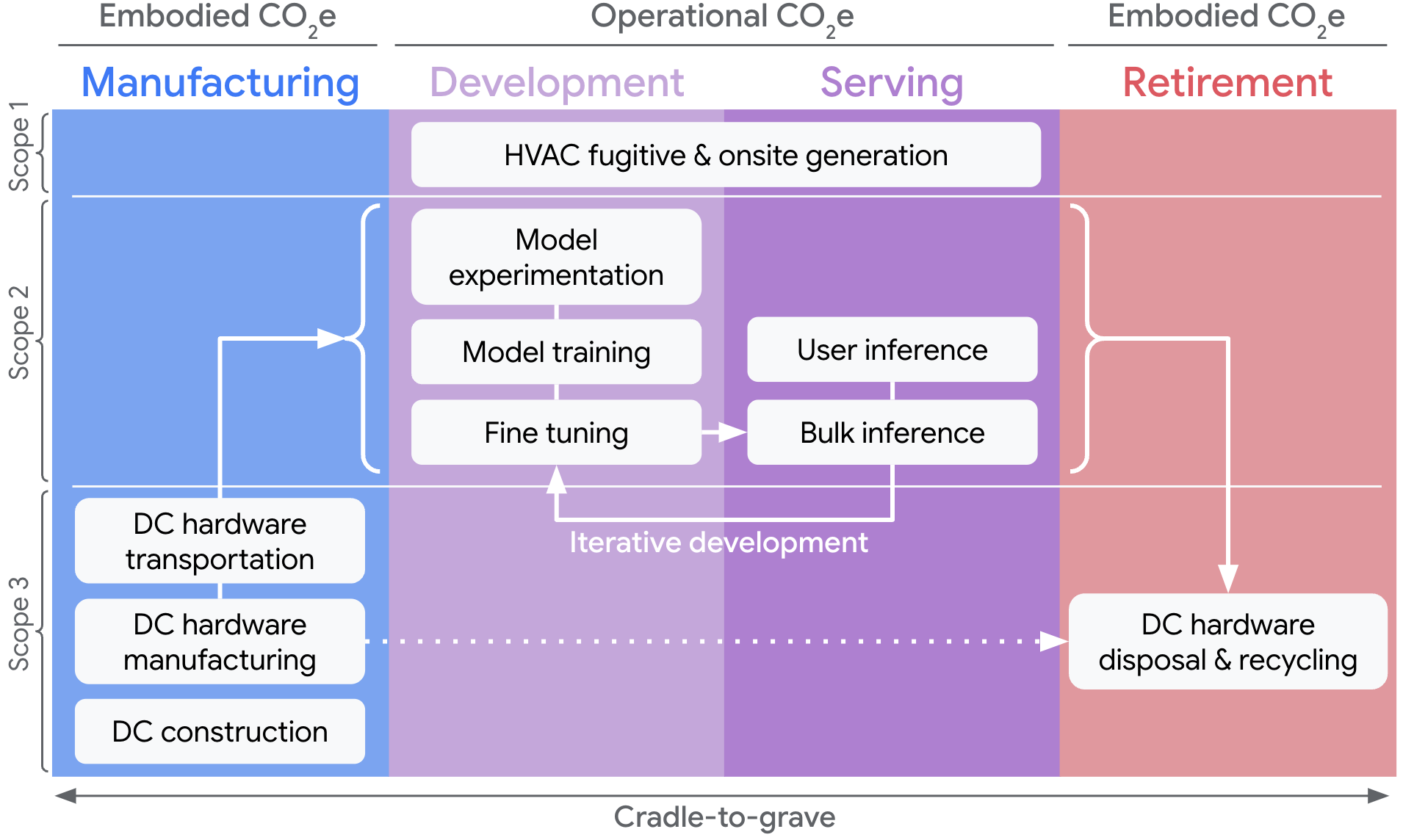
- Adopt a cradle-to-grave LCA boundary covering raw materials, manufacturing, data-center construction, operation (development, training, serving), and end-of-life.
- Use first-party Google data to measure operational energy and emissions across the TPU fleet.
- Define and apply Compute Carbon Intensity (CCI) as gCO2e per ExaFLOP (FLOPs) with embodied and operational components.
- Differentiate emissions under market-based (MB) and location-based (LB) electricity accounting, including a 24/7 hourly clean energy matching scenario.
- Measure utilized FLOPs with runtime counters and combine with measured energy to compute operational CCI.
- Employ propensity score weighting to account for fleet duty-cycle differences when comparing TPU generations.
- Provide an LCA tutorial-like appendices detailing tools, assumptions, and procedures.
Experimental results
Research questions
- RQ1What are the cradle-to-grave GHG emissions of Google AI hardware accelerators (TPUs) and attached hosts?
- RQ2How do embodied and operational emissions contribute to total lifecycle emissions across TPU generations?
- RQ3Can a normalized, hardware-focused carbon metric (CCI) fairly compare AI accelerators with different performance levels?
- RQ4How do different electricity accounting methods (MB vs LB vs 24/7 CFE) affect reported emissions and mitigation strategies?
- RQ5What are the emissions trends when moving from TPU v4i/v5e to v6e in terms manufacturing, operations, and lifecycle performance?
Key findings
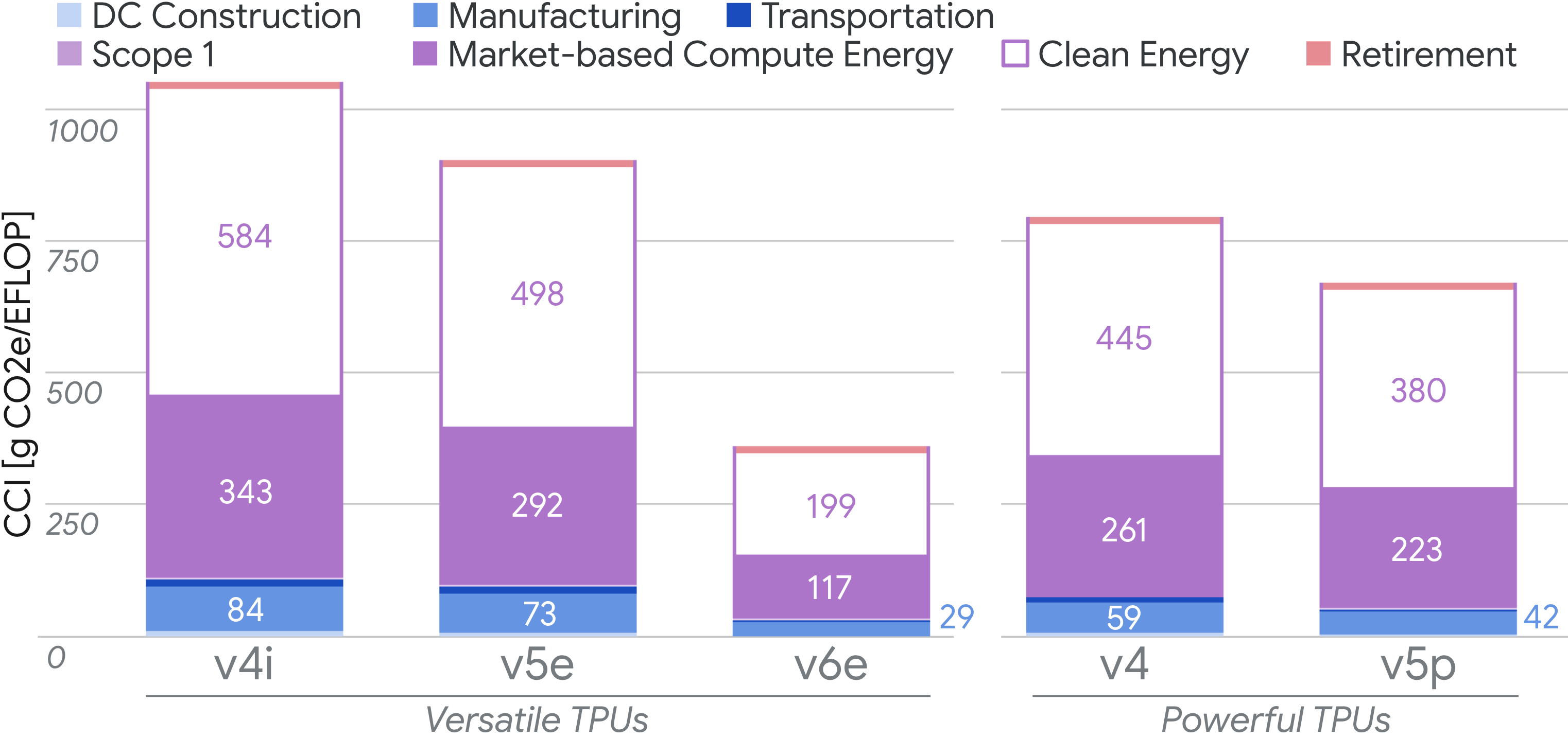
- Compute Carbon Intensity (CCI) improves 3x from TPU v4i to TPU v6e.
- Operational electricity emissions dominate embodied hardware emissions, accounting for ~70% (MB) to ~90% (LB) of lifetime emissions.
- MB accounting reduces reported operational emissions through clean-energy purchases, while 24/7 hourly CFE matching provides a more stringent, realistic mitigation picture.
- Manufacturing emissions rise with newer generations due to larger ASIC dies and increased memory, but improved performance yields lower emissions per unit of computation.
- Embodied CCI decreases as generations improve (e.g., 38–114 gCO2e/10^18 FLOPs across variants), while operational CCI also improves with hardware and energy strategies.
- In hypothetical 90% CFE scenarios, total CCI drops substantially, underscoring the impact of clean energy procurement on lifecycle emissions.
Read this paper
Open the full text in the Nubint reader and ask about any passage as you read.
Read this paper on NubintThis review was generated by AI from the original paper. Please check the paper before citing it.