
[Paper Review] Lite-HRNet: A Lightweight High-Resolution Network
Lite-HRNet is a lightweight high-resolution network for human pose estimation and semantic segmentation that replaces computationally expensive 1×1 convolutions in shuffle blocks with a conditional channel weighting unit. This efficient mechanism enables cross-channel and cross-resolution feature fusion with linear complexity, achieving state-of-the-art accuracy-efficiency trade-offs on COCO and MPII benchmarks, with Lite-HRNet-30 reaching 75.3% mIoU on Cityscapes at only 3.02 GFLOPs.
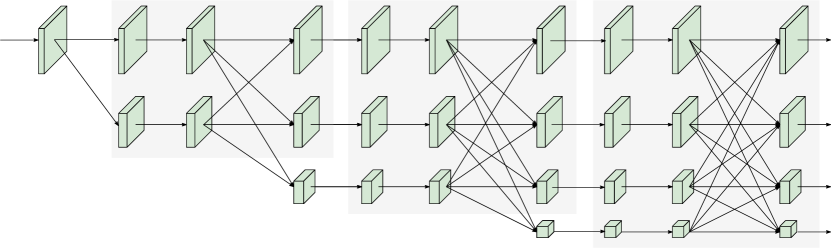
We present an efficient high-resolution network, Lite-HRNet, for human pose estimation. We start by simply applying the efficient shuffle block in ShuffleNet to HRNet (high-resolution network), yielding stronger performance over popular lightweight networks, such as MobileNet, ShuffleNet, and Small HRNet. We find that the heavily-used pointwise (1x1) convolutions in shuffle blocks become the computational bottleneck. We introduce a lightweight unit, conditional channel weighting, to replace costly pointwise (1x1) convolutions in shuffle blocks. The complexity of channel weighting is linear w.r.t the number of channels and lower than the quadratic time complexity for pointwise convolutions. Our solution learns the weights from all the channels and over multiple resolutions that are readily available in the parallel branches in HRNet. It uses the weights as the bridge to exchange information across channels and resolutions, compensating the role played by the pointwise (1x1) convolution. Lite-HRNet demonstrates superior results on human pose estimation over popular lightweight networks. Moreover, Lite-HRNet can be easily applied to semantic segmentation task in the same lightweight manner. The code and models have been publicly available at https://github.com/HRNet/Lite-HRNet.
Motivation & Objective
- To develop a lightweight high-resolution network that maintains high performance under computational constraints.
- To address the computational bottleneck of pointwise (1×1) convolutions in shuffle blocks within lightweight networks.
- To design an efficient alternative to 1×1 convolutions that enables effective cross-channel and cross-resolution feature exchange.
- To achieve superior accuracy-efficiency trade-offs in human pose estimation and semantic segmentation tasks.
- To generalize the proposed architecture to downstream tasks without architectural re-design.
Proposed method
- Introduces a conditional channel weighting unit that computes channel weights based on input features across multiple resolutions, replacing costly 1×1 convolutions.
- The channel weights are computed via a lightweight network module with linear complexity w.r.t. the number of channels, reducing computational cost compared to quadratic 1×1 convolutions.
- Leverages multi-resolution features from HRNet's parallel branches to enrich the information used for weight computation.
- Employs spatial and cross-resolution weighting mechanisms to enhance feature representation with minimal FLOP increase.
- Uses a simple, trainable module to compute dynamic weights conditioned on input features, enabling adaptive feature fusion.
- Applies the architecture to both human pose estimation and semantic segmentation tasks with minimal modification.
Experimental results
Research questions
- RQ1Can the integration of shuffle blocks into HRNet yield a more efficient and accurate lightweight network than existing models like MobileNet and ShuffleNet?
- RQ2Does replacing 1×1 convolutions in shuffle blocks with a conditional channel weighting unit reduce computational cost while preserving or improving feature representation?
- RQ3How does the use of multi-resolution features in the weight computation process affect model performance and efficiency?
- RQ4Can the proposed Lite-HRNet architecture generalize effectively to semantic segmentation with comparable efficiency and accuracy?
- RQ5What is the trade-off between computational complexity and performance gain when increasing network depth or using cross-resolution weighting?
Key findings
- Lite-HRNet achieves 75.3% mIoU on Cityscapes semantic segmentation with only 3.02 GFLOPs, outperforming hand-crafted and NAS-based methods.
- Lite-HRNet-18 achieves 72.8% mIoU on Cityscapes with 1.95 GFLOPs, surpassing models like BiSeNetV1-B and DFANet A’.
- The conditional channel weighting unit reduces the shuffle block’s computation complexity by 80% compared to standard 1×1 convolutions.
- Adding spatial and cross-resolution weighting improves COCO AP by 3.5 points with only a 16M FLOP increase.
- Increasing network depth improves AP by 1.5 points with similar FLOPs to wider versions, demonstrating improved capacity efficiency.
- The model achieves comparable performance to much more computationally expensive models like SwiftNetRN-18 (104 GFLOPs) while using only 3.02 GFLOPs.
Read this paper
Open the full text in the Nubint reader and ask about any passage as you read.
Read this paper on NubintThis review was generated by AI from the original paper. Please check the paper before citing it.