
[Paper Review] LLaMAX: Scaling Linguistic Horizons of LLM by Enhancing Translation Capabilities Beyond 100 Languages
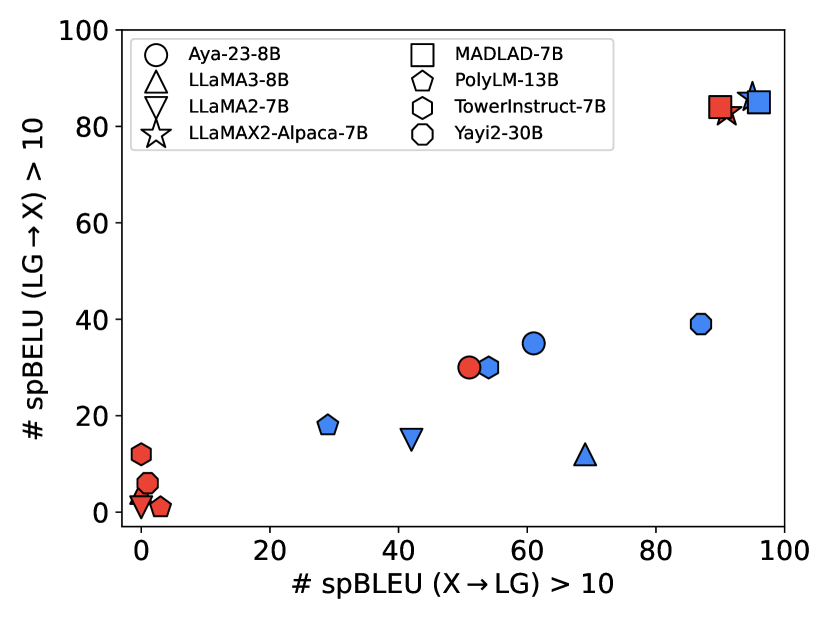
LLaMAX enhances multilingual translation capabilities of LLaMA-based models by conducting large-scale continual pre-training on 35,000 A100 GPU hours, incorporating vocabulary expansion and data augmentation across 102 languages. It achieves >10 spBLEU improvement over open-source LLMs and matches the performance of specialized models like M2M-100-12B on Flores-101, especially excelling in low-resource language translation without sacrificing generalization.
Large Language Models (LLMs) demonstrate remarkable translation capabilities in high-resource language tasks, yet their performance in low-resource languages is hindered by insufficient multilingual data during pre-training. To address this, we conduct extensive multilingual continual pre-training on the LLaMA series models, enabling translation support across more than 100 languages. Through a comprehensive analysis of training strategies, such as vocabulary expansion and data augmentation, we develop LLaMAX. Remarkably, without sacrificing its generalization ability, LLaMAX achieves significantly higher translation performance compared to existing open-source LLMs (by more than 10 spBLEU points) and performs on-par with specialized translation model (M2M-100-12B) on the Flores-101 benchmark. Extensive experiments indicate that LLaMAX can serve as a robust multilingual foundation model. The code \footnote{\url{https://github.com/CONE-MT/LLaMAX/.}} and the models \footnote{\url{https://huggingface.co/LLaMAX/.}} are publicly available.
Motivation & Objective
- Address the performance gap in low-resource language translation by enhancing multilingual capabilities of LLMs.
- Overcome data scarcity in low-resource languages through scalable pre-training and data augmentation.
- Maintain strong generalization while significantly improving translation quality across 102 languages.
- Achieve competitive performance against specialized translation models using open-source LLMs.
- Enable robust, multilingual foundation models suitable for diverse translation directions.
Proposed method
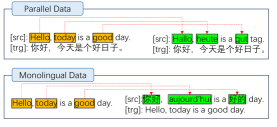
- Conduct large-scale continual pre-training on LLaMA models using 35,000 A100 GPU hours with monolingual and parallel multilingual data.
- Implement vocabulary expansion with language-specific tokens, analyzing impact on tokenization, embedding quality, and model distribution.
- Apply data augmentation via multilingual dictionaries (MUSE and PanLex) using 1-hop and 2-hop translations to enrich parallel and monolingual data.
- Use a hybrid data construction strategy: extract language-specific monolingual and parallel subsets, and supplement with English monolingual data when parallel data is insufficient.
- Employ both split-parallel and connected-parallel formats for supervised fine-tuning, evaluating their impact on translation performance.
- Apply structured prompt templates to ensure fair and reproducible evaluation across models.
Experimental results
Research questions
- RQ1How does vocabulary expansion affect model performance and distribution when adding language-specific tokens?
- RQ2What is the optimal data augmentation strategy (e.g., 1-hop vs. 2-hop translation) for improving low-resource language translation?
- RQ3Can continual pre-training on diverse monolingual and parallel data significantly improve translation performance across 102 languages without sacrificing generalization?
- RQ4How does LLaMAX compare to specialized translation models like M2M-100-12B in multilingual translation benchmarks?
- RQ5What is the impact of parallel data format (split-parallel vs. connected-parallel) on translation performance and cross-lingual generalization?
Key findings
- LLaMAX achieves more than 10 spBLEU points higher translation performance than existing open-source LLMs on the Flores-101 benchmark.
- LLaMAX performs on par with the specialized M2M-100-12B model on Flores-101, particularly excelling in low-resource language translation.
- Data augmentation using 1-hop translation from multilingual dictionaries significantly improves performance, while 2-hop translation shows no benefit and sometimes harms results.
- The connected-parallel format for parallel data yields significantly better translation performance than split-parallel, especially in high-resource directions.
- LLaMAX outperforms Japanese-specific models like Swallow in generating correct target language translations from Japanese, reducing language confusion.
- GPT-4 comparison shows LLaMAX matches or exceeds GPT-4 in low-resource translation directions, despite higher cost and limited evaluation.
Read this paper
Open the full text in the Nubint reader and ask about any passage as you read.
Read this paper on NubintThis review was generated by AI from the original paper. Please check the paper before citing it.